How to Write a CV Personal Statement in 2026: 15+ Examples for Every Industry

Your CV personal statement — also called a professional profile or career summary — is the first thing a recruiter reads. It sits at the very top of your CV, above your work history, and has one job: to make a hiring manager want to keep reading.
Get it right, and you land the interview. Get it wrong — or skip it entirely — and even a brilliant work history may not save you. In 2026, with AI-generated applications flooding recruiters' inboxes, a sharp, tailored personal statement is more important than ever.
This guide gives you everything: the exact formula, 15+ ready-to-use examples for every industry, the seven most common mistakes (and how to fix them), and a free AI tool that writes your statement in 30 seconds.
What Is a CV Personal Statement?
A CV personal statement is a short paragraph — typically 3 to 5 lines — placed at the top of your CV, just below your name and contact details. It summarises who you are professionally, what you bring to the role, and what you are looking for.
You may also hear it called a:
- Professional profile — most common in UK CVs
- Career summary — standard in US resumes (2–4 lines)
- Personal profile — used interchangeably with personal statement
- Professional summary — favoured for senior and executive CVs
Whatever the label, the function is identical: a punchy, tailored introduction that immediately signals to the recruiter that you are the right fit for this specific role.
Why Your Personal Statement Is the Most Important Section

Research by recruitment platform Ladders found that recruiters spend an average of just 7.4 seconds on an initial CV scan. In those seconds, their eyes move to the top of the page first. If your opening paragraph does not immediately communicate value, your CV is discarded — often before the recruiter has even seen your work history.
A strong personal statement does three things simultaneously:
- Passes ATS filters — Applicant Tracking Systems scan for keywords. Your personal statement is prime keyword real estate.
- Hooks the human reader — After ATS, a recruiter reads the top third of your CV first. Your statement sets the tone.
- Differentiates you from identical candidates — Many applicants have similar job titles and experience. Your statement makes you memorable.
Good vs. Bad: The Difference That Gets You Hired
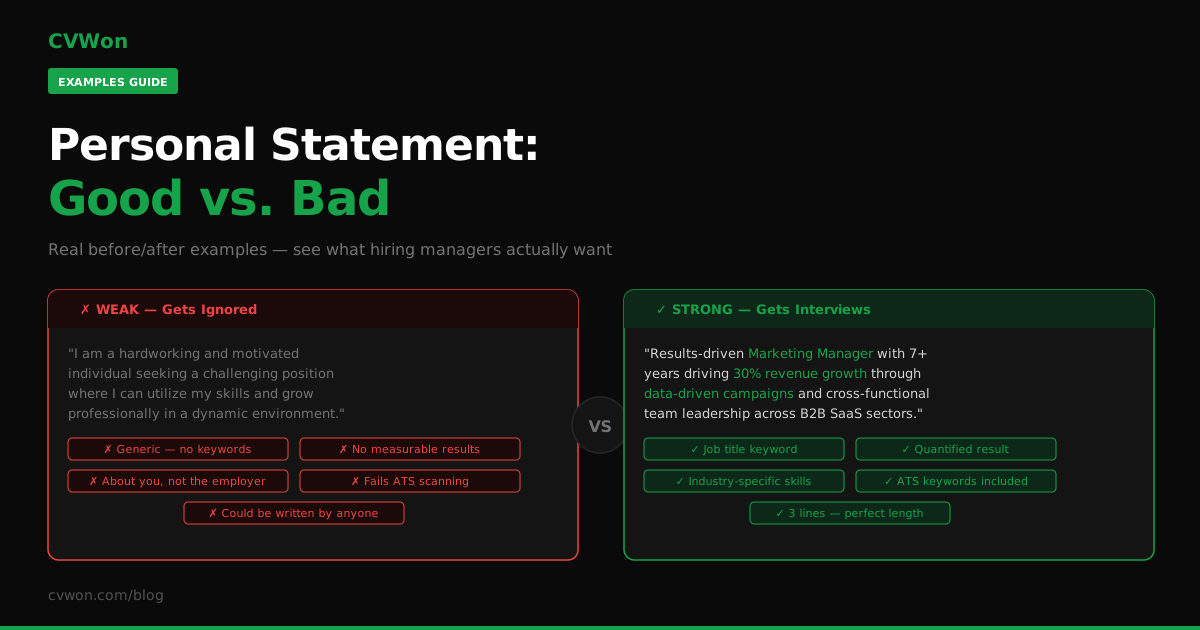
The difference between a weak and strong personal statement is not about writing skill — it is about specificity and evidence. Here is the core distinction:
Weak statements are generic, could apply to any candidate in any field, and contain no proof of performance. They are also invisible to ATS systems because they use no job-specific keywords.
Strong statements contain your exact job title, 2–3 specific skills matching the role, at least one quantified achievement, and a clear indication of what you can deliver for this employer.
The transformation is simple once you know the formula.
The 4-Part Personal Statement Formula
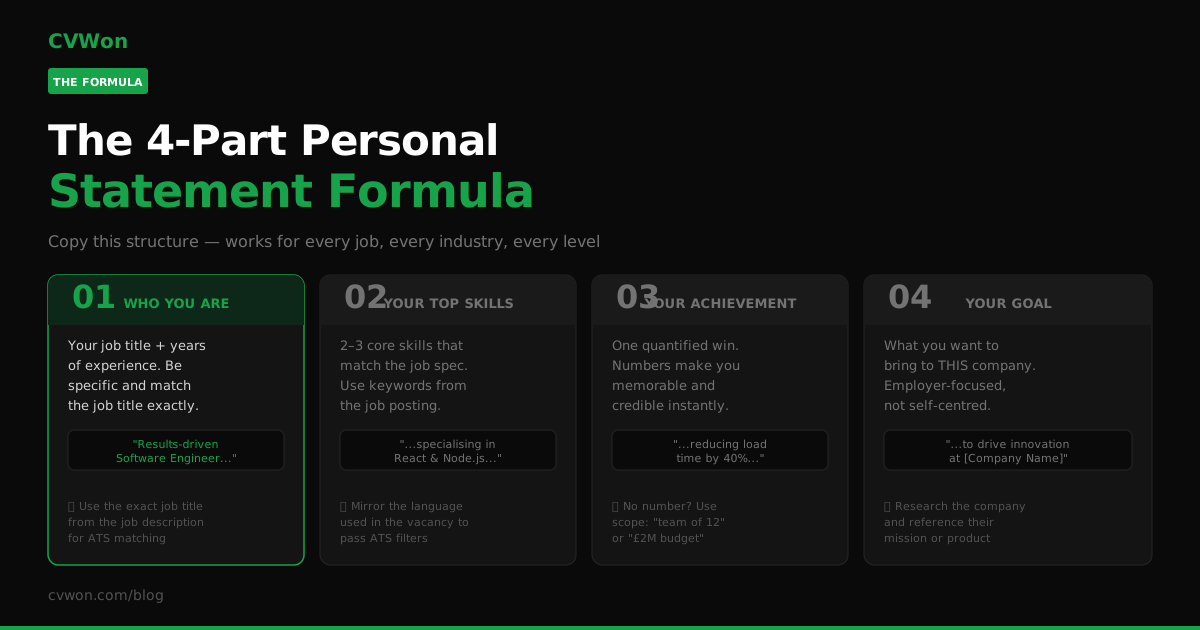
Every high-performing personal statement follows the same four-part structure. Use this as your template:
Part 1: Who You Are
Open with your job title and years of experience. Match the exact job title from the vacancy where possible — this is critical for ATS keyword matching. Never open with "I am" — start directly with your professional identity.
Example: "Results-driven Digital Marketing Manager with 6 years..."
Part 2: Your Top Skills
Name 2–3 core competencies that match what the job description asks for. Use the same language as the job posting. If the vacancy says "stakeholder management", use that exact phrase — not "working with clients" or "relationship building".
Example: "...specialising in SEO, paid media, and conversion rate optimisation..."
Part 3: Your Quantified Achievement
This is the part that makes you credible. One specific, measurable win that proves you deliver results. Numbers are ideal — percentages, revenue figures, team size, time saved. If you genuinely cannot quantify it, use scale: "managed a portfolio of 40+ enterprise accounts" or "led a team of 12 across three departments".
Example: "...having grown organic traffic by 180% and reduced CPA by 35% at a Series B SaaS company..."
Part 4: Your Career Goal (Employer-Focused)
Close with what you want to bring to this employer — not what you want to get from them. This is where most candidates get it wrong: they write about their own ambitions rather than the value they offer. Research the company and, where possible, reference their mission, product, or a specific challenge you can solve.
Example: "...seeking to drive growth for an ambitious B2C brand scaling internationally."
15+ Personal Statement Examples by Industry
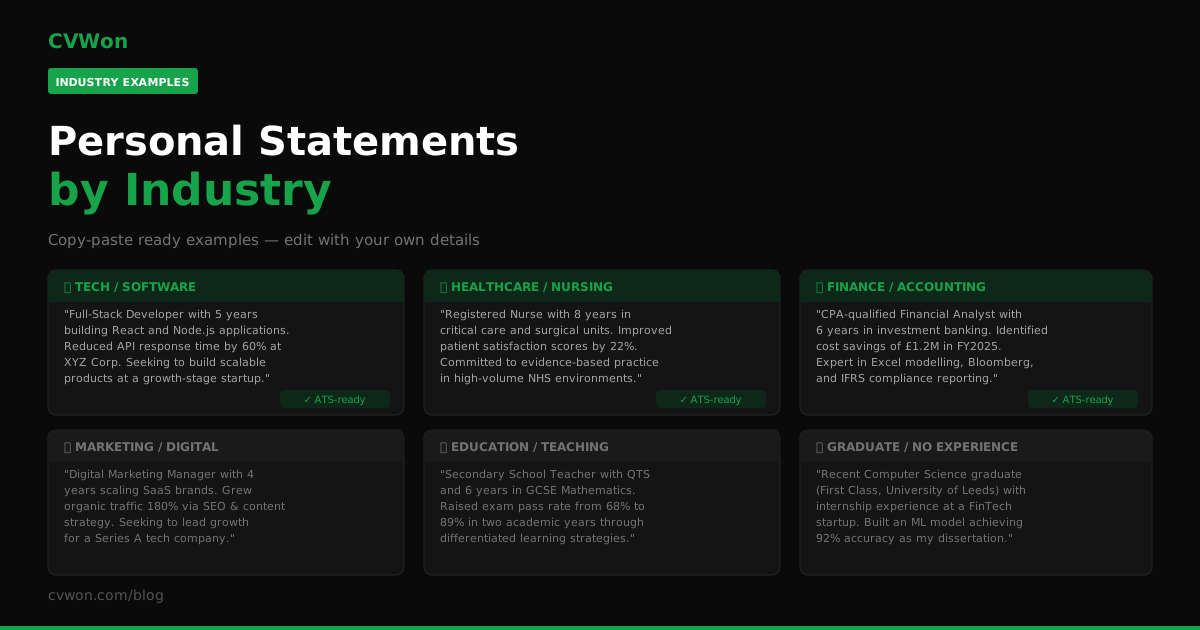
Technology / Software Engineering
"Full-Stack Developer with 5 years building React and Node.js applications for e-commerce platforms. Reduced average page load time by 60% through performance optimisation at XYZ Corp, serving 2M+ monthly users. Seeking to build fast, scalable products at a growth-stage tech startup."
Healthcare / Nursing
"Registered Nurse with 8 years of experience in critical care and surgical environments within NHS Trusts. Improved patient satisfaction scores from 72% to 94% through protocol redesign and team training initiatives. Passionate about evidence-based practice in high-acuity clinical settings."
Finance / Accounting
"CPA-qualified Financial Analyst with 6 years in investment banking and corporate finance. Identified and delivered cost savings of £1.2M in FY2025 through forensic variance analysis. Expert in Excel financial modelling, Bloomberg Terminal, and IFRS compliance reporting."
Marketing / Digital
"Digital Marketing Manager with 4 years scaling SaaS brands from seed to Series B. Grew organic traffic 180% through content strategy and technical SEO, while reducing CPL by 42% via paid channel optimisation. Seeking to lead growth marketing for an ambitious B2C product."
Education / Teaching
"QTS-qualified Secondary School Teacher with 6 years delivering GCSE and A-Level Mathematics. Raised exam pass rates from 68% to 89% in two academic years through differentiated learning strategies and targeted intervention programmes. Committed to inclusive education in diverse urban school environments."
Graduate / No Work Experience
"Recent Computer Science graduate (First Class Honours, University of Leeds) with internship experience at a FinTech startup and a strong foundation in Python, machine learning, and data analysis. Dissertation ML model achieved 92% accuracy in real-time fraud detection. Seeking a graduate software role in financial services."
Career Change
"Former Secondary School Teacher transitioning into corporate Training and Development, with 7 years designing differentiated learning programmes for groups of 30+. Delivered staff development workshops for 200+ employees as a voluntary union representative. Seeking an L&D role where I can apply pedagogical expertise in a commercial context."
Senior / Executive Level
"Chief Marketing Officer with 15 years leading brand strategy and demand generation for FTSE 100 and high-growth scale-ups. Delivered £45M in incremental revenue through a full-funnel transformation at ABC PLC. Board-level communicator and former MarTech advisor to three venture-backed startups."
7 Mistakes That Get Your Personal Statement Rejected
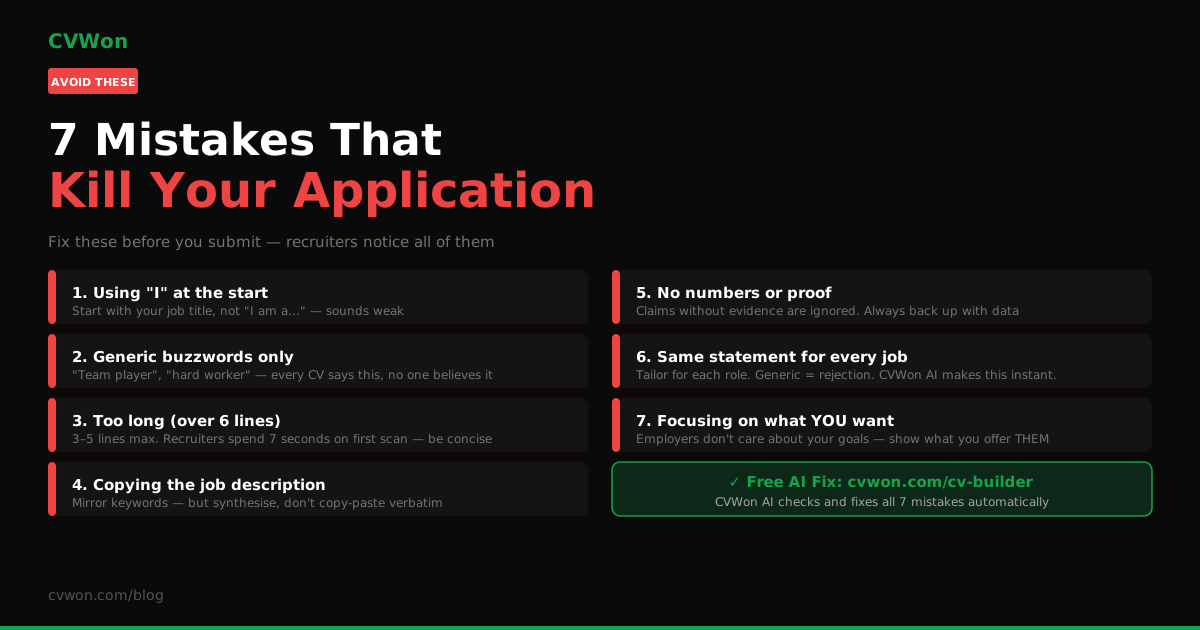
Mistake 1: Starting with "I"
Opening with "I am a..." is the single most common personal statement mistake. It sounds weak, wastes your first word on a pronoun, and misses the opportunity to lead with your strongest identifier — your job title. Always start directly: "Experienced Project Manager..." not "I am an experienced Project Manager..."
Mistake 2: Generic buzzwords with no proof
"Team player", "passionate", "results-oriented", "hardworking" — these phrases appear in millions of CVs and mean nothing without evidence. Recruiters have trained themselves to read straight past them. Replace every buzzword with a specific example or number.
Mistake 3: Writing over 6 lines
Your personal statement should be 3–5 lines. 6 at an absolute maximum. Longer statements get skimmed or skipped entirely. Brevity signals confidence: you know your value well enough to express it precisely.
Mistake 4: Making it about what YOU want
Phrases like "seeking a challenging role to develop my skills" focus entirely on your needs. Employers do not care what you want from them — they care what you will do for them. Flip the frame: every sentence should communicate value delivered, not value desired.
Mistake 5: Using the same statement for every application
A generic personal statement is worse than no personal statement. Recruiters read hundreds of applications for each role. A statement that is clearly not tailored to their specific vacancy signals low effort. Tailor for every application — CVWon's AI makes this take under 60 seconds.
Mistake 6: No quantified results
Saying you "improved customer satisfaction" means nothing. Saying you "increased NPS from 34 to 67 in 12 months" is compelling. If you genuinely cannot find numbers, use scale, scope, or frequency: "managed 14 direct reports", "processed 500+ daily transactions", "delivered training to 200+ staff annually".
Mistake 7: Missing ATS keywords
Many CVs are eliminated by ATS before a human sees them. Your personal statement must contain the exact keywords from the job description — especially the job title, required qualifications, and core technical skills. Check your CV against the job spec before submitting.
Personal Statement Length: How Long Should It Be?
The optimal length for a CV personal statement is 50–100 words — roughly 3 to 5 sentences. This equates to 3 to 5 lines on an A4 CV, depending on your font size and margin settings.
| Career Level | Recommended Length | Focus |
|---|---|---|
| Graduate / Entry Level | 3–4 lines (50–70 words) | Education, skills, potential |
| Mid-Career (3–10 years) | 4–5 lines (70–90 words) | Achievements, expertise, impact |
| Senior / Executive | 4–5 lines (80–100 words) | Strategic impact, leadership, vision |
How to Write a Personal Statement With No Work Experience
If you are a graduate or career changer, you cannot rely on years of experience and quantified results — but you can still write a compelling statement. Focus on:
- Your degree and classification — mention it, especially if it is relevant or a strong grade
- Transferable skills — leadership, project management, communication demonstrated in academic or volunteer contexts
- Dissertation, projects, or internships — treat these as proxy work experience and quantify where possible
- Enthusiasm for the industry — genuine, specific interest in the sector or company (backed by something you have done or studied)
Example for a graduate: "Recent Psychology graduate (2:1, University of Manchester) with 6 months internship experience in a digital marketing agency, where I led social media reporting for 8 client accounts. Strong analytical skills developed through research dissertation on consumer behaviour. Seeking a marketing analyst role to combine data insight with brand strategy."
Tailor Your Personal Statement for Every Job in Seconds
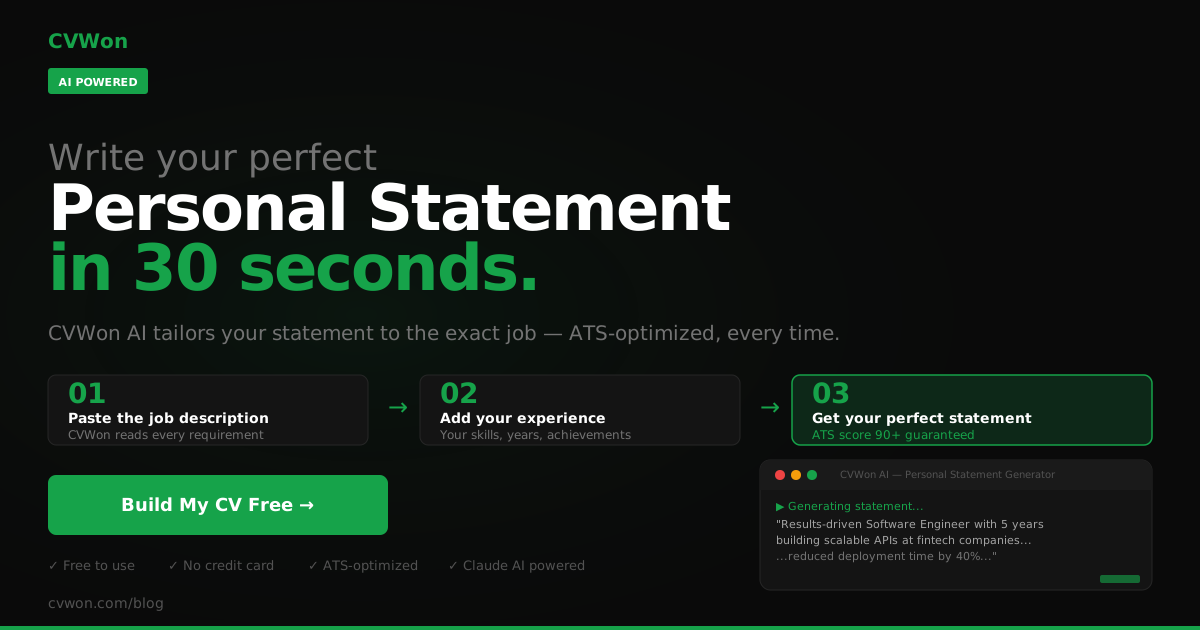
The biggest challenge with personal statements is not writing one — it is writing a new tailored version for every application. Most candidates either skip tailoring (and get filtered out) or spend 20–30 minutes per application rewriting manually.
CVWon's AI CV builder solves this in 30 seconds. Paste the job description, add your experience, and the AI generates an ATS-optimised personal statement tailored to that specific role — using the exact keywords and language the employer used in their posting.
It is free to use, requires no credit card, and is powered by Claude AI — the same model used by leading enterprise teams for precision language generation.
Frequently Asked Questions
Should I use "CV personal statement" or "professional profile"?
They are the same thing. Use whichever term you prefer as your section header — or omit the header entirely and let the paragraph speak for itself (many modern CVs do this).
Do I need a personal statement on my CV?
It is not compulsory, but it is strongly recommended. CVs without a personal statement make recruiters work harder to understand your value. In a competitive field, make their job easy.
Can I use the same personal statement for every job?
No. Always tailor. A statement written for a project management role at a tech startup should be substantially different from one written for the same role at a law firm. Keywords, tone, and emphasis must match the employer.
How often should I update my personal statement?
Update it for every application. Also review and refresh it every 6–12 months to reflect new skills, achievements, and career direction.
What tense should I use?
Present tense for current skills and what you offer. Past tense for specific achievements ("increased revenue by..."). Avoid future tense — it sounds uncertain.
Related guides: How to Write a CV With No Experience in (First Job & Career-Change Guide), Should You Put a Photo on Your CV, and How to Write a CV in: The Complete Step-by-Step Guide.
Conclusion
Your CV personal statement is 50–100 words that can determine whether you get an interview or land in the bin. The formula is simple: start with your job title, add your top 2–3 skills, include one quantified achievement, and close with what you offer the employer. Tailor it for every single application.
Use the examples in this guide as starting points, not templates to copy word-for-word. The best personal statements sound like you — specific, confident, and clear about the value you deliver.
And if you want the fastest path to a statement that works, CVWon's free AI CV builder generates a tailored, ATS-optimised personal statement in under 30 seconds. No subscription required.
About the Author
Founder and CEO of CVWon, an AI-powered career platform used by 10M+ professionals in 80+ countries. Writing about ATS optimisation, career development, and HR technology.