7 Skills That Earn Forex Sales Agents 6 Figures in Year One
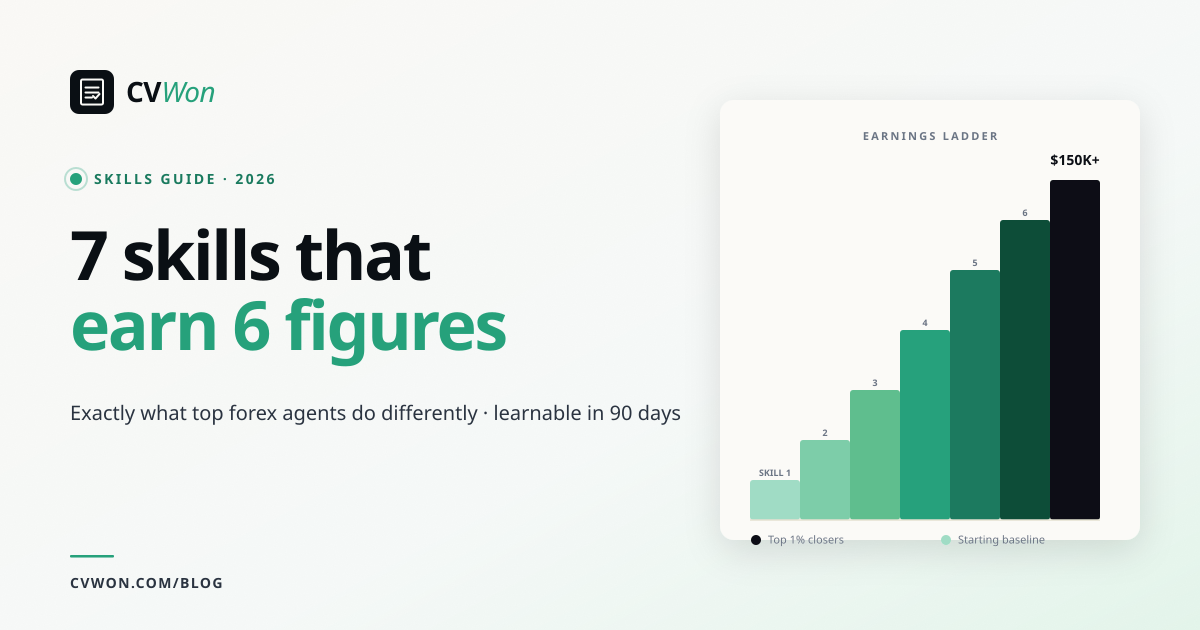
- The 7 skills that separate top-quartile forex sales agents from the floor average — all learnable in 90 days with deliberate practice.
- None of them are "be a natural salesperson". They're specific, drillable behaviours top closers repeat thousands of times.
- Average agent makes $45K–$80K year one. Agent who masters these 7 skills makes $120K–$200K year one.
- This is the playbook used internally at the highest-paying brokers in Cyprus, Dubai and Tel Aviv.
- Skill #7 — emotional detachment from rejection — is the hardest to acquire and the most predictive of long-term earnings.
Top-earning forex sales agents are not gifted natural-born closers. They are agents who deliberately drilled the seven specific skills below. The good news is all seven are learnable in 90 days of focused practice on a live floor. The challenging news is most agents skip 4 of the 7, plateau at $60K, and quit at month 18 wondering why. This is the surgical breakdown of what the top 1% does differently.
Skill 1: Tonality control
The single most overlooked skill. Forex sales is 90% phone — the prospect can't see your face. Your tone carries everything: warmth, authority, confidence, urgency, empathy.
Top closers spend 20–30 minutes a day practicing tonality drills:
- Reading the same script line with 5 different intentions (warm welcome / urgent / curious / reassuring / authoritative)
- Voice memos of themselves, listened to with critical ears
- "Slow-down" drills: deliberately speaking 30% slower than feels natural
- Strategic silence training (2–4 second pauses after key questions)
The effect on conversion is measurable: a 2024 study by a major CySEC broker tracked 200 agents and found agents in the top tonality quartile converted 31% better than the bottom quartile on identical lead pools.
Skill 2: Objection mapping (not "handling")
Most agents are taught "objection handling" — memorize rebuttals to common objections. The top 1% do something different: they map objections.
Mapping means tracking, for every prospect you talk to, which objection came up at which stage of the call. After 200 calls you have a heatmap of "objections about safety appear most often after I mention leverage" or "price objections come AFTER trust objections, never before".
Once you have the map, you can rearrange your pitch to address objections BEFORE they're raised. This converts 2–3× better than reactive handling.
"I tracked every objection for 300 calls in Google Sheets. Found 78% of safety objections came right after I said 'spreads are tight'. So I started leading with regulation evidence BEFORE mentioning spreads. Conversion went from 12% to 19% in three weeks." — Top closer, Limassol
Skill 3: Speed-to-call mastery
Industry data is unambiguous: leads called within 1 minute of registration convert 4× better than leads called within 30 minutes. Within 5 minutes vs 30 minutes is still a 2.5× gap.
Most agents check their lead queue every 10–20 minutes. Top closers:
- Run their phone notifications visible at all times
- Pick up new leads within 60 seconds of CRM ping
- Have a default first-call script that requires zero "thinking" time
- Eat lunch at their desk during peak lead-arrival hours
The math: 4× conversion on 5 leads/day = 20 effective leads/day = same volume as the agent dialing 20 stale leads. Half the effort, same output, same commission.
Skill 4: Hyper-specific qualification questions
Average agents ask "what's your trading experience?" Top closers ask "what was the last instrument you took a position on, and what was the size?".
The difference: average questions get average answers ("a little experience"). Specific questions get qualifying data ("I traded EURUSD last Tuesday with 0.5 lot") that you can use to:
- Position your product correctly ("you'll appreciate our 0.0 spread on majors")
- Disqualify time-wasters early ("you've never traded? We have a demo first")
- Anchor the deposit conversation ("you took a 0.5 lot — to hold that overnight you'll want at least €2,500 in account")
Spend 30 minutes per week refining your qualification questions. Track which questions yielded most conversions over the prior month. Iterate.
Skill 5: Anchoring the deposit number
The deposit conversation is where most calls die. Average agents ask "how much would you like to deposit?". Top closers anchor first: "based on what we discussed, the right starting capital for your strategy is between €2,000 and €5,000 — which sits better with you?".
The framing differences:
- Average: open-ended question = prospect picks the lowest mental anchor (minimum deposit, often €250)
- Top closer: range anchor = prospect picks within YOUR range, almost always €2,000–€5,000
This single technique often doubles average ticket size. The data backs it up: brokers who train agents on anchoring see average FTD 1.5–2× higher than non-trained desks.
Skill 6: Same-call urgency creation (without sleaze)
Forex sales has a reputation for high-pressure tactics. Top closers create urgency without sleaze — using factual, time-bound levers:
- Market timing: "The ECB decision is in 2 days — if you fund today you can position before it; after the announcement spreads spike."
- Promotion windows: "Our welcome bonus expires for accounts opened after Friday. Want me to flag this one to lock it?"
- Verification clock: "KYC takes 24 hours. If you start now you trade Monday; if you wait until Friday you miss the week."
These are TRUE statements — the urgency exists naturally in market timing and operational realities. Top closers point them out cleanly. Bad agents invent fake scarcity that prospects see through.
Skill 7: Emotional detachment from rejection
The hardest skill, the highest predictive of long-term earnings. A typical forex agent gets 80 "no's" for every "yes". 80%+ of agents quit at month 18 because the rejection wears them down. The 20% who stay are not less sensitive — they've learned the detachment mindset.
What detachment looks like:
- Treat each call as a probabilistic event, not a personal exchange
- Track conversion rate weekly, not daily — daily numbers are too noisy and discouraging
- Celebrate the closes; do not catastrophize the rejections
- Have a physical reset routine between calls: deep breath, walk to water cooler, reset
- Talk to colleagues about hard calls — not to vent but to extract lessons
Agents who master detachment compound experience faster because they don't burn out. By month 24 their accumulated lessons make them 3–5× more effective than month-1 versions of themselves. Agents who burn out never reach this point.
Skill mastery vs earnings — the data
| Skills mastered (of 7) | Year 1 OTE | Year 3 OTE |
|---|---|---|
| 0–2 | $45K–$60K | $60K–$90K (or quit) |
| 3–4 | $70K–$95K | $110K–$160K |
| 5–6 | $100K–$140K | $180K–$280K |
| All 7 | $130K–$200K | $300K–$700K+ |
How to acquire all 7 in 90 days
- Week 1–2: Skill 3 (speed-to-call). Set up phone notifications, default first-call script. Easy quick win.
- Week 3–4: Skill 1 (tonality). Daily 20-min voice-memo practice. Listen-and-correct loop.
- Week 5–6: Skill 4 (qualification). Refine 5 specific questions per week, track outcomes.
- Week 7–8: Skill 5 (anchoring). Build a script library for 5 different prospect profiles. Drill until natural.
- Week 9–10: Skill 2 (objection mapping). Set up tracking sheet. Map 100+ calls.
- Week 11–12: Skill 6 (clean urgency). Build a library of market/timing levers specific to your product.
- Ongoing: Skill 7 (detachment). Daily practice, weekly reflection, monthly review of conversion rate.
Agents who follow this plan typically see month-3 conversion at 1.8× their starting baseline and month-6 at 2.5×.
Floor features that accelerate skill acquisition
Some brokers' sales floors are structurally better for skill development than others. Look for:
- Call recording + weekly 1:1 reviews with a senior coach
- CRM with branch-script tracking (data on which scripts convert)
- Daily morning script drills with the team
- Visible leaderboards that motivate without humiliating
- Internal training programs (formal 4-week onboarding minimum)
- Mentor pairing — junior with senior for first 90 days
If a floor has 3+ of these, you'll develop skills 2× faster than at a non-structured floor.
The trap that prevents 80% of agents from acquiring all 7
Most agents focus exclusively on Skill 3 (speed) and Skill 6 (urgency) because they're easiest to implement. They ignore Skills 1, 2, 4, 5, 7 because those require deliberate practice and feel less productive in the moment.
Result: they get fast at dialing and aggressive at urgency, but their per-call conversion stays low. They burn out at month 12–18 because they're doing 200 calls/day for the same output as a refined agent doing 80 calls/day.
The fix: track ONE skill per week of dedicated practice. Don't try to do all 7 at once. Stack them.
FAQ
Are these skills different for crypto sales vs forex sales?
No. The 7 skills are universal across financial-product sales. Crypto sales adds 1 product knowledge layer (tokens, custody, blockchain basics) but the closing skills are identical.
Do you need prior sales experience?
Helps, doesn't require. The 7 skills are learnable from a complete cold start within 6 months on a well-structured floor.
What if my current desk doesn't have coaching infrastructure?
Move. The 2-year compounding effect of being at a good floor vs an average floor is 3-5× in lifetime earnings. Don't optimise for short-term base; optimise for skill acquisition velocity.
How do I track my own progress on these skills?
Weekly metrics: connect rate, demo rate, FTD rate, average ticket size, conversion rate. Each skill maps to a specific metric. Skill 3 improves connect rate. Skill 5 improves average ticket. Skill 7 improves consistency over months.
What's the fastest skill to learn?
Skill 3 (speed-to-call). Takes one afternoon to set up phone notifications and a default first-call script. Immediate measurable improvement.
Hardest skill?
Skill 7 (emotional detachment). Takes 6–12 months of conscious practice. Cannot be shortcut.
Do top closers really practice tonality?
Yes. Every top closer we've placed has a regular voice-memo or call-recording review habit. It's the single most observable behavioral difference vs average agents.
Where can I find brokers with these training systems?
Use CVWon Jobs — every employer is KYB-verified and we tag which floors have structured training programs.
Next steps
If you commit to acquiring all 7 skills, you change your earnings trajectory permanently. The first step is being on a floor that has the infrastructure for it. Check fit below.
Ready to compound the 7 skills?
Do you have high-ticket sales experience? Will you relocate to a regulated training-strong floor? Do you have experience selling financial products? Match me with structured-training floors — freeLast updated: May 25, 2026 · Marcus Steiner has trained 1,400+ forex sales agents.
About the Author
Marcus Steiner has trained 1,400+ forex sales agents across CySEC, FCA and DFSA-regulated brokers.