How to Negotiate Your Salary After a Job Offer (2026 Guide + Email Scripts)
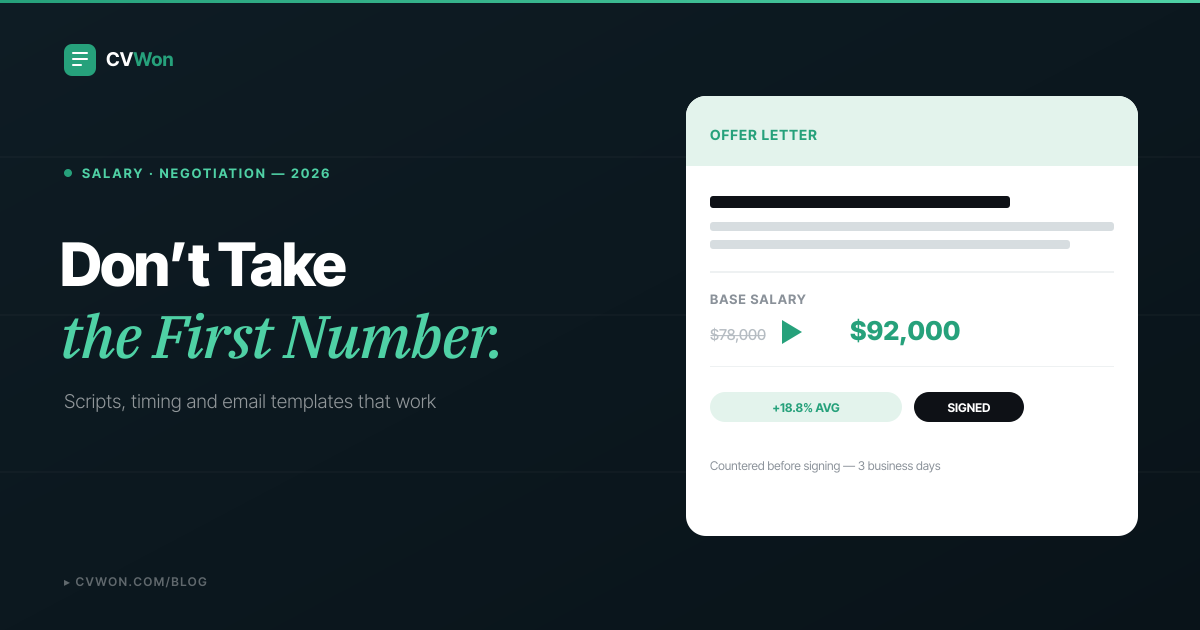
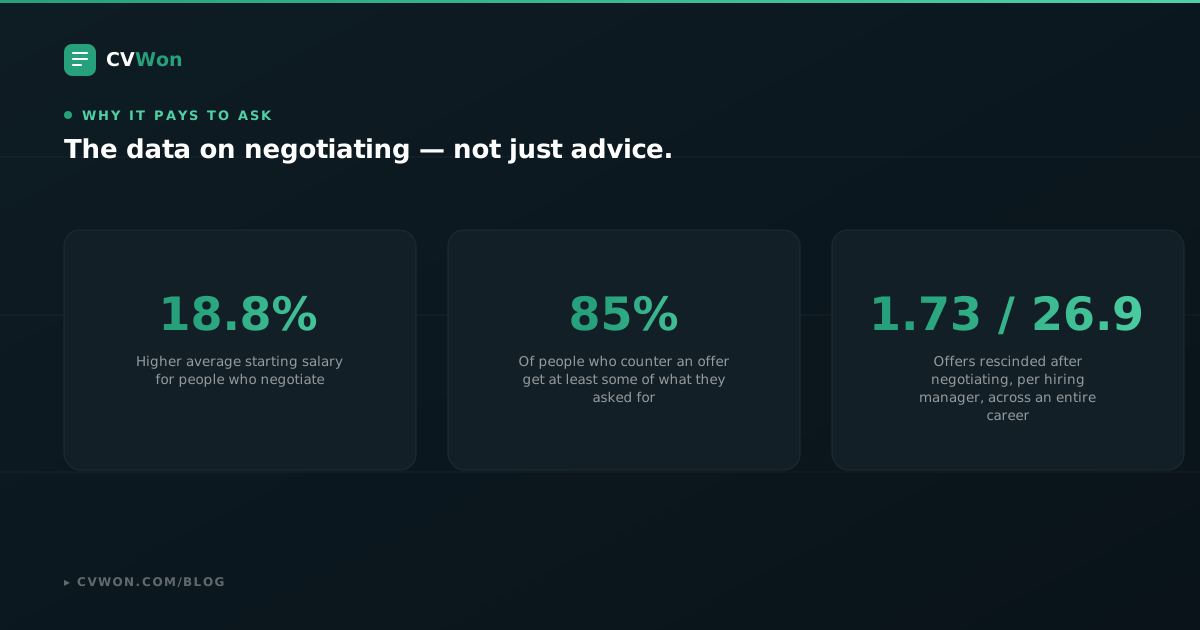
Only about a third of job seekers negotiate their salary — the rest simply accept whatever number lands in their inbox. People who negotiate end up with starting salaries that average 18.8% higher, and a Fidelity survey found 85% of people who countered an offer got at least some of what they asked for. Hiring managers largely expect it: most initial offers are set below the real budget on purpose, precisely because negotiation is part of the process.
This guide covers exactly what to say, when to say it, and how much to ask for — with copy-paste email scripts, a phone-call framework, and a dedicated section on negotiating for roles in the UAE and wider Gulf market. Once your number is agreed, make sure the CV or resume that got you the offer is just as strong: check it against our free ATS score checker.
Why You Should Always Negotiate
Recruiters build in room to move. Most companies set an initial offer below the true budgeted maximum for the role, precisely because they expect a counter — an offer with zero room to negotiate is the exception, not the rule. Declining to negotiate does not make you look easier to work with; it just means you leave money on the table that was already allocated for the role.
The downside risk is smaller than most candidates assume. Research from George Mason University found hiring managers report rescinding an offer only about 1.73 times out of every 26.9 offers made across their careers after a candidate negotiated — and nearly all of those cases involved candidates who were aggressive or unprofessional, not simply candidates who asked. A calm, well-reasoned counter offer essentially never costs you the job.
Research Your Market Rate Before You Say a Number
Never propose a number you cannot back up. Cross-check at least three sources so you can defend your figure with a range, not a guess:
- Aggregated salary data — Glassdoor, Payscale and LinkedIn Salary each pull from different samples, so cross-referencing all three narrows the range faster than trusting one site alone.
- Published salary ranges — pay-transparency laws now require salary ranges on job postings in a growing number of US states and several other countries; if the original posting listed one, treat it as your floor, not your target.
- Your own network — a short, direct message to someone in a similar role at a similar company beats any aggregator for accuracy, even if you only get a rough range back.
- The offer itself — if the company disclosed a range during the interview process, anchor your counter inside the upper half of that range, not the midpoint.
Write your target number down as a range (for example, "$78,000–$85,000") before any conversation. A range gives you room to move without looking indecisive, and it forces you to commit to a floor you won't go below.
When to Negotiate (and When Not To)
Negotiate after you have a written offer and before you sign anything — never earlier, and ideally never much later.
| Stage | Should you negotiate? | Why |
|---|---|---|
| During the first interview | No | You have no leverage yet and risk being screened out before you've proven your value. |
| When asked your salary expectations early on | Deflect, don't refuse | Give a researched range or redirect to the company's budgeted range rather than naming a hard number too soon. |
| The moment you receive a verbal offer | No — wait for it in writing | Verbal numbers change; negotiate against the written offer letter or email so there's a clear paper trail. |
| After the written offer, before you sign | Yes — this is the window | This is when the company has the most incentive to close the deal and the most flexibility to move. |
| After you've signed and started | Only at scheduled review points | Renegotiating a signed offer damages trust; save further asks for your first performance review. |
How Much to Ask For
A counter of 10–20% above the initial offer is a reasonable, defensible starting point for most roles. Where you land inside — or outside — that range depends on your actual leverage:
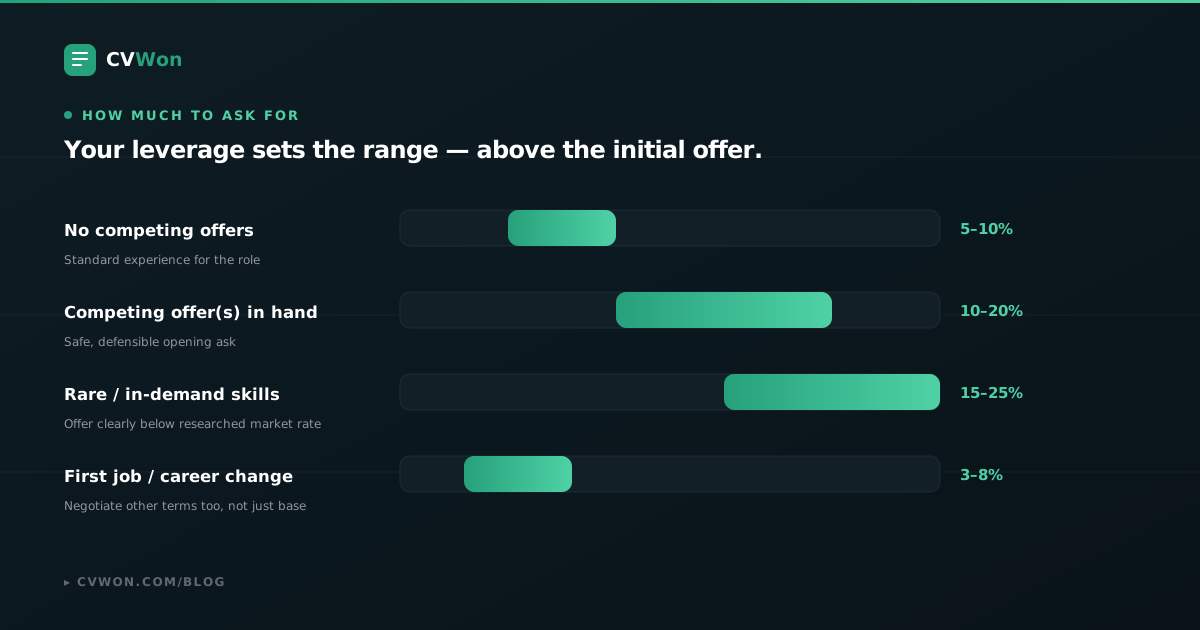
- No competing offers, standard experience for the role: aim for the lower end, around 5–10% above the initial number.
- One or more competing offers: 10–20% is a safe opening ask, and you can reference the competing offer's total value (not necessarily the exact number) as justification.
- Rare or in-demand skills, or the offer is clearly below the market range you researched: asking for 15–25% above the initial offer is defensible if your research supports it.
- First job, internship-to-full-time conversion, or a significant career change: negotiate, but expect a smaller gap — 3–8% above the initial offer is realistic, and negotiating other terms (start date, remote flexibility, review timeline) may matter more than base salary.
The Negotiation Process, Step by Step
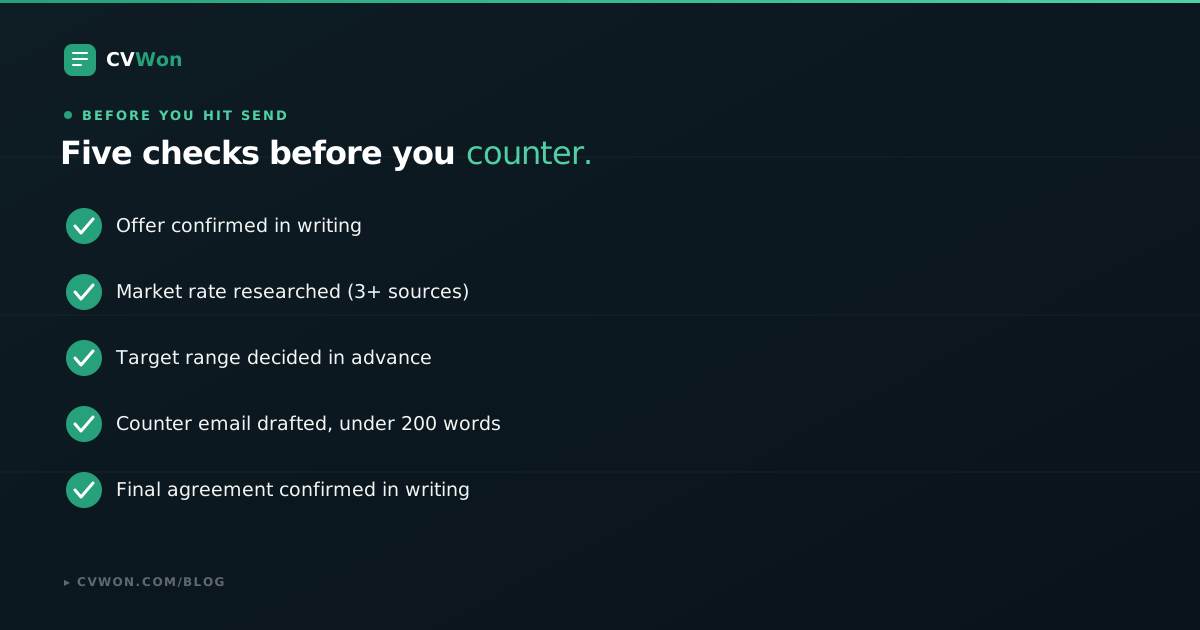
- Get the offer in writing. Thank them for the verbal offer and ask for it in writing before discussing numbers.
- Ask for time to review. "Thank you — this is exciting. Could I have until [specific date, typically 3–5 business days] to review the full offer?" is a completely normal, expected request.
- Finalize your target range using the research from the section above.
- Send your counter in writing first — email, not a phone call — using one of the templates below.
- Follow up by phone or video only if they ask to discuss it live, using the talking points in the phone-call section.
- Get the final agreement in writing before you resign from your current role or decline other offers.
Salary Negotiation Email Templates
Send your counter by email whenever possible. It gives you time to pick an exact number, avoids anchoring too low on a live call under pressure, and creates a written record. Keep it under 200 words: thank them, confirm enthusiasm, state a specific number, briefly justify it, and end collaboratively.
Template 1 — Standard counter offer
Hi [Name],
Thank you again for the offer to join [Company] as [Job Title] — I'm genuinely excited about the team and the scope of the role.
I've had a chance to review the full package, and based on my experience with [specific skill/achievement] and current market data for similar roles, I was hoping we could look at a base salary closer to $[target number]. Is there flexibility to revisit the number?
I'm confident we can find something that works well for both sides, and I'm ready to move quickly once we do.
Best,
[Your name]
Template 2 — Leveraging a competing offer
Hi [Name],
Thank you for the offer — [Company] remains my first choice, and I'd love to make this work.
I wanted to be transparent: I've also received an offer from another company at a higher total compensation. Given that [Company] is my preferred option, I'd like to see if we can bring your offer closer to $[target number] before I make a final decision.
I'm hoping to have an answer to both sides by [reasonable date], so I'd appreciate knowing if there's room to adjust.
Best,
[Your name]
Template 3 — First job / limited experience
Hi [Name],
Thank you so much for the offer — I'm excited to start my career at [Company].
Based on the research I've done into starting salaries for [Job Title] roles in [location/industry], I was hoping we could discuss a base salary closer to $[target number]. I understand there may be less flexibility for entry-level roles, so I'm also very open to discussing other elements of the offer if base salary isn't adjustable.
Thank you again for the opportunity — I'm looking forward to getting started.
Best,
[Your name]
Template 4 — Negotiating benefits instead of base salary
Hi [Name],
Thank you for the offer — I'm ready to move forward and I understand the base salary may be fixed at this stage.
Would there be flexibility on [a signing bonus / an additional [X] days of PTO / a 6-month compensation review / a remote-work arrangement] instead? Any of those would make a meaningful difference on my end.
Looking forward to finalizing this.
Best,
[Your name]
What to Say on a Phone or Video Call
If the recruiter or hiring manager wants to discuss your counter live rather than by email, prepare three things in advance: your target number, your walk-away number, and two or three sentences of justification you can say without notes.
- Open with enthusiasm, not demands: "I'm really excited about this role, and I wanted to talk through the offer to see if we can find a number that works for both of us."
- State your number once, clearly, then stop talking. "Based on my research and experience, I was hoping for something closer to $[number]." Silence after stating your number is normal and expected — resist the urge to fill it.
- If they ask "what would it take to sign today," answer directly. This is usually a genuine opening to close the gap, not a trick.
- If they push back, ask questions rather than immediately conceding: "Is the base salary fixed, or is there flexibility in other parts of the package?"
- Always confirm the final number in writing after the call, even if you reached verbal agreement: "Just to confirm what we discussed — could you send over an updated offer reflecting $[number]?"
Negotiating Beyond Base Salary
If base salary genuinely has no room left, other parts of the package often do — and some cost the employer less than an equivalent salary increase would.
| What to ask for | When it works best |
|---|---|
| Signing bonus | Company has a fixed salary band but discretionary one-time budget — common when the base is capped by internal pay bands. |
| Extra paid time off | Often easier to grant than a recurring salary increase, since it doesn't affect the ongoing payroll baseline. |
| Remote or hybrid flexibility | High-value to you, low direct cost to the employer if the role doesn't require daily office presence. |
| An earlier compensation review (e.g., at 6 months instead of 12) | Lets the company defer the cost while still meeting you partway. |
| Job title adjustment | Costs the company nothing directly and can matter for your next negotiation down the line. |
| Relocation or visa-processing support | Especially relevant for international moves, including UAE and Gulf roles — see the section below. |
| Professional development budget or certification sponsorship | Attractive if you're early-career or moving into a specialized or regulated field. |
Common Salary Negotiation Mistakes
- Naming a number first, before you've done any research. Whoever anchors first sets the range the rest of the conversation moves around — make sure your anchor is backed by data.
- Accepting on the spot. Even if the offer sounds good, "let me review the full offer and get back to you by [date]" is always appropriate and costs you nothing.
- Over-justifying with personal financial needs. "I have a higher rent now" is not a business reason a hiring manager can act on — anchor your ask to market data and your value, not your expenses.
- Negotiating over text or chat. Keep it to email or a scheduled call; informal channels read as less serious and are easy to misread in tone.
- Making an ultimatum you're not prepared to keep. Only say "I need $X or I can't accept" if you genuinely will walk away at that number.
- Going silent after the counter. If you haven't heard back within the timeline you agreed, a short, polite follow-up after 3–4 business days is expected, not pushy.
- Forgetting to negotiate at all. The single most common mistake remains simply accepting the first number, most often out of a fear of seeming difficult that the data does not support.
Salary Negotiation for UAE and Gulf Roles
Negotiating for a role in the UAE or wider Gulf market follows the same core process, with a few region-specific factors worth building into your research and your ask:
- Salary is usually quoted and negotiated as a monthly figure (AED per month), not an annual figure — confirm which one you're discussing before naming a number.
- Total package structure matters as much as base salary. UAE offers commonly separate base salary from housing allowance, transport allowance, and annual flight allowance — negotiate the total package, not just the base line, since employers often have more flexibility in the allowance components.
- End-of-service gratuity is calculated from your final basic salary under UAE labour law, so a higher basic-salary proportion (versus allowances) compounds in your favor over a multi-year stay — worth raising if the split is negotiable.
- Ask about medical insurance coverage explicitly — employer-provided coverage is mandatory in the UAE, but coverage tiers (self-only versus family) vary and are often negotiable for senior hires.
- For relocating candidates, negotiate visa and relocation costs separately from salary — flights, visa processing, and sometimes initial accommodation are commonly covered by the employer and are a normal ask, not an unusual one.
- Multilingual candidates have real leverage. Arabic/English fluency, or a third language relevant to the company's client base, is a legitimate point to raise if it wasn't already priced into the initial offer.
If you're building or updating your CV for a UAE-based application, our CV templates are structured for exactly this market, and role-specific examples are available for over a hundred job titles.
What If They Say No?
If the answer is a firm no on every part of the package, you have three real options, not two:
- Accept the original offer. This is a legitimate choice, not a failure — if the role, growth path, or team is strong enough, the salary gap may not be worth losing the opportunity over.
- Ask what it would take to reach your number in the future. "Understood — would it be possible to revisit this at a 6-month review if I hit [specific, agreed targets]?" turns a no into a concrete, written path forward.
- Decline and move on. If the gap is large and there's no flexibility on timeline either, it's reasonable to decline professionally and continue your search — a brief, polite decline preserves the relationship for future opportunities at the same company.
A firm no, delivered professionally, does not mean you did anything wrong by asking. Some companies genuinely operate on fixed bands with no room to move — the point of negotiating is that you never know which kind of company you're dealing with until you ask.
Frequently Asked Questions
Is it ever too late to negotiate salary after accepting an offer?
It's much harder, but not always impossible. If you haven't started yet and have new, material information (a competing offer, for example), a brief, honest conversation is possible — but the strongest window is always before you sign, so treat post-acceptance negotiation as the exception, not the plan.
Should I give a salary number first if a recruiter asks early in the process?
Where possible, redirect: "I'd like to learn more about the role first, but I'm confident we can find a number that works if it's a good fit — what range is budgeted for this position?" If pressed, give a researched range rather than a single figure.
How do I negotiate salary if I have no other job offers?
You can still negotiate on the strength of your research and your fit for the role — competing offers help, but they are not required. Lead with market data and the specific value you bring rather than leverage you don't have.
What percentage increase is realistic to ask for?
10–20% above the initial offer is a reasonable starting point for most professional roles, adjusted up or down based on your leverage, experience level, and how the offer compares to your market research.
Can negotiating salary get a job offer withdrawn?
It's rare. Research indicates hiring managers rescind offers only about 1.73 times per 26.9 offers made after a candidate negotiates, and those cases are typically tied to unprofessional or unreasonable behaviour rather than the act of negotiating itself.
Should I negotiate over email or over the phone?
Start with email for your initial counter — it lets you commit to an exact number without pressure and creates a written record. Move to a call only if the employer requests one to discuss further.
What if the recruiter says the offer is "non-negotiable"?
Base salary may genuinely be fixed on a pay band, but other terms — signing bonus, PTO, start date, review timeline — frequently still have room. Ask specifically: "Understood on the base — is there flexibility anywhere else in the package?"
How long should I take to respond to a job offer?
Three to five business days is a standard, reasonable window to request. Asking for it is expected and does not signal disinterest.
Do I need to justify my counter offer with a specific reason?
A brief justification helps — reference market research, a specific in-demand skill, or relevant experience — but you don't need an elaborate case. One or two sentences of grounding is enough; the number itself does most of the work.
Is negotiating salary different for internal promotions versus new job offers?
The principles are the same, but your leverage differs: for an internal promotion, lean on your track record and documented impact at the company rather than external market comparisons, and time the conversation around your formal review cycle where possible.
What should I do if I get a lowball counter-counter offer?
Treat it as a genuine second round, not a final answer. You can respond once more with a smaller ask that moves toward the middle, or accept if the gap has closed enough — most negotiations settle within two or three exchanges.
Does negotiating salary work the same way for remote roles?
Mostly, yes — research your target company's stated pay philosophy (some pay based on your location, others on a single national or global band) before naming a number, since that materially changes what's realistic to ask for.
Is it rude to ask for a higher salary right after receiving an offer?
No. Employers who extend offers generally expect a counter as a normal part of the process — asking professionally, with research behind it, is standard practice, not an imposition.
Related guides: How to Ask for a Raise in: Scripts, Timing & Data, Tell Me About Yourself Answer: 5 Templates, and Common Interview Questions and Answers (2026 Guide).
Negotiate Once, Benefit for Years
A single successful negotiation compounds: raises, bonuses, and future offers are often calculated as a percentage of your current base, so the number you agree to now sets the floor for every negotiation that follows. Do the research, pick a defensible range, send the email, and give yourself the few days it takes to do this properly — the data is clear that asking costs far less than it seems to, and staying silent costs more than it looks like at the time.
Once your offer is finalized, make sure the CV that got you there is just as strong for whatever comes next: build or update it with our AI-powered CV builder, choose a role-specific CV template, and confirm it's ready with the free ATS score checker.
About the Author
Founder and CEO of CVWon, an AI-powered career platform used by 10M+ professionals in 80+ countries. Writing about ATS optimisation, career development, and HR technology.