Tell Me About Yourself Answer 2026: 5 Templates
Last updated: 10 August 2026 · 16 min read · Reviewed by Muneeb Awan (Founder, CVWon)
The 2026 answer to “tell me about yourself” is now scored twice in most tech and finance interview loops — once by the interviewer in real time, once by an AI async-video screener that checks whether you name a role-specific specialisation in the first 15 seconds, quantify at least one outcome, and land the whole answer inside a 60-90 second target window. Overshooting the window is the single most common 2026 fail. Missing the specialisation in the opener is the second. This guide covers exactly how to answer “tell me about yourself” in 2026: the Present-Past-Future formula tuned to a 90-second cap, the 15-second specialisation opener, the AI-recruiter scoring rubric now applied on async video screens, five tier-appropriate templates (entry-level, career-changer, senior IC, manager, executive), the “reason I’m here” closing bridge that primes the next question, and how to handle a career gap or layoff inside the answer without reading as defensive.
TL;DR
- Target 60-90 seconds total, roughly 150-220 words spoken. Under 45 seconds reads as unprepared; over 100 seconds triggers the async-screener duration cap and drops points.
- Name the specialisation in the first 15 seconds. Not the years, not the last job title — the specialisation the target JD asks for. The opener sets the entire routing of the rest of the interview.
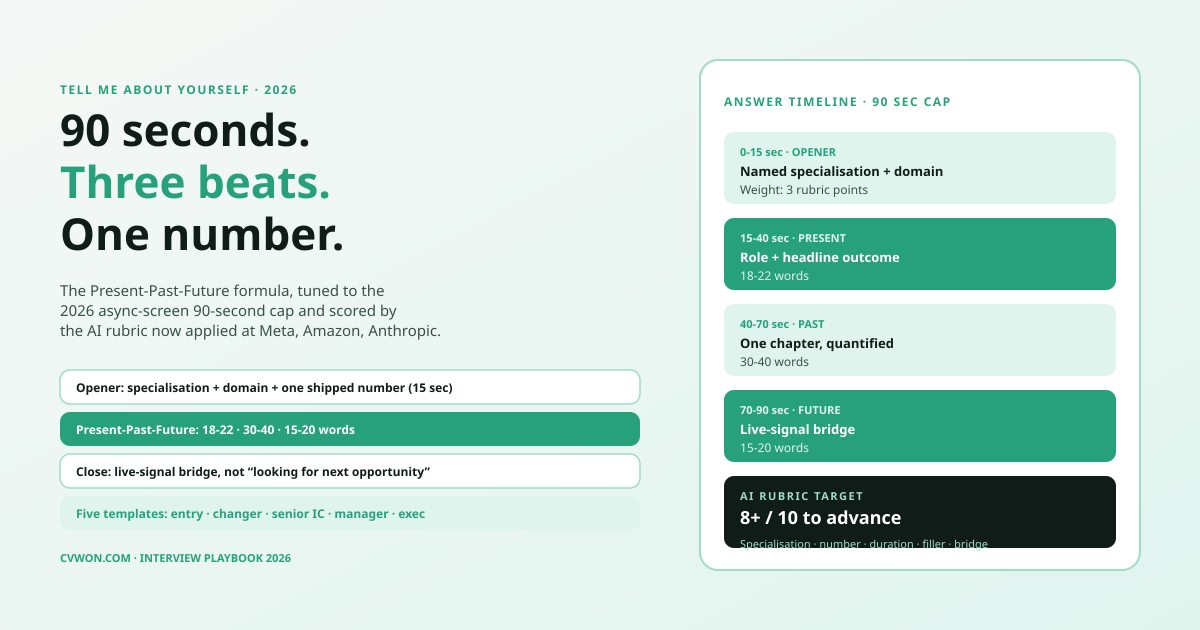
- Use the Present-Past-Future formula, tuned: 18-22 words Present, 30-40 words Past, 15-20 words Future. Every strong 2026 answer fits that shape.
- Close with a “reason I’m here” bridge, not a generic “and now I’m interested in this role”. One specific sentence that primes the interviewer’s next question is worth more than three sentences of career history.
- Five different scenarios need five different templates. Entry-level, career-changer, senior IC, manager, and executive answers share the formula but differ in what evidence each segment names.
What interviewers really ask when they say “tell me about yourself”
“Tell me about yourself” is a routing question, not a life-story question — interviewers use the 60-90 seconds to decide which of your themes to probe next and to check whether your positioning matches the JD they hired for. In 2026 the same question also serves as the calibration input for the interviewer’s scoring rubric and, on async video screens, for an AI layer that scores the same signals independently.

What the interviewer is actually listening for in 2026:
- Are you the specialisation the JD asked for? If the JD says Backend Engineer and the first 15 seconds say “I’m a Software Engineer” without further routing, the interviewer marks the answer as un-calibrated and adjusts follow-up questions to disambiguate.
- Do you have at least one shipped, measurable outcome? A single quantified past-tense claim (RPS moved, revenue lifted, MTTR cut) is worth more than three unquantified role summaries. The interviewer picks that claim to probe.
- Can you self-edit? A 3-minute rambling answer signals inability to structure thought under pressure and downweights every subsequent answer in the loop.
- Do you know why THIS company / THIS role? A generic “and now I’m looking for my next opportunity” close reads as spray-and-pray. A specific one-sentence bridge to the company’s current work reads as prepared.
The 2026 answer to “tell me about yourself” is judged in 90 seconds on the same four questions: does your opener match the JD, do you have one quantified outcome, can you self-edit, and do you have a specific reason for being in the room? An answer that misses any of the four lands mid-pack in a rubric-scored loop.
The Present-Past-Future formula, tuned to a 90-second cap
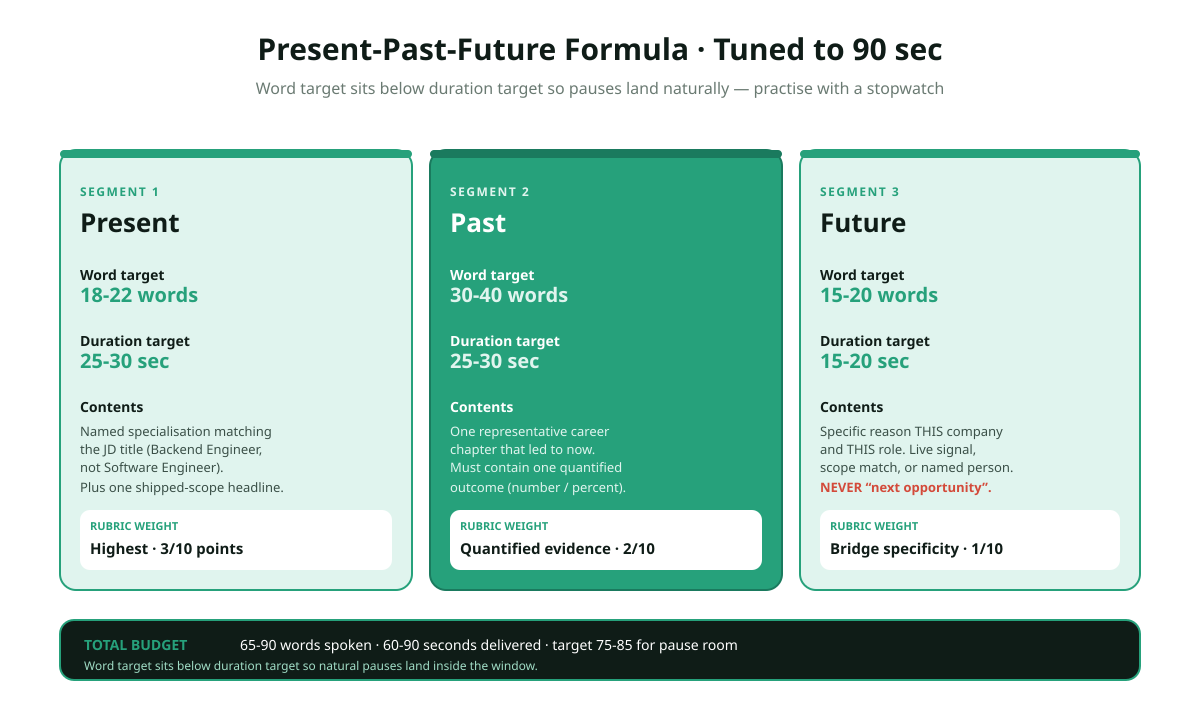
The Present-Past-Future formula is a three-segment structure for the “tell me about yourself” answer: what you do now, one representative past chapter that led here, and one specific reason you are talking to this interviewer today. The formula is not new. The 2026 tuning is the word-count and duration allocation per segment, which matches how both human interviewers and async AI screeners now expect the answer to arrive.
| Segment | What to say | Word target | Duration target |
|---|---|---|---|
| Present | Role specialisation + one headline shipped outcome | 18-22 words | 25-30 seconds |
| Past | One representative career chapter, quantified | 30-40 words | 25-30 seconds |
| Future | Why THIS company + THIS role, specific | 15-20 words | 15-20 seconds |
| Total | — | 65-90 words | 60-90 seconds |
The word target sits below the duration target because pauses matter. A 90-second answer that lands at 68 words gives you natural breathing room; a 90-second answer at 130 words reads as rushed. Practice with a stopwatch, not with a word counter alone.
Key takeaway: the formula is Present-Past-Future in that order because interviewers weight the first 15 seconds heaviest. Leading with Past (chronology) is the second-most-common 2026 fail because it front-loads the least-relevant information.
The 15-second specialisation opener (get this right or the rest is wasted)
The specialisation opener is the single most important 15 seconds of a “tell me about yourself” answer in 2026 — it must name the exact role specialisation the JD asked for, plus one shipped-scope headline, before any career chronology. A generic title in the opener (“I’m a software engineer with 8 years of experience”) routes the answer to the wrong shortlist and forces the interviewer to spend the rest of the loop clarifying scope.
The pattern that works — three parts:
- Named specialisation matching the JD title (Backend Engineer, not Software Engineer; Growth PM, not Product Manager; SRE, not DevOps)
- Domain qualifier (fintech, marketplace, healthtech, defence) — helps the interviewer place your context in one word
- One shipped-scope headline — a single measurable outcome, not a list
Two opener examples, side by side:
- Weak: “I’m Priya. I’m a software engineer with about 7 years of experience across a few different companies.”
- Strong: “I’m Priya, a senior backend engineer working in fintech — for the last two years I’ve owned a payments service at 14k requests per second and cut checkout error rate from 1.7% to 0.4%.”
The strong opener does four things in 34 words: names specialisation (senior backend engineer), names domain (fintech), names scope (14k RPS), names outcome (error rate 1.7→0.4%). Everything after is chosen by the interviewer based on what caught their attention. The weak opener names no specialisation, no domain, no scope, no outcome — forcing the interviewer to burn follow-up questions on triage.
The AI-recruiter scoring rubric for async video screens
The AI-recruiter scoring rubric on 2026 async video screens applies a five-dimension score to the “tell me about yourself” answer, and the platform-imposed duration cap is now enforced at the recording layer, not at the review layer. Candidates on Blind and the Anthropic, Meta and Amazon interview forums this year consistently report a 90-second stop-recording cap on the introductory prompt — the system will not let the answer run longer, and an answer that hits the cap without closing loses the Future segment automatically.
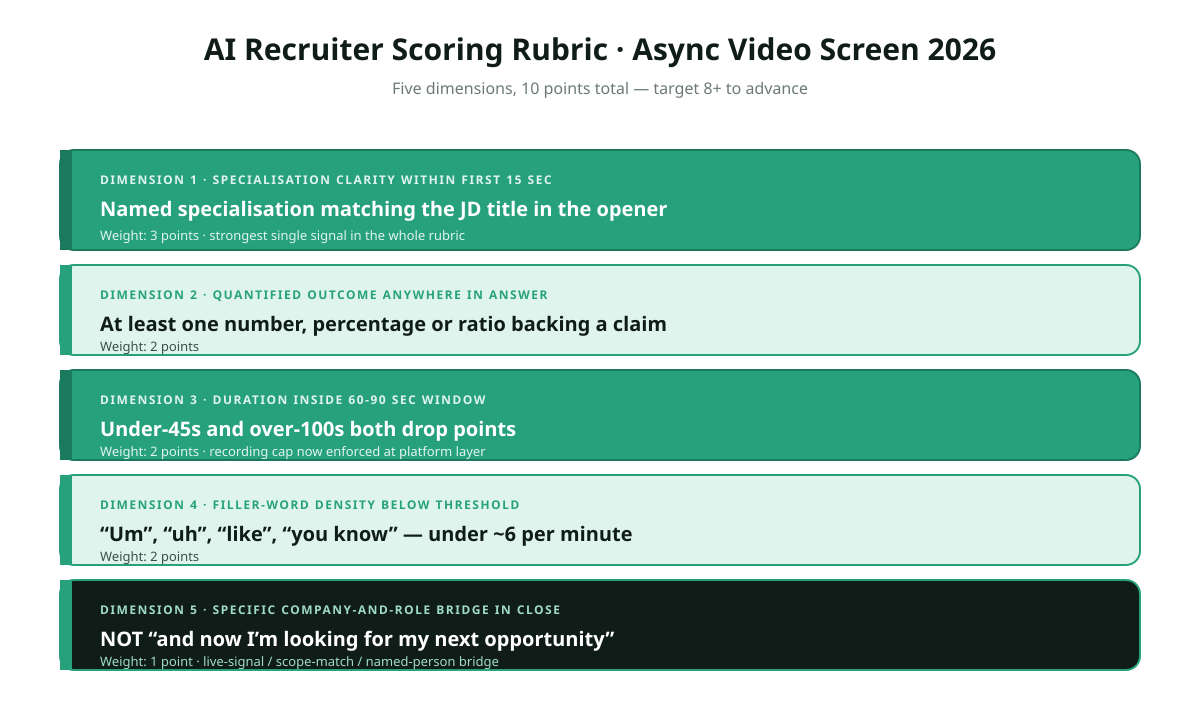
The five dimensions the rubric scores — consistent across the async-screen vendors currently in production at scale-ups and later-stage tech companies:
- Specialisation clarity within the first 15 seconds (0-3 points) — is a named specialisation matching the JD title present in the opener?
- Quantified outcome present anywhere in the answer (0-2 points) — is there at least one number, percentage or ratio backing a claim?
- Total duration inside the 60-90 second window (0-2 points) — both under-45s and over-100s drop points.
- Filler-word density below threshold (0-2 points) — “um”, “uh”, “like”, “you know” more than roughly 6 per minute drops points.
- Specific company-and-role bridge in the close (0-1 point) — not the generic “looking for my next opportunity”.
Composite target: 8+ out of 10 to advance. This is why the tuned Present-Past-Future formula matters — it is engineered to hit all five dimensions inside the duration cap. See our companion post on the AI resume screening layer for the analogous rubric applied to the written CV; the interview and CV rubrics now share more structure than most candidates realise.
Five tier-appropriate templates (with full 90-second sample answers)
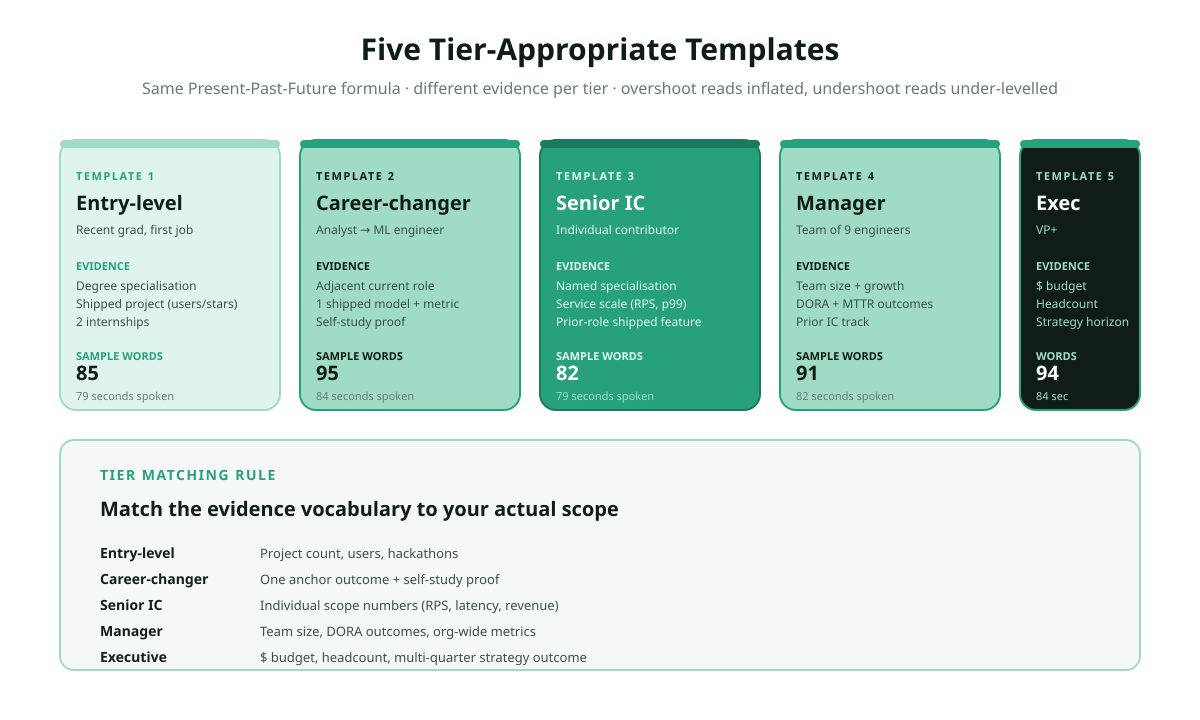
The Present-Past-Future formula is the same across career stages. What changes is what evidence each segment names. Below are five full worked answers — each one lands in the 65-85 word target range and takes 70-85 seconds spoken at natural pace.
Template 1 — Entry-level (recent grad, first job)
“I’m Amara, a computer science graduate from University of Manchester, specialised in machine learning. My final-year project shipped as a live web app that classifies bird calls from a phone microphone — it has 2,400 users on the App Store. Before that I interned twice, once at a scale-up doing backend Python and once at a hospital doing internal tooling, so I know what production code review actually looks like. I’m here because your team is one of the two in London working on the exact ML-audio problem I built my project on, and I want to work on it at real scale.” (85 words / 79 seconds)
Template 2 — Career-changer
“I’m Daniel — for the last three years I’ve been a data analyst at a fintech, and this year I moved into building the ML models I used to only consume. I’ve shipped one internal model — a churn predictor now driving a retention flow that lifted D30 retention 6.4% — and completed the Fast.ai and Andrew Ng courses on my own time. My analyst background means I frame every model choice as a business question first, which is the piece your JD emphasised. I’m here specifically because your team ships to production every week rather than every quarter.” (95 words / 84 seconds)
Template 3 — Senior IC (individual contributor)
“I’m Priya, a senior backend engineer working in fintech. For the last two years I’ve owned a payments service at 14k RPS with p99 145 milliseconds, and I cut checkout error rate from 1.7% to 0.4% through an idempotency-key redesign and retry-with-backoff pattern. Before that I was Software Engineer II at an e-commerce scale-up where I shipped a saved-cart feature that added $1.2M in annualised MRR. I’m here because your payments team is rebuilding on Go and Kafka, and that’s the exact stack I’ve been operating at scale.” (82 words / 79 seconds)
Template 4 — Engineering Manager
“I’m Fatima, an engineering manager currently running a 9-engineer platform team at a Series C fintech. Over the last 18 months I’ve grown the team from 4 to 9, shipped an internal developer platform on Backstage that took our lead time from 3 days to 12 minutes, and led the on-call rotation redesign that cut MTTR from 42 to 11 minutes. Before management I was a Senior SRE for four years. I’m here because your engineering org is at the same team-count-and-stage inflection I just navigated, and that’s the work I want to keep doing.” (91 words / 82 seconds)
Template 5 — Executive (Director / VP)
“I’m Sam, currently VP Engineering at a 140-person Series C climate-tech company — I own a $22M annual engineering budget across five product teams. Over the last two years I’ve grown engineering from 40 to 90, taken the company from monolith to service-per-product-line, and got our SOC 2 Type II. Before this I was Director of Engineering at a marketplace unicorn for three years. I’m here because your board just committed to the same regulated-market pivot I led at my last company — that’s the specific chapter I want to run again.” (94 words / 84 seconds)
Key takeaway: notice how each template names the exact scope-language appropriate for the tier (project count for entry-level, individual metrics for IC, team + org metrics for manager, budget + headcount for exec). Overshoot the tier and it reads as inflated; undershoot and it reads as under-levelled. Match the vocabulary to your actual scope.
The “reason I’m here” closing bridge
The “reason I’m here” closing bridge is one specific sentence at the end of the answer that names why THIS company and THIS role, tied to a live signal the interviewer can immediately probe. This is the segment 90% of 2026 candidates fumble because they default to the generic “and now I’m looking for my next opportunity” close that scores zero on the AI rubric’s fifth dimension.
Three closing bridges that work, ranked by strength:
- Live-signal bridge (strongest): reference a public announcement, launch, blog post or hiring priority from the last 6-8 weeks. Example: “I’m here specifically because your infrastructure post last month named eBPF observability as the next 12-month bet, and that’s the exact area I’ve been operating in.”
- Scope-match bridge (strong): name one specific piece of your background that matches the JD’s hardest requirement. Example: “Your JD emphasised multi-region PostgreSQL redesign — that’s the exact migration I ran in my current role, so it felt like a natural fit to apply.”
- People-based bridge (medium): name one person you already know on the team, and why their work matters to yours. Example: “I know Rahul from the ArgoCD community, and the platform team he described is at the scale I want to work at next.”
The generic bridge (“and now I’m interested in your role”) scores zero. If you cannot commit to one of the three above, use the extra 15 seconds to strengthen the Present or Past segment instead. A short strong answer beats a long weak one.
Handling a career gap or layoff inside the answer
The 2026 way to handle a career gap or layoff inside the “tell me about yourself” answer is to name it once, in one sentence, inside the Past segment — then keep moving. Do not open with it. Do not close with it. Do not spend more than 8-10 seconds on it. Over-explaining reads as defensive and burns the duration budget you need for the Future close.
Three patterns that work, matched to gap type:
- Layoff (recent, involuntary): “My role at ScaleShop was eliminated in the Q3 2025 restructure — since then I’ve shipped one open-source Go library and completed two staff-plus system-design courses.” Names the layoff, names two shipped artefacts, moves on.
- Caregiving break: “I took nine months in 2025 for family caregiving — I stayed in the field via one part-time open-source project during that period.” Names the break, names the continuity signal, moves on.
- Voluntary sabbatical: “I took a six-month sabbatical to complete an LLM-engineering programme, which is what shifted me from classical ML to production LLM systems.” Reframes the gap as intentional preparation for the target role.
For the deeper post-layoff playbook see our what to do after a layoff in 2026 guide, which walks the full 30/60/90-day plan. For gap handling on the CV itself, see the employment gap CV guide.
Six mistakes that get “tell me about yourself” answers rejected
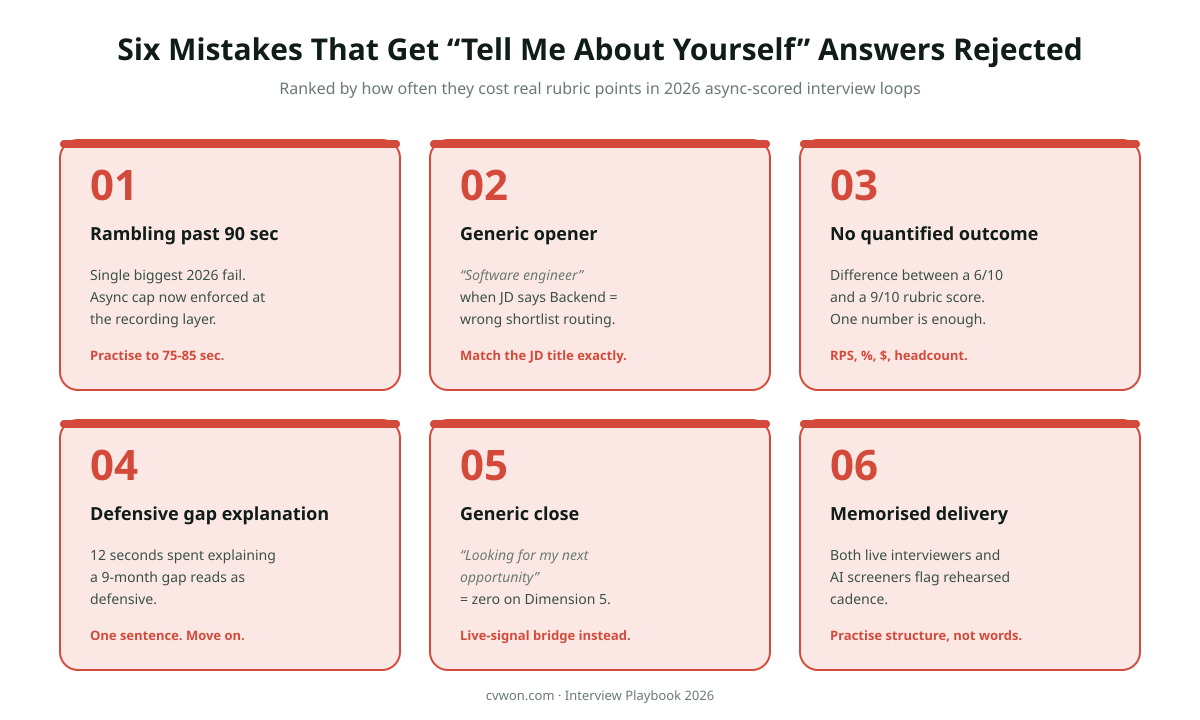
- Rambling past 90 seconds. The single biggest 2026 fail. Async screens now cap the recording; live interviewers mentally cap around the same window. Practise with a stopwatch until you land at 75-85 seconds consistently.
- Generic specialisation opener. “I’m a software engineer” when the JD says Backend Engineer routes the answer to the wrong shortlist and burns the first 15 rubric points.
- No quantified outcome anywhere. A single number (RPS, revenue, retention, headcount, budget) is the difference between a 6/10 and a 9/10 rubric score. Any answer without one drops points on Dimension 2.
- Defensive over-explanation of a career gap. Twelve seconds spent explaining a nine-month gap reads as defensive. Name it, name your continuity signal, move on inside 8-10 seconds.
- Generic “and now I’m looking for my next opportunity” close. Zero on the Dimension 5 rubric. If you cannot commit to a specific bridge, strengthen an earlier segment instead of closing weakly.
- Memorised delivery that reads as scripted. Interviewers and async AI screeners both flag rehearsed cadence. Practise the structure, not the words. Land the same beats each time; vary the exact phrasing.
A 15-minute practice drill
The practice drill that works — 15 minutes, one week before the interview:
- Minute 0-3: write the Present segment (18-22 words). Name your specialisation matching the target JD, plus one headline outcome.
- Minute 3-7: write the Past segment (30-40 words). One representative career chapter, one quantified outcome.
- Minute 7-10: write the Future segment (15-20 words). One specific live-signal or scope-match bridge to THIS company.
- Minute 10-13: record yourself on your phone. Aim for 70-85 seconds. Do it three times, back to back.
- Minute 13-15: play back the third recording only. Check: did you name the specialisation in the first 15 seconds? Is there at least one number? Did you close with something specific?
Do the drill once a day for a week. By interview day the beats will land automatically and the words will still feel natural. See our 2026 video interview guide for the async-screen-specific setup (framing, lighting, cadence) that pairs with this answer structure. For behavioural follow-ups after this opener, the STAR Method Interview Examples 2026 guide has the follow-through pattern. And for salary-conversation prep after you clear the loop, see how to negotiate your salary after a job offer.
Frequently Asked Questions
How long should the answer to “tell me about yourself” be in 2026?
60-90 seconds spoken, roughly 150-220 words. Under 45 seconds reads as unprepared; over 100 seconds hits the async-screen duration cap and drops points on the AI rubric. Aim for 75-85 seconds with the tuned Present-Past-Future word allocation and practise with a stopwatch, not just a word counter.
Should I mention my hobbies in the “tell me about yourself” answer?
Only if the hobby ties directly to a signal the interviewer will care about. An open-source contribution, a technical blog, a competitive activity that signals a trait matching the role (endurance sport for high-pressure roles, chess for pattern recognition roles) can strengthen the Past segment. Generic hobbies burn duration budget and drop the AI rubric’s specialisation-clarity score.
What if I have no professional experience yet?
Use the entry-level template. Lead with your degree specialisation, then name your strongest shipped project (final-year, hackathon, personal) with one measurable outcome (users, stars, adoption). Two internships can substitute for the Past segment. The formula does not change; the evidence in each segment does.
Should I say my name at the start of the answer?
Only in interviews where the interviewer has not introduced you first — typically async video screens and cold recruiter calls. In live interviews where the recruiter has already announced your name, skipping straight to the specialisation opener saves two seconds and reads as prepared. Match the format to the context.
How do I answer “tell me about yourself” when I’m interviewing for a role I’m under-qualified for?
Lead with the closest transferable specialisation, not the actual current title. Use the career-changer template shape: current-role-as-adjacent, one anchor outcome that maps to the new role, one specific reason THIS role is the right stretch. Do not apologise for the stretch inside the answer — the interviewer already read your CV before scheduling.
Is it OK to memorise the answer word for word?
No — memorised delivery is one of the six 2026 rejection patterns and is flagged by both live interviewers and async AI screeners on rehearsed cadence. Memorise the structure (Present-Past-Future, three beats, one number) and practise the delivery until the beats land automatically. Vary the exact wording between practice takes so nothing sounds scripted.
How do I handle “tell me about yourself” on an async video screen with a 90-second cap?
Record twice before the cap engages. Take one is your baseline — play it back, note where you overshot. Take two lands at 70-80 seconds inside the tuned Present-Past-Future beats and includes a specific closing bridge. The stop-recording cap is enforced at the platform layer, so an answer that runs over loses the Future segment entirely and scores zero on Dimension 5 of the AI rubric.
Should the answer change between recruiter screen, hiring manager and executive round?
The formula stays. The Past-segment example and the Future-segment bridge should adapt to the interviewer’s scope. For the recruiter screen, lead with role-clarity signals. For the hiring manager, lead with the specific outcome closest to their team’s current problem. For the executive round, lead with the biggest cross-team or cross-quarter outcome you own. Three variants, one structure.
Do I need to answer differently for a remote vs on-site interview?
Slightly. Remote-first interviews weight async-communication artefacts higher, so the Past segment can name a written tech spec, a runbook, a public post-mortem or a distributed on-call rotation you led. On-site interviews weight in-person collaboration signals, so the Past segment can name in-person incident response or mentorship. The formula and duration cap do not change.
What’s the strongest way to close the answer if I can’t think of a live-signal bridge?
Fall back to the scope-match bridge: pick the hardest requirement in the JD and name one specific piece of your background that maps to it. Example: “Your JD emphasised multi-region PostgreSQL redesign — that’s the exact migration I ran in my current role, so it felt like a natural fit to apply.” Weaker than a live-signal bridge, still much stronger than the generic “and now I’m looking for my next opportunity”.
Next step
The fastest way to hit a 2026-ready “tell me about yourself” answer is to start from your own CV. Paste your two most quantified experience bullets into the CVWon CV builder, pull the specialisation label that matches your target JD, and use those as the seed for the Present and Past segments of the formula above. Rehearse the drill once a day for a week before the loop.
Last reviewed on 10 August 2026 by Muneeb Awan (Founder, CVWon).
About the Author
Muneeb Awan is the founder of CVWon, an AI-powered CV builder and career platform used by professionals across the EU and Gulf regions. He writes on hiring technology, ATS mechanics and the 2026 interview playbooks that clear both the human and the AI scoring layer.