Common Interview Questions and Answers (2026 Guide)
TL;DR
- Most interviews reuse the same 10–15 questions. "Tell me about yourself", "Why this role?", "What's your greatest weakness?" and "Where do you see yourself in five years?" appear in almost every interview, in every industry.
- Interviewers are testing three things: can you do the job (competence), will you fit the team (culture), and are you genuinely motivated (intent). Every answer should signal at least one.
- Use the STAR method for any "tell me about a time…" question — Situation, Task, Action, Result — and always finish with a measurable result.
- Preparation beats talent. Research the company, prepare 5–6 stories from your own experience, and rehearse out loud. Most weak answers come from no structure, not no ability.
- Always ask questions back. Having no questions for the interviewer is one of the fastest ways to look uninterested.
Common interview questions are the small set of questions that hiring managers ask in almost every job interview — regardless of role, industry or seniority. Learn the dozen that come up most often, understand what each one is really testing, and prepare a structured answer using your own real experience, and you will walk into any interview calmer, sharper and far more convincing than the average candidate. This guide gives you the exact questions, what interviewers are listening for, word-for-word answer frameworks, and a preparation plan you can run in a week.
What interviewers are really assessing
Before you memorise a single answer, understand the game you are playing. An interview is not a test of how much you know — it is a structured way for an employer to predict how you will behave once hired. Almost every question, however it is phrased, is probing one of three things:
- Competence — can you actually do the work? Questions about your experience, your skills and "a time when" stories test this.
- Culture and collaboration — will the team want to work with you? Questions about conflict, feedback, and how you handle pressure test this.
- Motivation and intent — do you want this job, or any job? "Why us?" and "Why this role?" test whether you will stay and care.
First impressions form fast. Research on social perception shows people form judgements about trustworthiness and competence within the first seconds of meeting someone, and interviewers are no different — much of the early conversation is about confirming a gut read. That is why structure, warmth and a clear opening answer matter so much: you are setting the frame the rest of the interview is judged against. Your CV got you in the room; the interview is where the employer decides whether the person matches the paper.
The candidates who win are rarely the ones with the most impressive background. They are the ones who answer clearly, back claims with specifics, and make it easy for the interviewer to imagine them in the role.
The STAR method: your answer framework
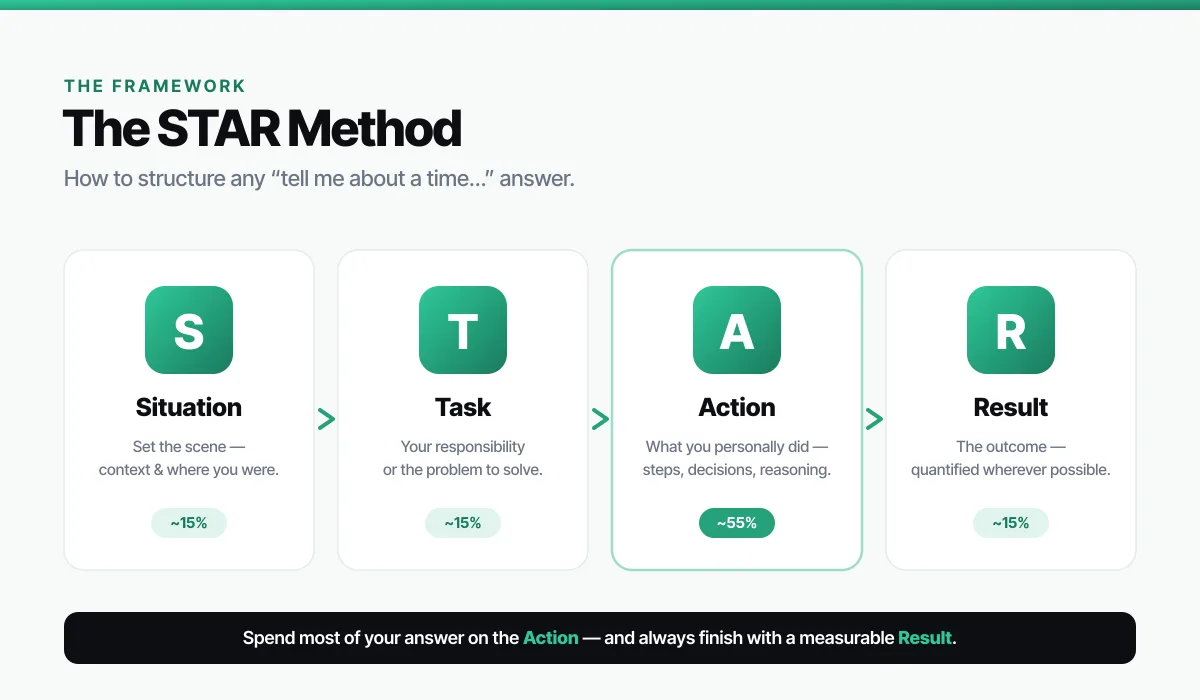
The STAR method is a four-part structure for answering behavioural questions: Situation, Task, Action, Result. It is the single most useful tool in interview preparation because it turns a vague "tell me about a time…" prompt into a tight, evidence-backed story. Whenever a question starts with "Tell me about a time", "Give me an example", or "Describe a situation", reach for STAR.
| Step | What to cover | Keep it to |
|---|---|---|
| S — Situation | Set the scene in one or two sentences. Where were you, what was the context? | ~15% |
| T — Task | What was your specific responsibility or the problem you had to solve? | ~15% |
| A — Action | What you did — the steps, decisions and reasoning. This is the heart of the answer. | ~55% |
| R — Result | The outcome, ideally with a number. What changed because of you? | ~15% |
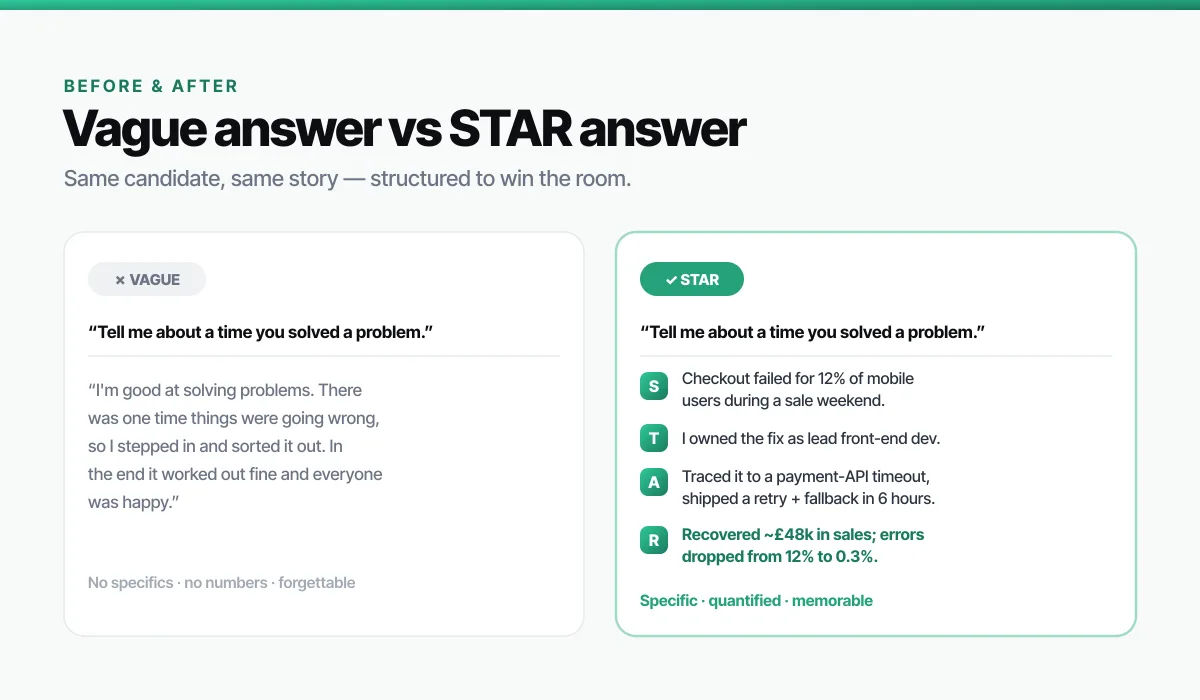
Two rules make STAR work. First, spend most of your words on Action — interviewers want to hear what you personally did, not what "the team" did. Second, always land a Result, and quantify it where you can: "cut processing time by 30%", "retained a client worth £40k a year", "trained four new starters". A story without a result sounds like an anecdote; a story with one sounds like proof. Prepare five or six STAR stories from your real experience and you can adapt them to almost any behavioural question.
The 12 most common interview questions (with answers)
These twelve questions, or close variants, appear in the overwhelming majority of interviews. For each one, here is what the interviewer is really asking and how to structure a strong answer.
1. "Tell me about yourself."
What they're really asking: give me a relevant, confident summary of who you are professionally — not your life story. This is almost always the opener, and it sets the tone.
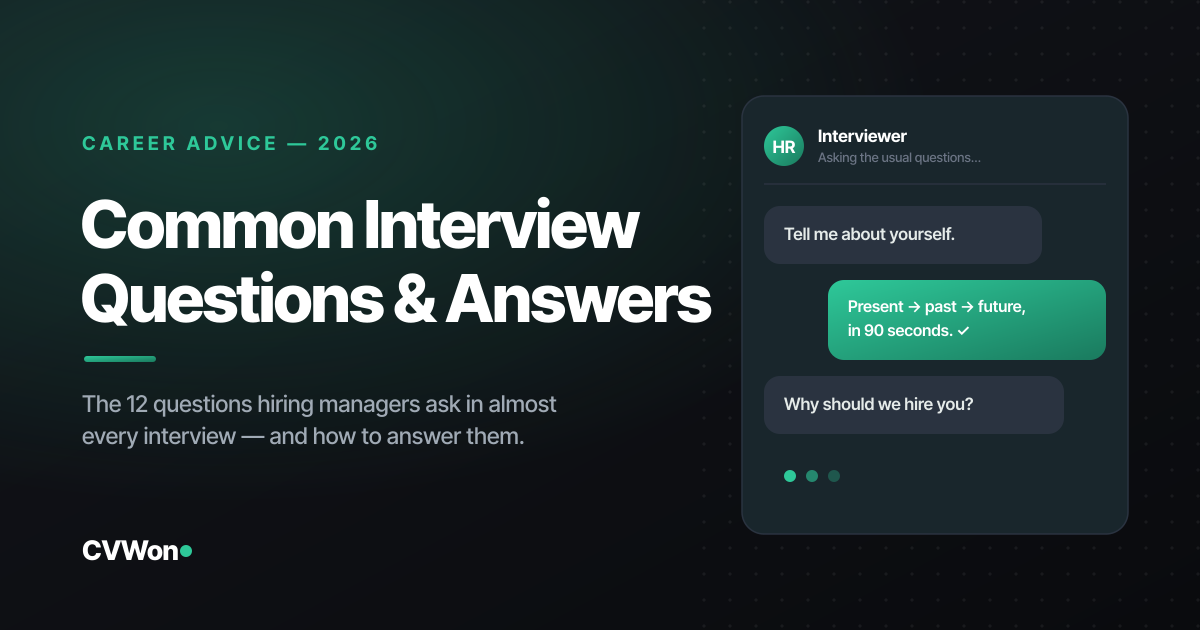
How to answer: use a simple present–past–future arc. Start with your current role and a headline strength, give one or two relevant past achievements, then connect to why this role is the logical next step. Keep it to 60–90 seconds.
Example opening: "I'm a logistics coordinator with five years in fast-moving retail supply chains. In my current role I manage a £2m inventory across three warehouses and cut stockouts by 22% last year by rebuilding the reorder system. I'm now looking to bring that operational eye to a larger network — which is exactly why this role caught my attention."
2. "Why do you want to work here?"
What they're really asking: have you done your homework, and is this a considered choice rather than a mass application? This is where research pays off.
How to answer: connect something specific about the company — a product, a value, a recent project, a growth direction — to your own goals. Avoid generic praise ("you're a great company"). Show you understand what they do and why it fits you.
3. "Why should we hire you?" / "Why are you the best fit?"
What they're really asking: can you summarise your value proposition and match it to their needs? Treat this as your closing argument.
How to answer: pick the two or three requirements most central to the role and give a one-line proof point for each. The structure is "You need X. I've done X — here's the evidence." Confidence without arrogance wins here.
4. "What is your greatest strength?"
What they're really asking: do you know what you're good at, and is it relevant to this job? Choose a strength the role actually needs.
How to answer: name one strength, then back it with a short example and a result. "My strength is turning messy data into decisions — last quarter I built a dashboard that helped the sales team reprioritise and lift conversion by 15%." One proven strength beats a list of unproven ones.
5. "What is your greatest weakness?"
What they're really asking: are you self-aware, and do you act on feedback? They are not trying to catch you — they want honesty plus growth.
How to answer: name a real but non-disqualifying weakness, then show the system you've built to manage it. Avoid the clichéd "I'm a perfectionist". Try: "I used to hold onto tasks too long instead of delegating. I now run a weekly plan that forces me to assign work early, and my team's output has improved because of it." The fix is the point.
6. "Where do you see yourself in five years?"
What they're really asking: will you stay, and is your ambition compatible with what this role can offer? They want to invest in someone who has a direction.
How to answer: show ambition that fits the company. Talk about the skills and responsibility you want to grow into, not a specific title elsewhere. Make it clear the role is a genuine step on your path.
7. "Why are you leaving your current job?" / "Why the gap?"
What they're really asking: is there a problem I should know about, and how do you talk about difficult situations? Stay positive and forward-looking.
How to answer: frame it around growth, not grievance. Never badmouth a previous employer. For a career gap, be brief and honest — caring responsibilities, study, redundancy, health — then pivot to what you did to stay sharp and why you're ready now.
8. "Tell me about a time you faced a conflict at work."
What they're really asking: how do you handle friction with colleagues? Use STAR and emphasise the resolution.
How to answer: choose a real disagreement that ended constructively. Focus on how you listened, found common ground and reached an outcome — not on who was "right". The result should show a preserved relationship or a better decision.
9. "Tell me about a time you failed."
What they're really asking: can you own mistakes and learn from them? Avoiding the question or claiming you've never failed is the worst answer.
How to answer: pick a genuine failure that wasn't catastrophic, take clear ownership, and spend most of the answer on what you changed afterwards. Resilience and learning are what they're scoring.
10. "How do you handle pressure or tight deadlines?"
What they're really asking: will you stay effective when things get hard? Give a concrete method plus an example.
How to answer: describe your actual system — prioritising, communicating early, breaking work down — then a STAR example of a time it worked under real pressure.
11. "What are your salary expectations?"
What they're really asking: are we in the same range, and do you know your market value? Preparation here protects your offer.
How to answer: research the market rate for the role and location first. Give a researched range rather than a single number, and where possible let them anchor first: "Based on my research for this kind of role, I'd expect somewhere in the range of X to Y, but I'm open to discussing the full package." Never undersell on the spot.
12. "Do you have any questions for us?"
What they're really asking: are you genuinely interested and thinking like someone in the role? "No, I think you covered everything" is a missed opportunity. We cover exactly what to ask below.
Want these tailored to your exact profession? Our role-specific interview pages list the questions hiring managers actually ask for hundreds of jobs — for example accountant interview questions, registered nurse interview questions, and account executive interview questions.
Behavioural and situational questions
Behavioural questions ask what you did in the past ("Tell me about a time…"); situational questions ask what you would do in a hypothetical ("What would you do if…"). Both are predictors — employers believe past behaviour and considered judgement forecast future performance better than opinions about yourself.
| Question type | Sounds like | Best approach |
|---|---|---|
| Behavioural | "Describe a time you led a project." | STAR, real story, quantified result |
| Situational | "What would you do if a client was unhappy?" | Walk through your reasoning step by step |
| Competency | "How do you prioritise competing deadlines?" | State your method, then give a quick example |
| Technical / role | "How would you approach X in our tools?" | Think aloud; show process over a perfect answer |
The most common behavioural themes are leadership, conflict, failure, working under pressure, dealing with change, and going above and beyond. Prepare one strong STAR story for each theme and you will have an answer ready for almost anything. The same stories that prove your value in an interview also belong on your CV — if yours is thin on measurable results, our guide to writing a CV with AI shows how to turn duties into achievements.
Questions you should ask the interviewer
When the interviewer turns it around with "Do you have any questions?", treat it as part of the assessment — because it is. Good questions signal that you are evaluating the role as seriously as they are evaluating you. Avoid anything you could have answered with a quick search, and avoid leading with pay and holidays. Strong options include:
- "What does success look like in this role in the first 90 days?"
- "What are the biggest challenges the person in this role will face?"
- "How would you describe the team and the way it works together?"
- "What are the opportunities to grow and develop here?"
- "What are the next steps in the process, and when can I expect to hear back?"
Asking about the first 90 days is particularly powerful — it makes the interviewer picture you already in the job, which is exactly the mental image you want to leave them with.
How to prepare: a 7-day plan
The best interview preparation is specific, written down and rehearsed out loud. Reading answers in your head feels productive but rarely survives the pressure of the room. Here is a realistic week-long plan you can compress into two or three days if you have to.
- Day 1 — Research. Study the company: products, recent news, values, competitors. Re-read the job description and highlight the must-have requirements. Run the listing through a tool like our job description analyser to surface the exact skills and keywords they care about.
- Day 2 — Match. For each key requirement, write down one piece of evidence from your experience. This becomes your "Why should we hire you?" backbone.
- Day 3 — Build STAR stories. Write five or six stories covering leadership, conflict, failure, pressure and a proud achievement. Quantify every result.
- Day 4 — Draft core answers. Write your "Tell me about yourself", "Why this role?" and "greatest weakness" answers. Keep them short; bullet points, not scripts.
- Day 5 — Rehearse out loud. Say your answers to a friend, a mirror or your phone camera. Time them. Cut anything over 90 seconds.
- Day 6 — Prepare logistics and questions. Plan your route or test your video setup, choose your outfit, print your CV, and finalise your questions for the interviewer.
- Day 7 — Light review and rest. Skim your notes, get a good night's sleep, and arrive (or log on) early.
One non-obvious tip: bring a printed copy of your CV and re-read it the night before. Interviewers ask about what is on the page, and you should never be surprised by your own document. If you are still refining it, check it against the systems that screen it first with our free ATS score checker, and tighten your summary using these personal statement examples.
Virtual, video and AI interviews in 2026
A large share of first-round interviews now happen on video, and a growing number include some form of automation — one-way recorded interviews, AI-assisted scheduling, and screening tools that analyse responses. The fundamentals do not change, but a few things matter more:
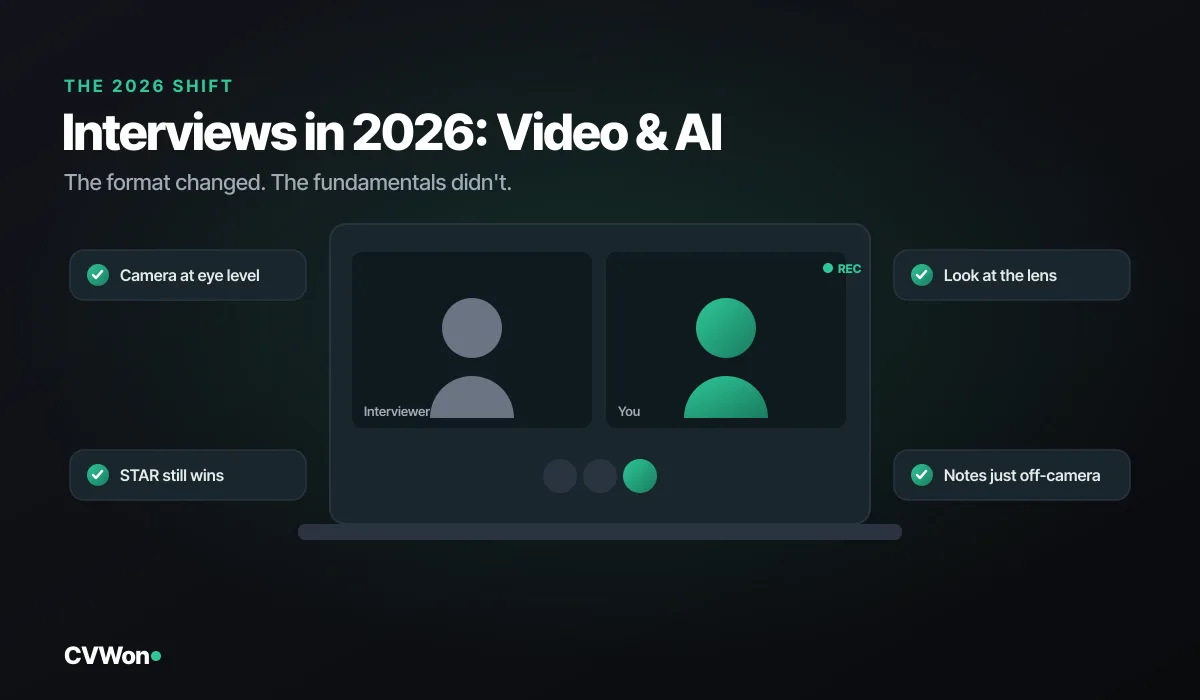
- Test your setup. Camera at eye level, a clean and well-lit background, headphones, and a stable connection. Technical fumbling reads as disorganisation.
- Look at the camera, not the screen. It feels unnatural, but it is how you make "eye contact" on video.
- For one-way (recorded) interviews, treat the green light like a person. Structure answers with STAR, smile, and don't rush — you usually get a moment to think before recording.
- Keep notes just off-camera. A few bullet points for your key stories and questions are fine on video; reading a full script is obvious and is not.
AI is now on both sides of the table: employers use it to screen, and candidates use it to prepare. Using AI to rehearse answers, research a company, or sharpen your CV is smart. Using it to invent experience is not — the truth surfaces fast in a live conversation. The same principle that governs writing a CV with AI applies to interviews: let the tools polish what is real, never fabricate.
Mistakes that cost people the offer
Most rejections after a competent interview come down to a short list of avoidable errors:
- No structure. Rambling answers with no STAR backbone lose the interviewer halfway through.
- No specifics. Claims without examples or numbers sound rehearsed and hollow.
- Badmouthing a past employer. It signals you'll do the same to them.
- No research. Not knowing what the company does is an instant red flag.
- No questions at the end. Reads as low interest.
- Talking too long. Monologues over two minutes bury your best points.
- No follow-up. A short, specific thank-you email within 24 hours keeps you top of mind and is still skipped by most candidates.
Notice that none of these are about talent. They are about preparation and self-awareness — which is exactly why this guide is worth a week of your time.
Interview success by the numbers
A few figures worth keeping in mind as you prepare:
| What the research suggests | Why it matters for you |
|---|---|
| First impressions form within seconds of meeting | Your opening answer and demeanour set the frame — rehearse the first 90 seconds hardest |
| Behavioural questions appear in most structured interviews | Prepared STAR stories cover the majority of what you'll be asked |
| A minority of candidates send a follow-up thank-you | Sending one is a cheap, easy way to stand out |
| Most interviewers ask the same core questions | Preparation has an unusually high return — you can predict 80% of the interview |
The headline takeaway: interviews are far more predictable than they feel. The questions repeat, the frameworks are known, and the people who prepare specifically — not generically — win disproportionately.
Frequently asked questions
What are the most common interview questions?
The most common are "Tell me about yourself", "Why do you want to work here?", "Why should we hire you?", "What are your greatest strengths and weaknesses?", "Where do you see yourself in five years?", "Why are you leaving your current job?", and "Do you have any questions for us?" Behavioural prompts such as "Tell me about a time you faced a conflict" are also near-universal.
How do I answer "Tell me about yourself"?
Use a present–past–future structure. Start with your current role and a headline strength, mention one or two relevant past achievements, then connect to why this job is your logical next step. Keep it to 60–90 seconds and focus only on what's relevant to the role — not your personal life history.
What is the STAR method?
STAR stands for Situation, Task, Action and Result. It is a four-part structure for answering behavioural questions: set the scene briefly, state your specific task, describe in detail the actions you took, and finish with a measurable result. Spend most of your answer on the Action, and always end with an outcome.
What is the best answer to "What is your greatest weakness?"
Name a real but non-disqualifying weakness and show how you actively manage it. Avoid clichés like "I'm a perfectionist." The point of the question is self-awareness and growth, so the system or habit you've built to improve matters more than the weakness itself.
How long should interview answers be?
Most answers should run 60 to 90 seconds. "Tell me about yourself" can reach 90 seconds; behavioural STAR answers usually take one to two minutes. Anything over two minutes risks burying your best points and losing the interviewer's attention.
How should I answer "What are your salary expectations?"
Research the market rate for the role and location before the interview. Give a researched range rather than a single figure, and where possible let the employer name a number first. You can say you're flexible and interested in the full package, but never undersell yourself on the spot without preparation.
What questions should I ask the interviewer?
Ask about what success looks like in the first 90 days, the biggest challenges of the role, how the team works, opportunities to grow, and the next steps in the process. Avoid questions you could answer with a quick search, and don't lead with pay and holidays.
How do I prepare for an interview in a few days?
Research the company and re-read the job description, write one piece of evidence for each key requirement, prepare five or six STAR stories, draft your core answers, and rehearse them out loud and timed. Even two focused days of this beats a week of passive reading.
How do I handle a video or one-way recorded interview?
Test your camera, lighting and connection in advance, position the camera at eye level, and look at the lens rather than the screen. For recorded interviews, structure each answer with STAR, smile, and use a few bullet-point notes just off-camera — but never read a full script.
Should I send a thank-you email after an interview?
Yes. A short, specific thank-you email within 24 hours reinforces your interest, lets you add anything you forgot, and keeps you top of mind. Most candidates skip it, so it's an easy way to stand out.
How do I answer "Why should we hire you?" without sounding arrogant?
Match yourself to their needs with evidence. Pick the two or three most important requirements of the role and give one concrete proof point for each. Framing it as "you need X, here's where I've delivered X" is confident without being boastful.
What are behavioural interview questions?
Behavioural questions ask how you acted in real past situations — "Tell me about a time you…" — on the principle that past behaviour predicts future performance. Answer them with the STAR method, using genuine examples and quantified results.
How important is my CV once I've got the interview?
Very. Interviewers question you directly on what's written on it, so you must know your own CV cold and be able to expand any line into a STAR story. A clear, achievement-focused CV also frames the conversation in your favour — which is why it's worth getting both the document and your answers right.
Related guides: Tell Me About Yourself Answer: 5 Templates, How to Ask for a Raise in: Scripts, Timing & Data, and STAR Method Interview Examples: Answers That Land.
Next steps
Interviews reward preparation more than almost any other stage of the job hunt, because the questions are predictable and most candidates still wing it. Learn the dozen common questions, build your STAR stories from real experience, research the company, rehearse out loud, and always come with questions of your own. Do that, and you'll be in the small minority who walk in ready.
It all starts with a CV strong enough to win the interview in the first place. Build yours with CVWon's AI CV builder — it writes from your real experience, keeps the format ATS-safe, and scores it before you apply. Already have a CV? Run it through our free ATS score checker, tailor it to the role with our job description analyser, and read our guide to beating ATS systems in 2026 so you clear the screening and land more interviews to practise these answers on.
About the Author
Muneeb Awan is the founder of CVWon, an AI-powered CV builder and ATS-optimisation platform used by job seekers worldwide.