How to Write a CV with AI Without Getting Rejected
TL;DR
- You can write a great CV with AI — but only if you treat AI as an editor of your real experience, not a ghostwriter that invents it.
- 62% of hiring managers reject AI-generated CVs that lack personalization. The trigger is generic, not AI itself.
- The method that works is section by section: feed AI your real facts plus the job description, and rewrite one part at a time.
- Keep it ATS-friendly — single column, standard headings, no graphics — and strip robotic "AI-tells" so it sounds like you.
- Never let AI fabricate experience; recruiters reject lies far faster than they reject AI.
Writing a CV with AI means using a tool like ChatGPT, Claude, or a dedicated builder to draft and refine your CV from your own real experience. Done well, AI sharpens your wording, mirrors a job description's keywords, and saves hours. Done badly — a one-click "write my resume" — it produces the generic output that 62% of recruiters now reject. The difference is method, and this guide gives you the exact one.
Can you write a CV with AI?
Yes — writing a CV with AI is both possible and now common. About 29% of job seekers already use AI to create or improve their CV, up from single digits 18 months ago. The technology is good at the things people find hardest: phrasing achievements crisply, matching keywords, and fixing structure.
What AI cannot do is know your career. It does not know the deal you closed, the system you migrated, or the team you led. That is why the winning approach pairs AI's language skill with your real facts. The same fundamentals from our guide to writing a CV still apply — AI just helps you execute them faster.
Which AI tools work best
Three categories of tool can write a CV, and they suit different needs. General chatbots like ChatGPT and Claude are flexible and free to start, but they leave formatting and ATS-safety entirely to you. Dedicated AI CV builders combine the writing help with a parseable layout and a score, so the format never breaks. AI inside word processors (such as built-in writing assistants) is convenient for quick edits but weakest on job-specific tailoring. For most applicants, a chatbot for drafting plus a builder for formatting and the final ATS check is the strongest combination — you get flexible wording and a file that actually parses.
Why generic AI CVs get rejected
A generic AI CV is one produced by a single lazy prompt with no personal input — and it is the version recruiters reject. The problem is not the tool; it is the absence of you.
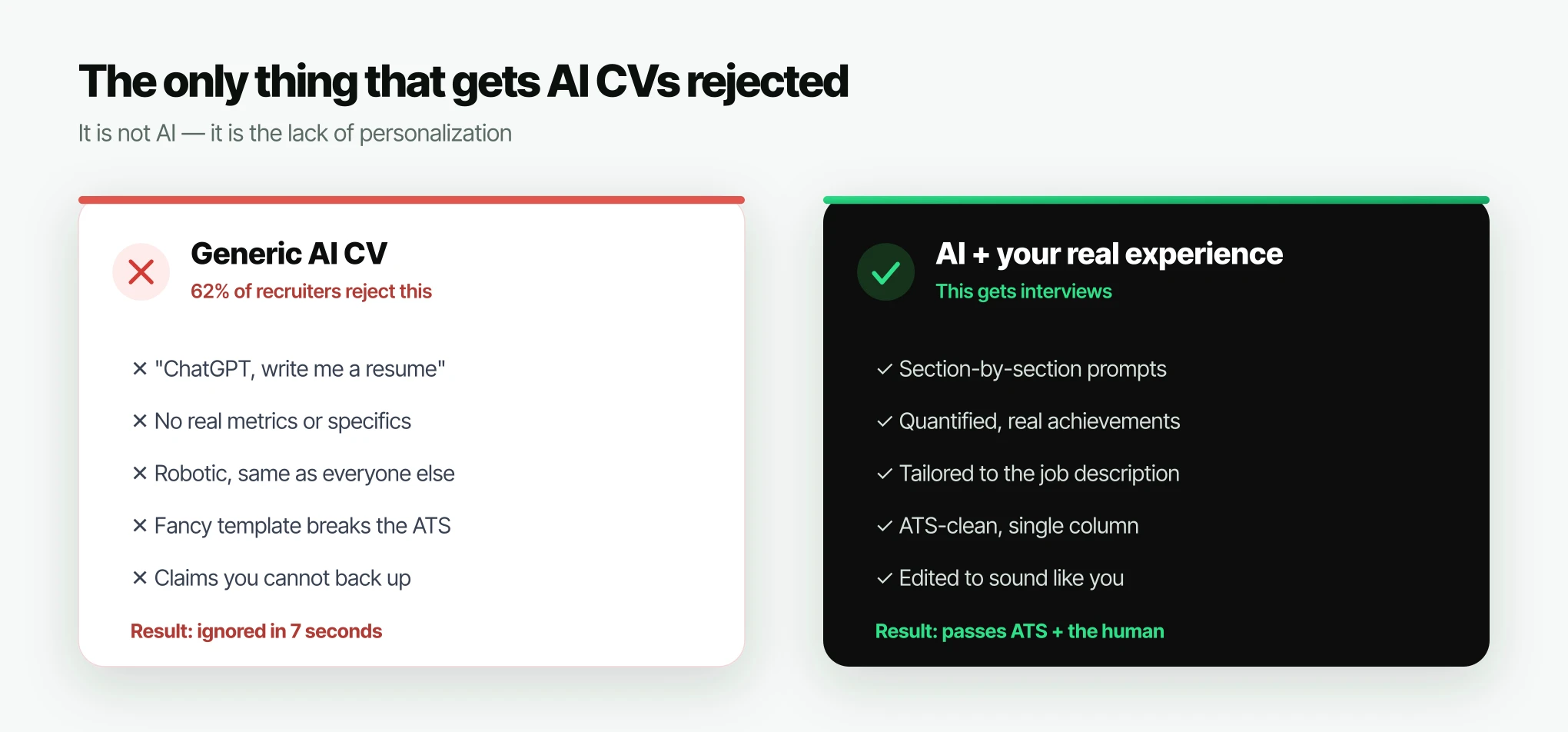
The data is blunt. A Resume Now survey found 62% of hiring managers reject AI-generated CVs that are not personalized. Recruiters spend roughly seven seconds on a first scan, and response rates have fallen threefold since 2021 as application volumes exploded. When every third CV reads the same, sameness is the kiss of death.
Recruiters are not afraid of AI. They are afraid of generic — and of lies. Personalize with real detail and the tool becomes invisible.
The section-by-section method
The section-by-section method is the reliable way to write a CV with AI: instead of one giant prompt, you rewrite each part with a focused, single-task prompt fed by your real experience. It keeps the output specific and ATS-aligned.
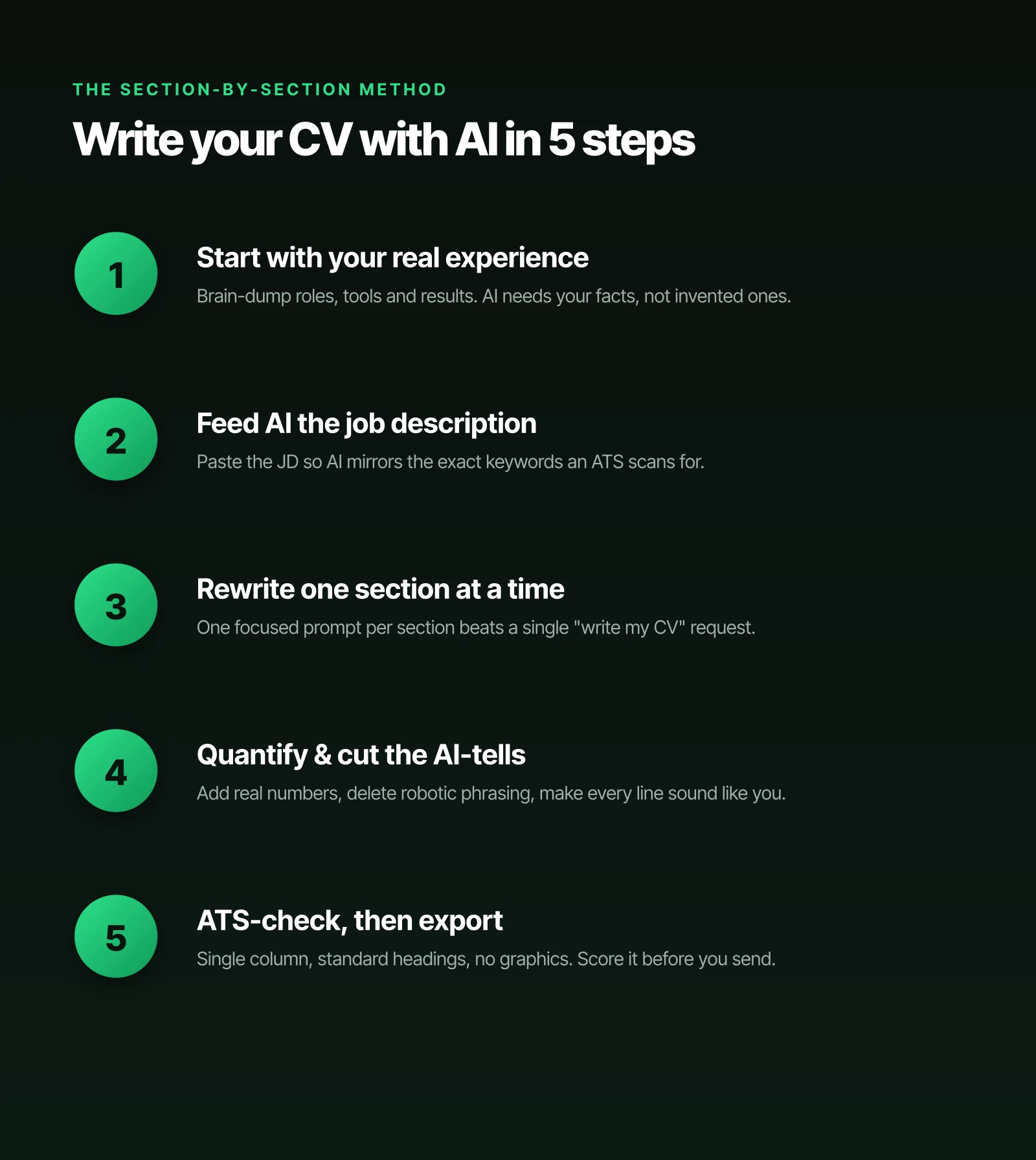
- Start with your real experience. Brain-dump your roles, tools, projects, and measurable results into a plain document. AI needs your facts, not invented ones.
- Feed AI the job description. Paste the full JD and ask AI to extract the keywords an applicant tracking system will scan for.
- Rewrite one section at a time. Do the summary, then experience, then skills — each as its own prompt. One task per prompt beats "write my whole CV".
- Quantify and cut the AI-tells. Add real numbers, then delete robotic phrasing so every line sounds like a person, not a model.
- ATS-check, then export. Confirm a single-column layout with standard headings, score it, and only then send.
AI prompts that actually work
A good CV prompt gives the model three things: your real material, the target job, and one specific task. Vague prompts produce vague CVs. Use the table below as a template for each section.
| CV section | Ask AI to… | You must… |
|---|---|---|
| Professional summary | Draft 3 versions from your facts + the JD | Pick one and edit it to your voice |
| Experience bullets | Rewrite with strong verbs and metrics | Supply the real numbers and outcomes |
| Skills | Match your skills to the JD's keywords | Delete anything you can't defend in an interview |
| Personal statement | Tighten tone and remove clichés | Keep a specific, true detail — see our examples guide |
A reliable prompt looks like: "Here is my real experience [paste]. Here is the job description [paste]. Rewrite only my work-experience bullets using my facts, lead each with an action verb, include a metric where I provided one, and keep it to one line each." Specific in, specific out.
A before-and-after example
The gap between a generic AI bullet and a personalized one is easy to see. Here is the same job, written three ways.
Generic AI ("write me a resume"): "Results-driven professional who leveraged cutting-edge strategies to drive impactful outcomes and exceed expectations." It says nothing, and a recruiter has read it a hundred times this week.
Your raw note: "Ran paid ads for the online shop, sales went up a lot, spent about 12k a month." True, but flat and unquantified.
AI + your real facts: "Managed a €12K/month paid-ads budget that grew online-store revenue 38% in two quarters and cut cost-per-acquisition by 21%." Same truth, sharpened — strong verb, real numbers, no clichés.
AI did not invent a single number here. It restructured the facts you already had into the format a recruiter and an ATS both reward.
That is the whole game: you bring the substance, AI brings the polish. Apply the same pattern to every bullet, and follow the structure in our CV-writing guide for the sections around them.
Keep it ATS-friendly
An applicant tracking system (ATS) is software that parses your CV into fields before a human sees it. AI can write strong content and still fail the ATS if the format is wrong, so the two must work together.
Stick to the rules confirmed by Indeed's 2026 ATS guidance: use standard headings like "Work Experience", "Education", and "Skills"; keep a single-column layout; avoid images, charts, and text boxes; and never bury contact details in headers or footers. Ask AI explicitly for "an ATS-friendly, single-column CV with standard section headings". Then verify with our free ATS resume checker and the deeper tactics in how to beat ATS systems.
The most common AI-CV mistake is letting the tool add a "beautiful" multi-column template. It looks great to you and unreadable to the ATS.
How to remove AI-tells
An "AI-tell" is a phrase that signals machine-generated text. Recruiters now spot them instantly, so editing them out is essential. The fix is to read every line aloud and cut anything you would not actually say.
- Delete filler verbs and clichés: "spearheaded", "leveraged synergies", "results-driven professional".
- Replace vague claims with numbers: "improved performance" becomes "cut load time 40%".
- Vary sentence length — AI defaults to uniform, medium-length lines.
- Add one specific, human detail per role that only you would know.
- Match your own register — if you would not say "utilize", change it to "use".
This step is where a CV stops sounding generated and starts sounding like a candidate. It is also what separates your application from the 90% of low-effort submissions recruiters report seeing.
AI & CVs by the numbers
The 2026 data explains why method beats tool choice. AI use is mainstream, recruiters are saturated, and personalization is the deciding factor.
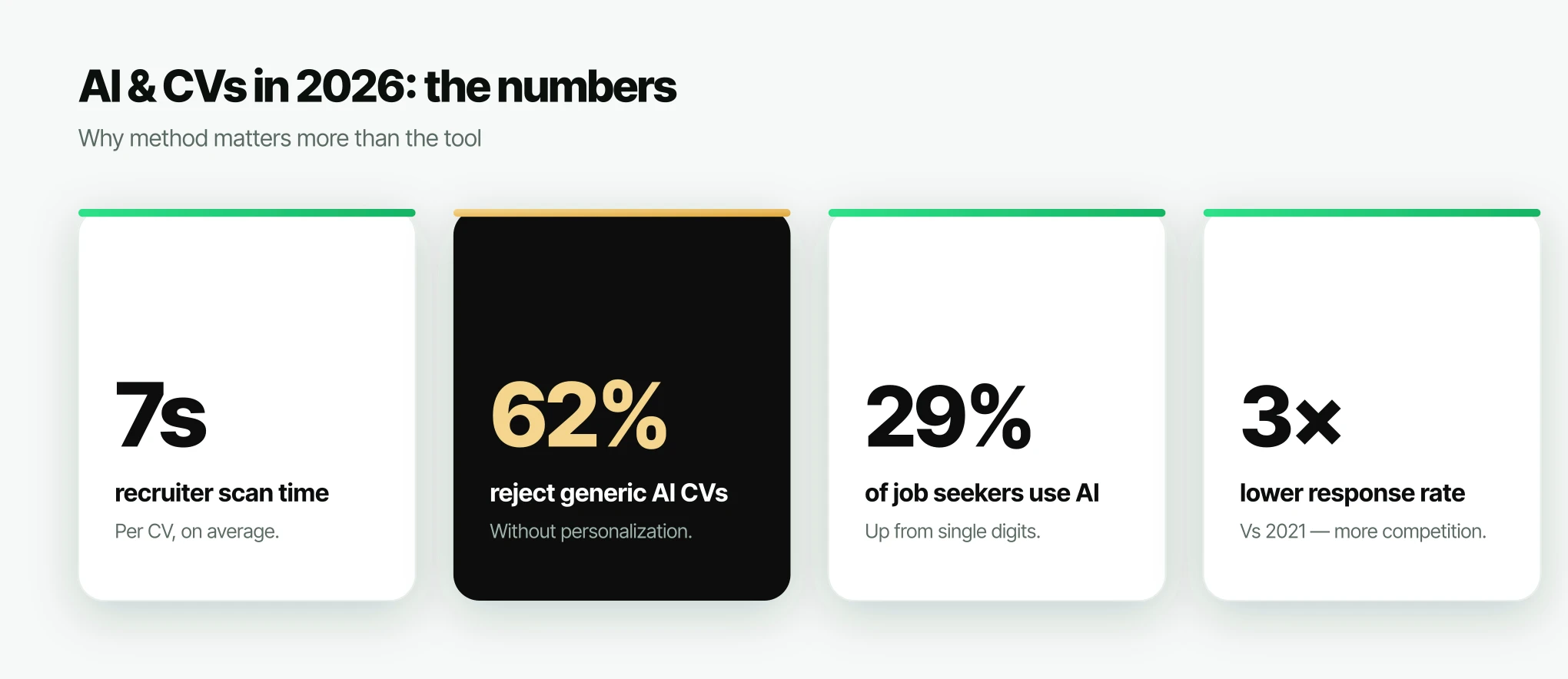
Hiring managers report that 55% of candidates use AI most often for CVs and cover letters, and 57% have seen a clear rise in AI-assisted submissions in the past year. With response rates down threefold since 2021 — a competitive squeeze visible in U.S. labor-market data — standing out is harder than ever. The candidates who win are not the ones who avoid AI; they are the ones who personalize it.
There is a useful way to read these numbers together. If 29% of applicants use AI and 62% of those generic attempts get rejected, then the personalized minority is competing against a huge pile of near-identical CVs. That is good news: the bar to stand out is mostly effort, not talent. A CV with real metrics, the right keywords, and a human voice now leaps over most of the field automatically — precisely because so many people are sending the generic version.
What AI should never do
AI should never invent experience, qualifications, or results. Fabrication is the fastest route to rejection — and to losing an offer when a reference check or interview exposes it. Recruiters consistently say they worry less about AI and more about lies.
Treat AI as a collaborator that presents your real qualifications more effectively, never as a way to manufacture credentials. Keep your CV truthful, keep the achievements yours, and use AI only to phrase them well. A polished lie still fails the interview that a modest truth would have passed. The same honesty rule applies to AI-written cover letters — see how to write a cover letter — and it is what protects your reputation long term.
Use AI across the whole application
Your CV is one document in a larger application, and the same AI method works across all of it. Consistency between your CV, cover letter, and LinkedIn profile is itself a signal of effort that recruiters reward.
Use AI to tailor a cover letter to each company — feeding it the role and one genuine reason you want it — rather than sending the same letter everywhere; our cover letter guide shows the structure. Use it to tighten your LinkedIn headline and summary so they mirror your CV's keywords. And re-run the section-by-section method for each application, because a CV tailored to the specific job description always beats a single master CV sent to everyone. If you are still deciding which format your market expects, settle that with our CV vs resume guide before you scale up.
One tailored application beats ten generic ones. AI makes tailoring fast enough that there is no excuse not to.
Do it faster with an AI CV builder
An AI CV builder is a purpose-built tool that combines AI writing with ATS-safe formatting, so you do not have to manage prompts and layout separately. Unlike a raw chatbot, a good builder structures your real experience, suggests wording, and exports a clean, parseable file in one place.
That is exactly what CVWon's AI CV builder does: it works from your real details, optimizes for ATS, and scores your CV before you send it. If you are unsure whether you even need a CV or a resume for your market, our CV vs resume guide clears it up first. The goal is the same as doing it by hand — only faster, and without the formatting traps that break AI-written CVs.
The other advantage is iteration. Because a builder scores your CV against ATS criteria instantly, you can see the effect of each edit and tighten weak sections before a recruiter ever opens the file. That feedback loop — draft, score, refine — is hard to replicate by copy-pasting between a chatbot and a word processor, and it is where most of the quality gain actually comes from.
Frequently asked questions
Can I write my CV with ChatGPT?
Yes, but not with a single "write my resume" prompt. Feed ChatGPT your real experience and the job description, then rewrite one section at a time. Edit the output for accuracy and tone before you send it.
Do recruiters reject AI-written CVs?
They reject generic ones. A 2026 Resume Now survey found 62% of hiring managers reject AI CVs that lack personalization. A CV built from your real, specific experience is rarely flagged as AI at all.
Can recruiters tell if a CV was written by AI?
Often, if it is generic or full of clichés. If you customize with your real job history, accomplishments, and voice, it is very hard to tell. The giveaway is robotic phrasing and a lack of specifics, not the use of AI itself.
Will an AI CV pass the ATS?
Only if it is formatted correctly. Ask AI for a single-column, standard-heading layout with no images or text boxes. Then run it through an ATS checker, because strong wording still fails if the structure is unparseable.
Is it cheating to use AI for my CV?
No, as long as everything in it is true. Using AI to phrase your real experience well is no different from using a thesaurus or a proofreader. Fabricating experience, however, is dishonest and risky.
What is the best AI prompt for a CV?
A focused, single-task prompt that includes your real material and the job description. For example: "Using my experience below and this job description, rewrite my work bullets with action verbs and the metrics I provided, ATS-friendly, one line each."
How do I make an AI CV sound human?
Read it aloud and cut anything you would not say. Remove clichés, vary sentence length, add specific numbers, and include one detail only you would know per role. That edit removes the AI-tells recruiters notice.
Should I use a chatbot or an AI CV builder?
A chatbot is flexible but leaves formatting to you, which is where AI CVs often break the ATS. A dedicated AI CV builder combines writing help with ATS-safe export and scoring, making it faster and safer for most people.
How long does it take to write a CV with AI?
With your experience prepared and the section-by-section method, about 30–60 minutes for a tailored CV. The preparation — gathering your real metrics and the job description — is what determines quality, not the typing.
Next steps
AI is the biggest shortcut in CV writing since the spellchecker — but only for people who feed it the truth and edit like a human. Prepare your real experience, work section by section, keep it ATS-clean, and strip the AI-tells.
Want to skip the prompt-juggling? Build your CV with CVWon's AI builder — it writes from your real experience, keeps the format ATS-safe, and scores it before you apply. Or check your current CV first with our free ATS score checker.
About the Author
Muneeb Awan is the founder of CVWon, an AI-powered CV builder and ATS-optimisation platform used by job seekers worldwide.