How to Write a Cover Letter in 2026: The Complete AI-Powered Guide with Free Generator
Here is a statistic that should change how you approach every job application: 83% of hiring managers read cover letters, and 45% read your cover letter before they even open your CV. Yet most candidates still treat the cover letter as an afterthought — a copy-pasted formality that adds nothing to their application.
The data is clear. Candidates who submit a tailored cover letter are 1.9 times more likely to land an interview. And 82% of hiring managers say a strong cover letter can convince them to interview an otherwise weak candidate. In a market where AI screening tools filter applications before human eyes see them, your cover letter is the one place where personality, context, and genuine motivation still matter.
This guide walks you through exactly how to write a cover letter that gets results in 2026 — and how to use CVwon's free AI cover letter generator to create one in under 60 seconds.
Do Employers Still Read Cover Letters in 2026?
Yes — and the data has never been stronger. According to a 2025 hiring manager survey by Resume Genius, 94% of hiring managers say cover letters influence their interview decisions. One in four considers them "very important."
The "cover letters are dead" narrative was always misleading. What died was the generic, copy-pasted cover letter. Personalised, well-structured cover letters are more effective than ever because they stand out in an ocean of identical AI-generated applications.
| Statistic | Data | Source |
|---|---|---|
| Hiring managers who read cover letters | 83% | Resume Genius 2025 |
| Read cover letters even when not required | 73% | Resume Genius 2025 |
| Read cover letter BEFORE the CV | 45% | Resume Genius 2025 |
| Say cover letters influence interview decisions | 94% | Resume Genius 2025 |
| Strong cover letter can save a weak candidate | 82% | Resume Genius 2025 |
| Interview likelihood increase with cover letter | 1.9x | Resume.io 2025 |
| Average time spent reading a cover letter | 60 seconds | Indeed / Glassdoor |
Pro Tip: Even when a job posting says "cover letter optional," treat it as required. 73% of hiring managers read optional cover letters — and the fact that most applicants skip them gives you an immediate advantage.
What Is the Best Cover Letter Format?
The best cover letter format in 2026 follows a clean, four-paragraph structure designed for both human readers and ATS systems. Here is the anatomy of a cover letter that works:
| Section | Purpose | Length |
|---|---|---|
| Header | Your name, contact details, date, employer address | 4-6 lines |
| Greeting | Address the hiring manager by name | 1 line |
| Opening paragraph | Hook with a relevant achievement + state the role | 2-3 sentences |
| Body paragraph | Match 2-3 of your skills/achievements to job requirements | 4-6 sentences |
| Company paragraph | Show genuine knowledge of the company + cultural fit | 2-3 sentences |
| Closing | Confident call to action + professional sign-off | 2 sentences |
Formatting Rules
- Font: Calibri, Arial, Helvetica, or Georgia — 11pt body, 12-14pt name
- Margins: 2.5 cm (1 inch) on all sides
- Spacing: Single or 1.15 line spacing, left-aligned
- Length: One page maximum — 250 to 400 words
- File format: PDF to preserve formatting across devices
If you need a matching CV to go with your cover letter, build your CV with CVwon's free AI builder to ensure both documents share consistent formatting.
How to Write a Cover Letter — Step by Step
Follow these six steps to write a cover letter that gets you interviews. Each step builds on the last — do not skip ahead.
Step 1 — Research the Role and Company
Before you write a single word, read the job description twice. Highlight every requirement, skill, and keyword. Then research the company: check their About page, recent news, product launches, and company values. You need at least one specific detail to reference in your letter.
Step 2 — Open with a Hook, Not a Cliché
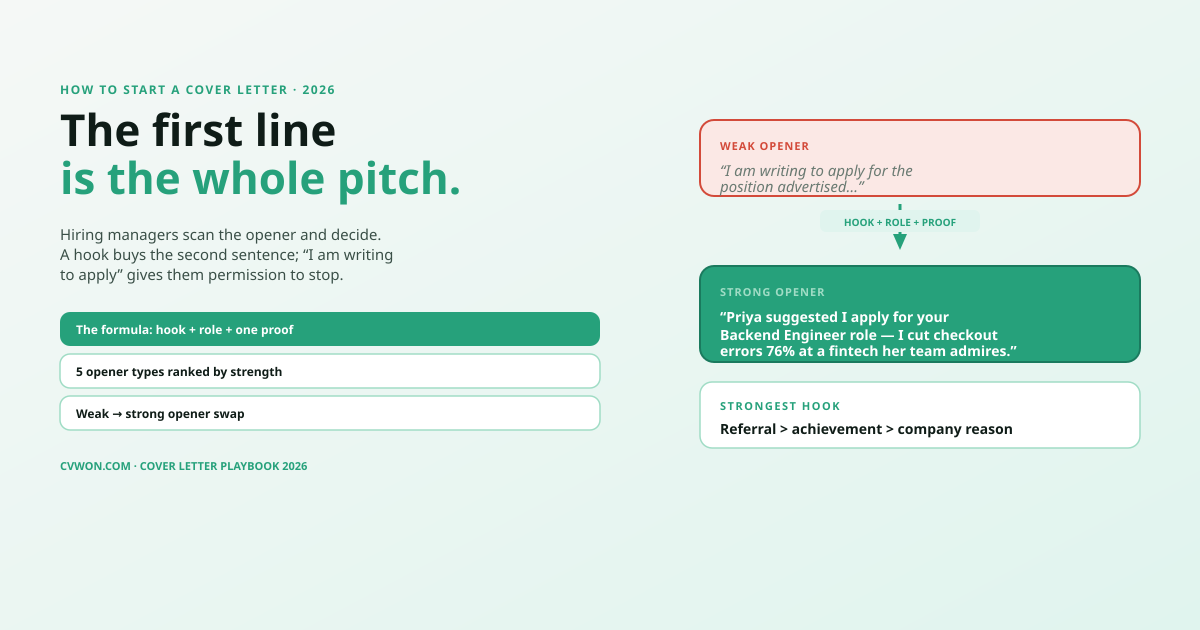
Your opening sentence determines whether the hiring manager keeps reading. Lead with a quantified achievement that is directly relevant to the role.
Weak opening:
"I am writing to express my interest in the Marketing Manager position at your company."
Strong opening:
"I grew organic traffic from 12,000 to 53,000 monthly visitors in 18 months at Fintech Ltd — and I want to bring that same data-driven approach to the Marketing Manager role at Google UK."
Pro Tip: Recruiters spend an average of 7 seconds on a first-pass scan. Your opening must pass the "so what?" test — if the reader could respond with "so what?" to your first sentence, rewrite it.
Step 3 — Match Your Skills to the Job Description
Your second paragraph is where you prove your fit. Pick two to three requirements from the job description and match them to specific achievements from your career. Use the same keywords the employer used — ATS systems scan cover letters too.
The job description says "cross-functional collaboration." Your cover letter should say "cross-functional collaboration" — not a paraphrase of it.
Step 4 — Show Real Company Knowledge
"I admire your innovative culture" is filler. A real company connection references something specific: a product launch, a sustainability initiative, a competitor challenge, an earnings call statement. This paragraph proves you did your homework and are not mass-applying.
Step 5 — Close with Confidence
Restate your core value proposition in one sentence, express enthusiasm for the opportunity, and include a clear call to action. Use "I look forward to discussing how my experience in [skill] can contribute to [Company]'s [goal]" — not "I hope to hear from you."
Step 6 — Proofread Ruthlessly
One spelling error can eliminate you. Read your letter backwards (sentence by sentence) to catch errors your brain auto-corrects. Check that you have the correct company name, hiring manager name, and job title. Then run it through CVwon's ATS checker to ensure keyword alignment.
How to Generate a Cover Letter with AI for Free
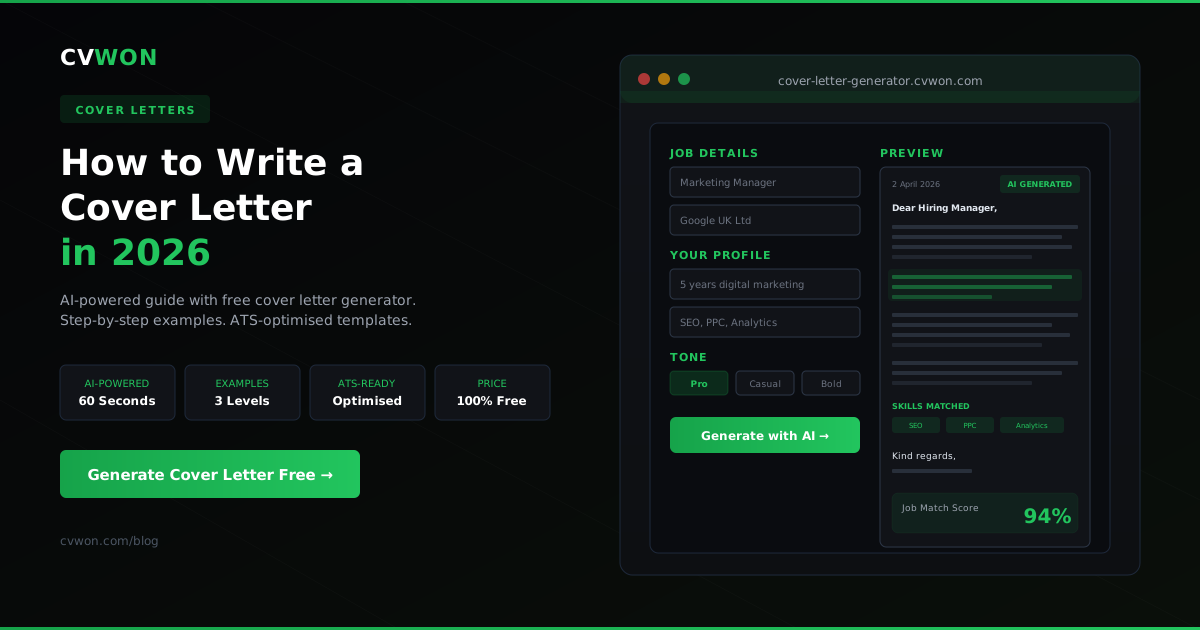
Writing a personalised cover letter for every application is time-consuming. CVwon's AI cover letter generator solves this by producing a tailored, ATS-optimised cover letter in under 60 seconds.
How It Works — 5 Steps
- Enter the job title and company name — the AI uses this to match tone and keywords
- Paste the job description (optional but recommended) — the AI extracts requirements and keywords
- Add your key qualifications — 2-3 bullet points about your most relevant experience
- Select your tone — Professional, Conversational, or Bold
- Generate and download — review the AI output, make personal edits, and download as PDF
| Feature | Manual Writing | CVwon AI Generator |
|---|---|---|
| Time per letter | 30-45 minutes | Under 60 seconds |
| ATS keyword matching | Manual (error-prone) | Automatic |
| Job description analysis | Manual | AI-powered |
| Consistency with CV format | Requires effort | Auto-matched |
| Cost | Free (but costly in time) | Free |
| Personalisation | High (if done well) | High (with your edits) |
Cover Letter Examples — Entry Level, Career Change, Senior
Below are three cover letter examples showing the exact structure and tone that works in 2026. Each example follows the four-paragraph formula.
Example 1 — Entry-Level Marketing Graduate
Before (generic):
Dear Sir/Madam,

I am writing to apply for the Marketing Assistant position. I recently
graduated from university with a degree in Business Studies. I am a hard
worker and a fast learner. I believe I would be a great fit for your team.

Thank you for your consideration.
After (CVwon-optimised):
Dear Ms Chen,

During my final-year dissertation at the University of Manchester, I planned
and executed a social media campaign for a local non-profit that increased
their Instagram following by 2,400 followers in eight weeks — with zero
budget. That experience taught me how data, creativity, and consistency
drive results, and it is exactly what I want to bring to the Marketing
Assistant role at Bloom & Wild.

My coursework in digital marketing and consumer behaviour gave me hands-on
experience with Google Analytics, Hootsuite, and A/B testing. I also managed
the university Marketing Society's LinkedIn page, growing engagement by 65%
in one semester. These skills align directly with your requirement for
someone who can support multi-channel campaigns.

I have followed Bloom & Wild since your "Care Wildly" rebrand in 2025 — the
shift to subscription-first messaging resonated with everything I studied
about retention marketing. I would be excited to contribute to a team that
treats marketing as a relationship, not a transaction.

I look forward to discussing how my university experience can support Bloom
& Wild's growth. I am available for an interview at your convenience.

Kind regards,
Sarah Mitchell
Example 2 — Career Changer (Teacher to UX Design)
Dear Mr Okafor,

After seven years of designing lesson plans for 30 unique learners every
semester, I realised I was already doing UX — just without the job title.
My transition from secondary school teaching to UX design is grounded in
2,000+ hours of user research (classroom observation), iterative design
(curriculum refinement), and accessibility-first thinking.

I completed the Google UX Design Certificate in 2025 and built three
portfolio projects, including a mobile app prototype for NHS appointment
booking that reduced task completion time by 40% in usability testing. My
teaching background gives me an edge most junior designers lack: the
ability to explain complex concepts simply and facilit ate stakeholder
workshops with confidence.

Wise's mission to make international banking "instant, convenient,
transparent, and eventually free" mirrors my own belief that good design
removes friction. Your recent expansion into business accounts tells me
the design challenges are only getting more interesting.

I would welcome the chance to discuss how my unique combination of
education expertise and UX skills can contribute to Wise's product team.

Kind regards,
James Adeyemi
Example 3 — Senior Software Engineer
Dear Dr Müller,

I led the migration of Monzo's core payments infrastructure from a
monolithic architecture to event-driven microservices — reducing P99
latency by 62% and saving £1.2M annually in compute costs. I am now
looking to apply that same technical leadership to the Principal Engineer
role at Stripe.

Over 12 years in fintech, I have architected systems processing 50M+
transactions daily, mentored teams of 15+ engineers, and driven adoption
of observability-first development practices. My expertise in Go,
Kubernetes, and distributed systems aligns directly with your
requirements. At Monzo, I also introduced a technical RFC process that
reduced architectural decision time by 35%.

Stripe's developer-first philosophy is what attracted me to the role. The
recent launch of Stripe Tax and the expansion of Stripe Connect tell me
you are building infrastructure that will define the next decade of online
commerce. I want to be part of that.

I look forward to discussing how my infrastructure experience can
contribute to Stripe's engineering excellence.

Kind regards,
Elena Vasquez
Pro Tip: Notice how each example leads with a specific, quantified achievement — not a generic statement about being "passionate" or "hard-working." Numbers build credibility. If you struggle to quantify your achievements, use CVwon's AI CV builder — it helps transform vague job descriptions into measurable impact statements.
What Should You Include in a Cover Letter?
Every effective cover letter includes these elements. Missing even one weakens your application.
| Element | Required? | Details |
|---|---|---|
| Your contact information | Yes | Full name, email, phone, LinkedIn URL, city |
| Employer details | Yes | Hiring manager name, company name, address |
| Date | Yes | The date you are submitting the application |
| Personalised greeting | Yes | "Dear [Name]" — never "To Whom It May Concern" |
| Opening hook with achievement | Yes | Quantified result relevant to the role |
| Skills matched to job description | Yes | 2-3 specific matches with keywords |
| Company-specific knowledge | Yes | Reference a product, initiative, or value |
| Call to action | Yes | "I look forward to discussing..." not "I hope..." |
| Professional sign-off | Yes | "Kind regards" (UK) or "Sincerely" (US) |
| Salary expectations | Only if asked | Provide a range, not a fixed number |
| Portfolio/website link | If relevant | For design, writing, development roles |
How Long Should a Cover Letter Be?
A cover letter should be 250 to 400 words — three to four paragraphs on a single page. This is not a suggestion; it is a rule. Exceeding one page signals poor communication skills and disrespect for the reader's time.
Hiring managers spend an average of 60 seconds reading a cover letter. At a normal reading speed (200-250 words per minute), 400 words is the maximum they will process in that window. Every word must earn its place.
| Length | Impact |
|---|---|
| Under 150 words | Too short — suggests low effort or interest |
| 250-400 words | Ideal — concise, impactful, respects the reader's time |
| 400-600 words | Too long — hiring managers lose focus after one page |
| 600+ words | Counterproductive — signals inability to communicate concisely |
Cover Letter vs Motivation Letter — What Is the Difference?
A cover letter and a motivation letter serve similar purposes but differ in focus, format, and regional usage. Understanding the distinction matters if you are applying internationally.
| Aspect | Cover Letter | Motivation Letter |
|---|---|---|
| Primary focus | Professional qualifications for a specific job | Personal motivation, values, career goals |
| Common regions | UK, US, Australia, Canada, India | Germany, Netherlands, France, Scandinavia, academia |
| Tone | Professional, achievement-driven | Personal, reflective, values-driven |
| Length | 250-400 words (1 page) | 400-600 words (1-1.5 pages) |
| Structure | 4 paragraphs: hook, skills, company, CTA | Introduction, motivation, qualifications, vision |
| Used for | Corporate job applications | Academic programmes, grants, NGOs, EU institutions |
If you are applying for a job in Germany, the Netherlands, or academic positions, read more about the specific requirements in our motivation letter guide (Dutch) or cover letter guide for Spain.
How to Personalise an AI-Generated Cover Letter
AI cover letter generators produce excellent drafts — but the final 20% of personalisation is what separates good from outstanding. Here is how to take an AI-generated cover letter from CVwon and make it uniquely yours.
The 5-Minute Personalisation Checklist
- Replace the generic opening — If the AI used "I am excited to apply for...", swap it for your strongest, most specific achievement
- Add a company-specific reference — Mention a recent product launch, earnings result, news article, or company value that genuinely resonates with you
- Insert a personal detail — Something only you would write: a specific project name, a metric from your work, a tool you mastered
- Match the company tone — If the company culture is casual (startup), loosen the language. If it is formal (law firm, bank), tighten it
- Read it aloud — If any sentence sounds like it could have been written by anyone, rewrite it
Pro Tip: The "swap test" is the fastest way to check personalisation: replace the company name with a competitor. If the letter still makes sense, it is not personalised enough. Go back and add specifics.
Cover Letter Mistakes That Cost You Interviews
These are the ten most common cover letter mistakes in 2026 — and every one of them is avoidable.
Mistake 1 — Using a Generic Template Without Changing Anything
51% of hiring managers say a weak cover letter deters them from interviewing an otherwise strong candidate. "Dear Hiring Manager, I am writing to express my interest in..." is the fastest way to signal that you mass-applied.
Mistake 2 — Repeating Your CV in Paragraph Form
Your cover letter is not a prose version of your CV. It should provide context, motivation, and personality that your CV cannot. If a sentence appears in both documents, delete it from the cover letter.
Mistake 3 — Addressing the Wrong Company or Person
Nothing ends an application faster than "Dear [Wrong Name]" or referencing a different company. Triple-check every application before sending.
Mistake 4 — Exceeding One Page
One page. 250-400 words. No exceptions. If you cannot communicate your value concisely, hiring managers will assume you cannot communicate concisely at work either.
Mistake 5 — No Specific Achievements
Adjectives like "hard-working," "passionate," and "results-driven" mean nothing without evidence. Replace every adjective with a number: "I increased sales by 23%" beats "I am results-driven" every time.
Mistake 6 — Ignoring ATS Keywords
Modern ATS platforms scan cover letters alongside CVs. If the job description says "project management" and your letter says "managing projects," the ATS may not match it. Use the exact phrasing from the job posting. Run your application through CVwon's free ATS checker to verify keyword alignment.
Mistake 7 — Passive Closing
"I hope to hear from you" is passive and uncertain. "I look forward to discussing how [specific skill] can contribute to [Company]'s [specific goal]" is confident and action-oriented.
Mistake 8 — Not Proofreading
One typo. That is all it takes. Read your letter backwards, use a spell-checker, and have someone else review it before submitting.
Mistake 9 — Submitting a .docx Instead of PDF
Word documents render differently across devices and operating systems. A PDF preserves your formatting exactly as intended. Always export as PDF.
Mistake 10 — Sending Without a Cover Letter When It Is Optional
73% of hiring managers read optional cover letters. Skipping it when competitors submit one puts you at a measurable disadvantage.
Cover Letter Tips by Industry
Different industries expect different approaches. Here is what to emphasise in your cover letter based on your target sector.
| Industry | What to Emphasise | Tone | Key Keywords |
|---|---|---|---|
| Technology | Technical skills, projects, GitHub, system design | Direct, technical | Scalability, CI/CD, agile, microservices |
| Finance | Quantified results, compliance knowledge, risk | Formal, precise | ROI, compliance, audit, regulatory |
| Healthcare | Patient outcomes, certifications, empathy | Compassionate, professional | Patient care, evidence-based, triage |
| Marketing | Campaign metrics, creativity, tools (GA4, HubSpot) | Creative, data-driven | Conversion rate, engagement, ROI, attribution |
| Education | Teaching philosophy, student outcomes, curriculum | Warm, evidence-based | Differentiation, assessment, inclusion |
| Legal | Case outcomes, research skills, attention to detail | Formal, meticulous | Due diligence, litigation, compliance |
| Design | Portfolio link, process, user research | Visual, user-focused | User research, prototyping, Figma, accessibility |
For industry-specific CV templates that match your cover letter, browse CVwon's CV template library — available for software engineers, nurses, marketing managers, and 100+ other roles.
Frequently Asked Questions About Cover Letters
Do I need a cover letter in 2026?
Yes. 83% of hiring managers read cover letters, and 73% read them even when they are listed as optional. A well-written cover letter makes you 1.9 times more likely to land an interview. The only exception is when the job posting explicitly says "do not include a cover letter."
How long should a cover letter be?
A cover letter should be 250 to 400 words — roughly three to four paragraphs on a single page. Hiring managers spend an average of 60 seconds reading a cover letter, so brevity and impact matter more than length.
What is the best cover letter format for 2026?
The best format in 2026 is a four-paragraph structure: a strong opening hook with a relevant achievement, a middle section matching your skills to the job requirements, a paragraph showing genuine company knowledge, and a confident closing with a call to action. Use a clean, ATS-compatible font like Calibri or Arial at 11pt.
Can AI write a good cover letter?
AI can generate an excellent first draft in seconds — especially tools like CVwon that analyse the job description and match your skills automatically. However, you should always personalise the output: add specific company references, adjust the tone to match your personality, and include details that only you would know.
What is the difference between a cover letter and a motivation letter?
A cover letter is typically used in the UK, US, and Commonwealth countries and focuses on your professional qualifications for a specific job. A motivation letter is common in continental Europe and academic applications — it places more emphasis on personal motivation, values, and long-term career goals.
Should I address the hiring manager by name?
Yes, always when possible. Check the job posting, company website, and LinkedIn for the hiring manager's name. If you genuinely cannot find it, use "Dear [Company Name] Hiring Team" — never use "To Whom It May Concern."
What should the first sentence of a cover letter say?
Your first sentence should lead with a specific, quantified achievement that is directly relevant to the role. Avoid generic openings like "I am writing to apply for..." — they waste the most valuable real estate in your application.
Do cover letters need to match the CV format?
Yes. Using the same font, header style, and colour scheme across your CV and cover letter creates a professional, cohesive application package. CVwon's cover letter generator automatically matches the formatting of your CV template.
How do I write a cover letter with no experience?
Focus on transferable skills from university projects, volunteering, part-time work, and extracurricular activities. Use the STAR method (Situation, Task, Action, Result) to describe achievements even from non-professional settings. If you need help structuring your first CV, read our complete CV writing guide.
Is a cover letter the same as a personal statement?
No. A personal statement is a broader document used for university admissions or academic positions. A cover letter is shorter, more targeted, and written specifically for one job application.
Can I use the same cover letter for multiple jobs?
No. Generic cover letters are the number one reason applications get rejected. Each cover letter must reference the specific job title, company name, and key requirements. AI tools like CVwon make this easy by generating a tailored letter for each application in under 60 seconds.
What font should I use for a cover letter?
Use a clean, professional font that is ATS-compatible: Calibri, Arial, Helvetica, or Georgia. Font size should be 11pt for body text and 12-14pt for your name.
Should I mention salary expectations in a cover letter?
Only if the job posting explicitly asks for salary expectations. In that case, provide a researched range rather than a fixed number. Otherwise, save salary discussions for the interview stage.
How do I explain a career gap in a cover letter?
Address the gap briefly and positively. Focus on what you did during the gap (upskilling, freelancing, caregiving) and pivot immediately to why you are now the right fit for this role. One to two sentences is sufficient.
What is the difference between a cover letter and a CV?
A CV lists your work history, education, and skills in bullet points. A cover letter explains why you are the right person for a specific job. Your CV says what you did; your cover letter explains why it matters. For a detailed comparison, read our guide on CV vs resume differences.
Do ATS systems scan cover letters?
Yes. Many modern ATS platforms scan cover letters for keywords alongside your CV. Include relevant keywords from the job description naturally. Check your keyword alignment with CVwon's free ATS score checker.
How do I end a cover letter professionally?
End with a confident call to action: "I look forward to discussing how my experience in [skill] can contribute to [Company]'s goals." Sign off with "Kind regards" (UK) or "Sincerely" (US).
Should a cover letter be one page?
Yes, always. Three to four paragraphs totalling 250-400 words is the ideal length. Hiring managers lose interest beyond one page.
Can CVwon generate a cover letter for free?
Yes. CVwon's AI cover letter generator is completely free. Enter the job title, company name, and your key qualifications — the AI generates a personalised, ATS-optimised cover letter in under 60 seconds.
What are the biggest cover letter mistakes in 2026?
The top mistakes are: using a generic template without personalisation, repeating your CV in paragraph form, addressing the wrong company, exceeding one page, omitting a call to action, ignoring ATS keywords, and submitting an AI-generated letter without personal editing.
Related guides: How to Start a Cover Letter: Opening Lines, How to End a Cover Letter: Confident Closes, and How Long Should a Cover Letter Be.
Write a Cover Letter That Gets You Hired — Key Takeaways
- 83% of hiring managers read cover letters — skipping one puts you at a measurable disadvantage
- Lead with a quantified achievement — not a generic statement about being "passionate" or "motivated"
- Match your skills to the job description — use the exact keywords from the posting for ATS compatibility
- Personalise every letter — reference the specific company, role, and a detail only research would reveal
- Keep it to one page (250-400 words) — every word must earn its place
Ready to write your cover letter? Generate a professional, ATS-optimised cover letter in under 60 seconds with CVwon's free AI cover letter generator — no signup required.
About the Author
Founder and CEO of CVWon, an AI-powered career platform used by 10M+ professionals in 80+ countries. Writing about ATS optimisation, career development, and HR technology.