How to End a Cover Letter 2026: Confident Closes
Last updated: 21 August 2026 · 14 min read · Reviewed by Muneeb Awan (Founder, CVWon)
To end a cover letter in 2026, close with a confident call to action, a line of availability, and a professional sign-off — not the passive "I look forward to hearing from you". The last paragraph is the reader's final impression, and a confident close signals you expect the interview rather than merely hope for it. This guide gives you the closing formula, a weak-to-strong swap for the tired closing lines, the sign-off hierarchy (including the "Yours sincerely" versus "Yours faithfully" rule most people get wrong), and how to sound confident without tipping into arrogant or desperate.
TL;DR
- Close with a confident call to action. "I'd welcome the chance to show you how I'd cut your onboarding time" beats "I look forward to hearing from you".
- Use the formula: confident CTA + a line of availability + a brief thank-you, then a professional sign-off.
- Match the sign-off to the greeting. "Yours sincerely" when you named the person; "Yours faithfully" (UK) when you didn't. "Best regards" works either way.
- Avoid the passive default. "I look forward to hearing from you" is not wrong, but it is weak — every applicant writes it, so it carries no signal.
- Sound confident, not arrogant or desperate. State the value you'd bring, not that you'd "do anything" for the role or that you're "the perfect candidate".
Why the last line of a cover letter matters
The last line of a cover letter is the closing impression that colours how the reader remembers the whole letter — and a confident close signals you expect to be interviewed rather than merely hoping. Recruiters finish on the ending, and a passive final line ("I look forward to hearing from you") deflates a strong letter. A confident one carries the momentum into the interview decision.

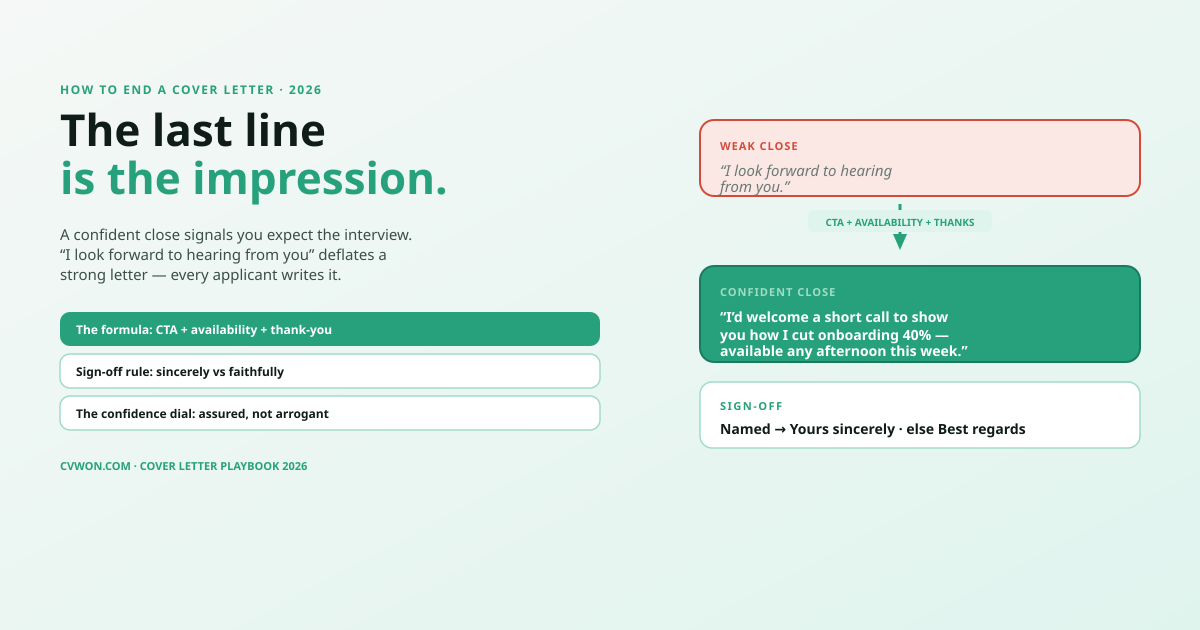
Compare two endings for the same letter. "I look forward to hearing from you. Yours sincerely," closes on the reader's action and adds nothing. "I'd welcome a short call to show you how I cut onboarding time 40% in my last role — I'm available any afternoon this week. Thank you for considering my application. Yours sincerely," closes on your value, offers a concrete next step, and stays gracious. The ending mirrors the opener discipline in our how to start a cover letter guide: lead with value, not filler.
A cover letter is remembered by how it opens and how it closes. A weak ending — passive, generic, or grovelling — can undo three strong paragraphs. The last line should sound like someone who expects the interview, not someone bracing for a rejection.
Key takeaway: write the ending as deliberately as the opening. If your final line puts the ball entirely in the reader's court and offers nothing new, rewrite it into a confident call to action.
The closing formula: CTA + availability + thank-you
The cover letter closing formula is a confident call to action, a line of availability, and a brief thank-you — in that order, before the sign-off. The CTA proposes the next step, the availability removes friction, and the thank-you keeps it gracious. Most weak closings have only the thank-you, or worse, only a passive hope.
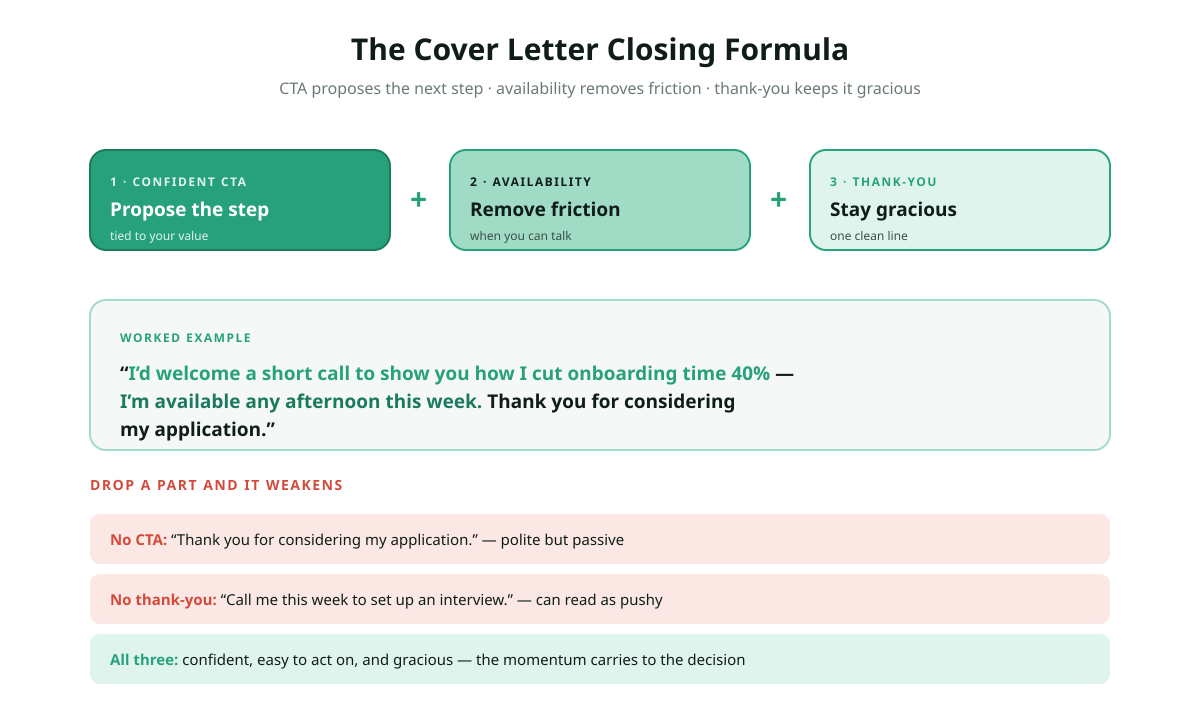
The three parts:
- Confident CTA — propose the next step and tie it to your value: "I'd welcome a short call to show you how I'd…"
- Availability — make it easy to act: "I'm available any afternoon this week" or "happy to talk whenever suits you".
- Thank-you — one gracious line: "Thank you for considering my application."
Applied: "I'd welcome a short call to show you how I cut onboarding time 40% in my last role — I'm available any afternoon this week. Thank you for considering my application." The CTA carries a proof point, the availability removes an excuse to delay, and the thank-you lands it gracefully. Drop the CTA and it goes passive; drop the thank-you and it can read as pushy.
Key takeaway: end on your value and a concrete next step, then thank them. If your closing paragraph does not propose a next action, it is not finished.
Weak-to-strong closing-line swap table
Fixing a weak cover letter ending usually means replacing a tired stock phrase with a confident, specific call to action. The weak closers are predictable across applications, which makes them easy to spot and swap. Run your final paragraph against the table below.
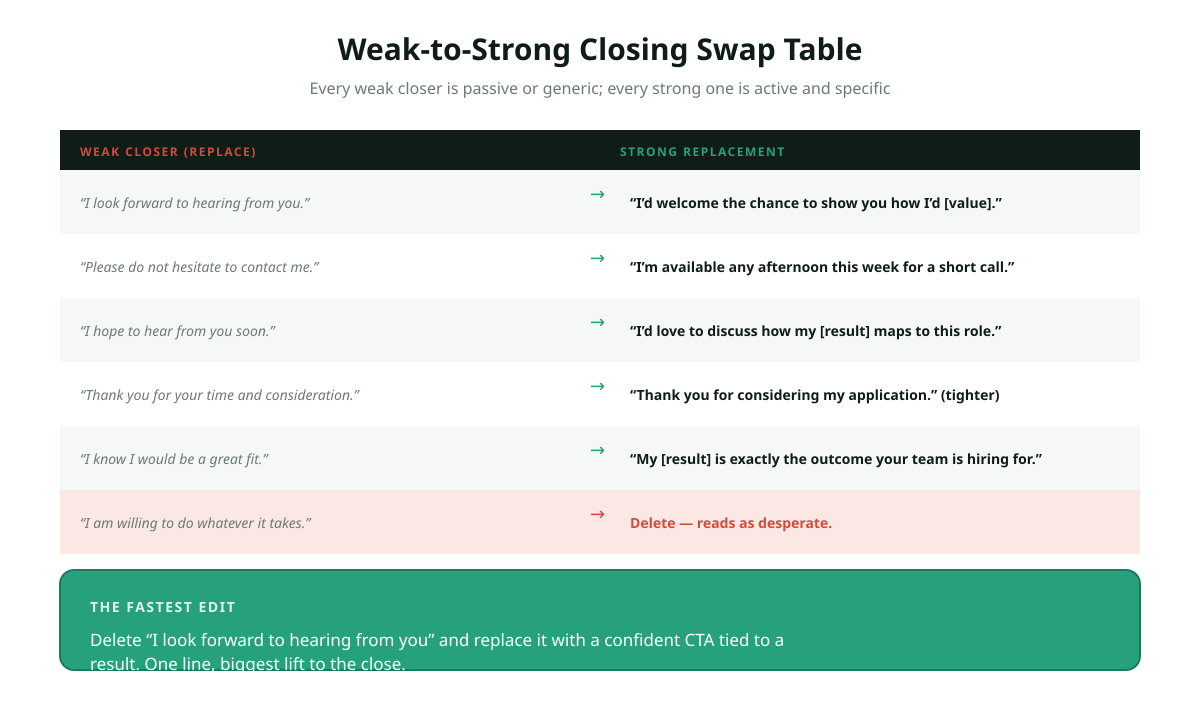
| Weak closer (replace) | Strong replacement |
|---|---|
| "I look forward to hearing from you." | "I'd welcome the chance to show you how I'd [specific value]." |
| "Please do not hesitate to contact me." | "I'm available any afternoon this week for a short call." |
| "I hope to hear from you soon." | "I'd love to discuss how my [result] maps to this role." |
| "Thank you for your time and consideration." | "Thank you for considering my application." (tighter) |
| "I know I would be a great fit." | "My [specific result] is exactly the outcome your team is hiring for." |
| "I am willing to do whatever it takes." | (Delete — reads as desperate.) |
Every weak closer on the left is passive or generic; every strong replacement is active and specific. The single fastest edit is deleting "I look forward to hearing from you" and replacing it with a confident CTA tied to a result. This mirrors the swap discipline in our action verbs guide — cut the stock phrase, lead with the value.
The sign-off hierarchy (and the sincerely/faithfully rule)
A cover letter sign-off is the closing salutation before your name, and the correct choice depends on your greeting: "Yours sincerely" when you addressed a named person, "Yours faithfully" (UK convention) when you did not. Getting this pairing wrong is a small but noticeable error that undercuts an otherwise polished letter.
| Sign-off | Use when | Register |
|---|---|---|
| Yours sincerely | You named the person ("Dear Priya Sharma") | Formal (UK/EU) |
| Yours faithfully | You did not have a name ("Dear Hiring Manager") — UK | Formal (UK) |
| Sincerely | US formal, any greeting | Formal (US) |
| Best regards / Kind regards | Modern professional, either greeting | Semi-formal (widely safe) |
| "Cheers", "Warmly", "Thanks!" | Rarely — too casual for most applications | Avoid unless the culture is very informal |
The safe modern default across markets is "Best regards" or "Kind regards" — professional, correct with any greeting, and free of the sincerely/faithfully trap. If you want the traditional formal register, match it to your greeting: named person gets "Yours sincerely", no name gets "Yours faithfully". Always leave a space for a signature and type your full name beneath. For the greeting side of this pairing, see the addressing rules in our how to start a cover letter guide.
The confidence dial: assured, not arrogant or desperate
The right closing tone is assured — you state the value you would bring — not arrogant ("I am the perfect candidate") and not desperate ("I will do anything for this role"). Confidence comes from evidence, not adjectives. A closing that names a result sounds confident; one that claims a trait sounds arrogant; one that over-promises availability sounds desperate.
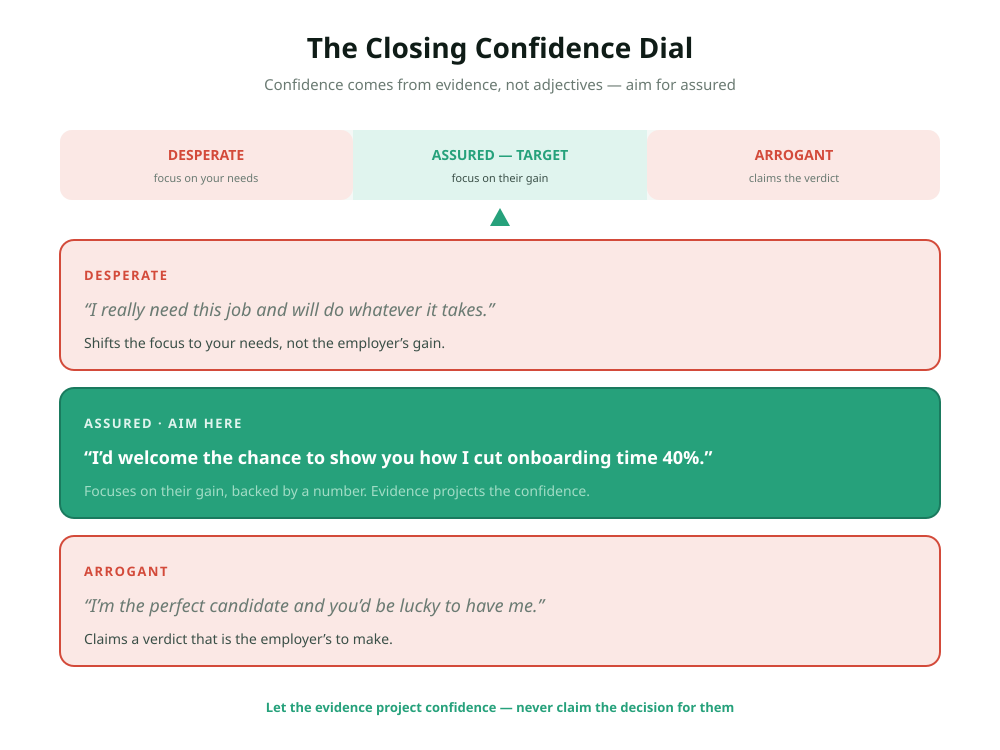
The three tones, illustrated:
- Desperate: "I really need this job and will do whatever it takes." — shifts focus to your needs.
- Assured (target): "I'd welcome the chance to show you how I cut onboarding time 40%." — focuses on their gain, backed by a number.
- Arrogant: "I'm the perfect candidate and you'd be lucky to have me." — claims a verdict that is theirs to make.
Key takeaway: aim the dial at assured by closing with a specific result and a useful next step. Let the evidence project confidence — never claim the hiring decision on the reader's behalf.
Closing examples by scenario
The best closing adapts to your situation — a standard application, a career change, or a referral each calls for a slightly different final line. The three below apply the formula (CTA + availability + thank-you). Swap in your specifics.
Standard application
"I'd welcome a short call to walk you through how I [result]. I'm available any afternoon this week. Thank you for considering my application. Yours sincerely,"
Career change
"I'd value the chance to show how my [transferable result] applies directly to this role. I'm happy to talk whenever suits you. Thank you for your time. Best regards," — the same transferable framing our CV with no experience guide uses for the whole application.
Referral
"[Name] thought my [result] would fit your team well, and I'd love to explore that with you. I can make any time work this week. Thank you. Yours sincerely,"
There is no single correct closing line — there is the closing that fits your letter and offers a clear next step. Keep the formula (CTA + availability + thank-you) and change the specifics to match your situation and the role.
US vs UK closing differences
US and UK cover letters close slightly differently: the UK uses the "Yours sincerely/faithfully" pairing, while the US favours "Sincerely" or "Best regards" regardless of the greeting. The closing paragraph itself — a confident CTA plus a thank-you — is the same across both markets; only the sign-off convention shifts.
Two market-specific rules:
- UK: named greeting → "Yours sincerely"; unnamed greeting → "Yours faithfully". "Kind regards" is a widely accepted modern alternative.
- US: "Sincerely" or "Best regards" works with any greeting; the faithfully rule is not used. American letters also tend to be slightly more direct in the CTA.
If you are applying across markets — common for Gulf and EU roles that hire internationally — "Best regards" or "Kind regards" is the safest neutral choice, as it is correct everywhere and avoids the regional trap. Match the rest of the letter's spelling and date format to the target market too.
Closing mistakes that undo a strong letter
The common closing mistakes all weaken the final impression: passivity, desperation, arrogance, a mismatched sign-off, or a typo in the last thing the reader sees. A strong body cannot fully recover from a weak close, so treat the ending with the same care as the opening.
- The passive default. "I look forward to hearing from you" ends on their action, not your value. Replace with a confident CTA.
- Desperation. "I'll do anything", "I really need this" — shifts focus to your needs. State their gain instead.
- Arrogance. "I'm the perfect fit" claims the hiring decision. Show a result and let them conclude it.
- Mismatched sign-off. "Yours sincerely" after "Dear Hiring Manager" (should be "faithfully" in the UK). Match the sign-off to the greeting.
- A closing typo. The last line is the freshest in the reader's memory — proofread it twice, the same discipline as our common CV mistakes guide applies to the CV.
Next step
The fastest way to write a confident close is to start from your best result: paste it and the target role into the CVWon cover letter builder, and it drafts a closing using the CTA + availability + thank-you formula, picks the correct sign-off for your greeting, and flags passive lines like "I look forward to hearing from you". Pair it with our complete cover letter guide for the full structure.
Related guides: How Long Should a Cover Letter Be.
Frequently Asked Questions
How do you end a cover letter in 2026?
End with a confident call to action, a line of availability, and a brief thank-you, followed by a professional sign-off. Use the formula: propose a next step tied to your value ("I'd welcome a short call to show you how I…"), remove friction ("I'm available any afternoon this week"), then thank them. Avoid the passive "I look forward to hearing from you".
What is the best way to sign off a cover letter?
Match the sign-off to your greeting. Use "Yours sincerely" when you named the person and "Yours faithfully" (UK) when you did not; in the US, "Sincerely" or "Best regards" works with any greeting. The safest modern default across markets is "Best regards" or "Kind regards" — professional and correct regardless of how you opened.
Is "I look forward to hearing from you" a bad way to end a cover letter?
It is not wrong, but it is weak — it ends on the reader's action and every applicant writes it, so it carries no signal. Replace it with a confident call to action that offers a next step and ties to your value, such as "I'd welcome the chance to show you how I cut onboarding time 40%". Confidence beats passivity in the closing line.
What is the difference between "Yours sincerely" and "Yours faithfully"?
In UK convention, "Yours sincerely" is used when you addressed a named person ("Dear Priya Sharma"), and "Yours faithfully" when you did not have a name ("Dear Hiring Manager"). Matching the pairing correctly signals attention to detail. In the US, neither faithfully rule applies — "Sincerely" or "Best regards" is standard with any greeting.
How do I sound confident in a cover letter closing without being arrogant?
Let evidence carry the confidence. "I'd welcome the chance to show you how I cut onboarding time 40%" sounds assured because it names a result and a next step. "I'm the perfect candidate" sounds arrogant because it claims a verdict that is the employer's to make. State the value you'd bring, not a judgement about your own fit.
Should I include my availability in the cover letter ending?
Yes — a short availability line removes friction and makes it easy for the reader to act. "I'm available any afternoon this week" or "happy to talk whenever suits you" turns a vague hope into a concrete next step. Keep it brief and flexible; over-promising ("available at any hour, any day") can read as desperate rather than accommodating.
How long should the closing paragraph of a cover letter be?
Two to three sentences: the confident call to action, the availability line, and the thank-you. Anything longer dilutes the close. The goal is a crisp, confident finish that proposes a next step and thanks the reader — not a summary of the whole letter, which the reader has just finished.
Do I need a call to action at the end of a cover letter?
Yes — a call to action is what separates a confident close from a passive one. Without it, the ending puts the entire next move on the reader and offers nothing. A good CTA proposes a specific next step (a call, a meeting) and ties it to the value you'd bring, which keeps the momentum going into the hiring decision.
How is ending a cover letter different from ending a CV?
A CV has no closing line — it ends on its last section (usually education or interests). A cover letter ends with a persuasive paragraph and a sign-off, because it is a direct message to a person. The letter's ending is an active pitch for the next step; the CV simply concludes its final section. Treat the cover letter close as the last word in a conversation.
What should I never write at the end of a cover letter?
Never end with desperation ("I'll do anything", "I really need this job"), arrogance ("you'd be lucky to have me"), a mismatched sign-off, or a typo. Also avoid over-thanking ("thank you so very much for your valuable time and kind consideration") — one clean thank-you is stronger. The last line is the freshest in the reader's mind, so keep it confident, specific, and error-free.
Last reviewed on 21 August 2026 by Muneeb Awan (Founder, CVWon).
About the Author
Muneeb Awan is the founder of CVWon, an AI-powered CV builder and career platform used by professionals across the EU and Gulf regions. He writes on hiring technology, ATS mechanics and the 2026 CV and cover-letter playbooks that get read.