Common CV Mistakes 2026: Which Ones Auto-Reject You
Last updated: 15 August 2026 · 16 min read · Reviewed by Muneeb Awan (Founder, CVWon)
The most common CV mistakes in 2026 are a two-column layout that breaks the parser, a generic summary with no specialisation, unquantified experience bullets, listing skills with no matching evidence, and typos — and they do not all cost the same. Some are fatal (an automatic reject at the first gate); others are minor (a small ding a human might forgive). This guide rates each mistake by severity and maps it to the exact screening layer it fails — the classic ATS, the 2026 LLM ranking layer, or the human recruiter — so you can fix the fatal ones first. It includes an original severity matrix, the 3-second recruiter scan, and a fix-forward table linking each fix to the full method.
TL;DR
- Not all CV mistakes are equal. A two-column layout or an image-based PDF is fatal (auto-reject at the parser); a slightly long summary is minor. Fix the fatal ones first.
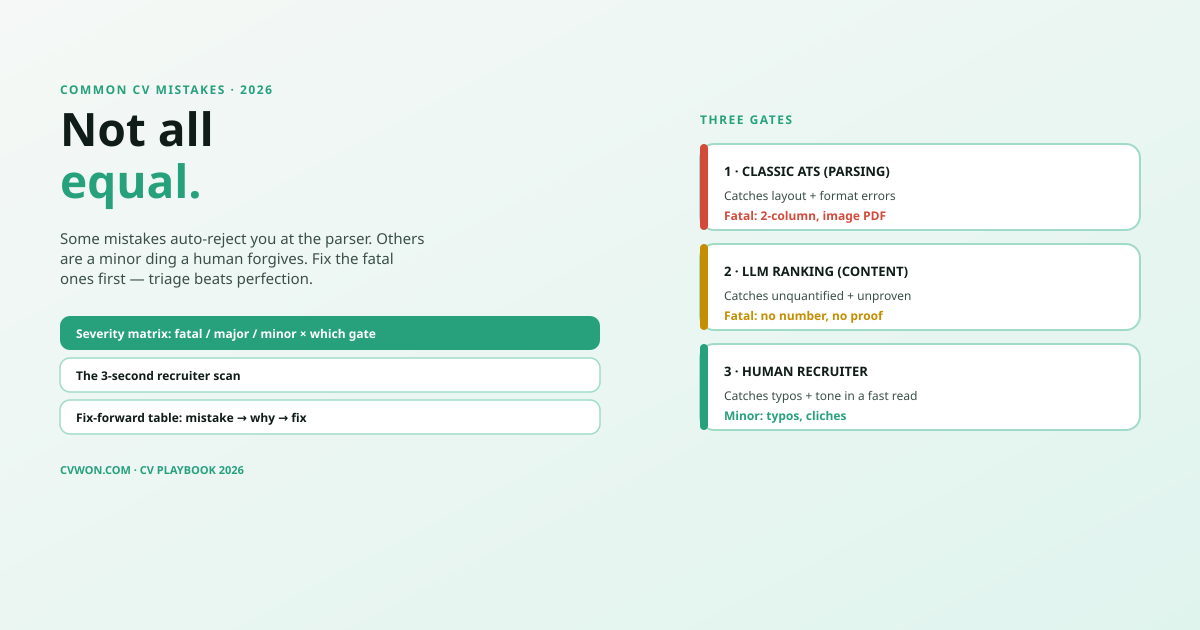
- Three gates catch different mistakes: the classic ATS catches layout and format errors, the 2026 LLM ranking layer catches unquantified and unproven content, and the human catches typos and tone.
- The five fatal mistakes: two-column/sidebar layout, image-based or design-tool PDF, no specialisation in the summary, zero quantified bullets, and unproven skill claims (including floating AI-tool labels).
- The 3-second scan catches layout, job titles, and obvious typos before a word is read closely — so those must be right.
- Every mistake has a specific fix that takes minutes. The fix-forward table below pairs each with the method and the guide that covers it in depth.
Why CV mistakes are not all equal in 2026
A CV mistake in 2026 is any element that costs you ranking or trust at one of the three screening gates — and its cost depends entirely on which gate it hits. The old advice treats every mistake as equally bad, which leaves readers polishing typos while a two-column layout silently auto-rejects them. Triage matters more than perfection: fix what gets you binned before you fix what gets you a raised eyebrow.

The three gates a 2026 CV passes through, and what each catches:
- Classic ATS (parsing gate): catches structural mistakes — two-column layouts, image-based PDFs, non-standard section names. These are fatal because the CV never becomes readable text.
- LLM ranking layer (content gate): catches weak content — generic summaries, unquantified bullets, unproven skill claims. These drop you mid-pack even when the CV parses perfectly. The mechanics are in our AI resume screening 2026 guide.
- Human recruiter (final gate): catches typos, tone, and red flags in a fast read. These rarely auto-reject but erode trust.
The most expensive CV mistake is not the typo you can see — it's the two-column template you can't, silently converting your CV to jumbled text before a human ever reads it. Fix the invisible structural mistakes first; they are the ones that auto-reject.
Key takeaway: before polishing wording, confirm your CV clears the parser gate. A fatal structural mistake makes every content refinement irrelevant, because the CV never reaches the layer that would reward it.
The CV mistake severity matrix
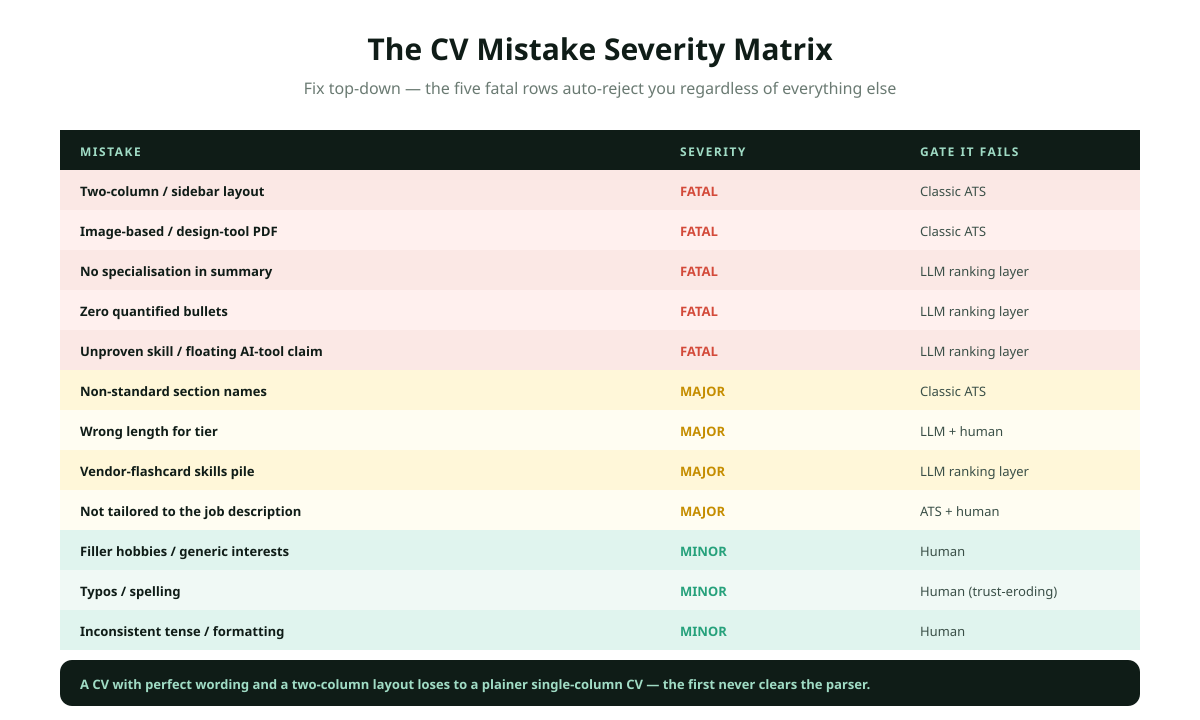
The CV mistake severity matrix rates each common mistake by how badly it costs you (fatal / major / minor) and maps it to the gate it fails. This is the triage tool every competing list skips: they enumerate mistakes without ranking them, so readers can't tell an auto-reject from a minor ding. Use the matrix to fix top-down.
| Mistake | Severity | Gate it fails |
|---|---|---|
| Two-column / sidebar layout | Fatal | Classic ATS |
| Image-based or design-tool PDF | Fatal | Classic ATS |
| No specialisation in summary | Fatal | LLM ranking layer |
| Zero quantified bullets | Fatal | LLM ranking layer |
| Unproven skill / floating AI-tool claim | Fatal | LLM ranking layer |
| Non-standard section names | Major | Classic ATS |
| Wrong length for tier | Major | LLM + human |
| Vendor-flashcard skills pile | Major | LLM ranking layer |
| Not tailored to the job description | Major | ATS + human |
| Filler hobbies / generic interests | Minor | Human |
| Typos / spelling | Minor (but trust-eroding) | Human |
| Inconsistent tense / formatting | Minor | Human |
Read it top-down: the five fatal rows are the ones that auto-reject or drop you to the bottom regardless of everything else. A CV with perfect wording and a two-column layout loses to a plainer single-column CV every time, because the first never clears the parser.
Key takeaway: fix all five fatal mistakes before touching a single minor one. Severity, not visibility, decides the order.
The 5 fatal mistakes (auto-reject)
A fatal CV mistake is one that auto-rejects you or drops you to the bottom of the ranking regardless of the rest of the CV. There are five in 2026, split across the parser gate and the content gate. Each has a fast, definite fix.
- Two-column / sidebar layout. The parser reads left-to-right and interleaves the sidebar into your main text, producing a jumbled hash. Fix: single column, top to bottom. Full detail in the 2026 CV format guide.
- Image-based or design-tool PDF. A PDF exported from Figma/Canva with text as vector paths looks perfect and is un-parseable. Fix: export text-based PDF from a real editor. Test by trying to select and copy your name.
- No specialisation in the summary. "Experienced professional" routes nowhere. Fix: name the exact role the JD asks for in the first line.
- Zero quantified bullets. "Responsible for sales" carries no evidence. Fix: lead each bullet with a number — revenue, percentage, count, time saved.
- Unproven skill claims / floating AI-tool labels. Listing "GitHub Copilot, Cursor" with no supporting bullet reads as vibe-coding. Fix: anchor every skill to an experience bullet, per the skills to put on CV 2026 guide.
The 6 major mistakes (drop you mid-pack)
A major CV mistake does not auto-reject you, but it drops you below stronger candidates who avoided it. These are the difference between a shortlist and a "maybe" pile. Unlike the fatal five, a human might overlook one — but stack two or three and the CV reads as careless.
- Non-standard section names. "My Story" instead of "Experience" breaks the parser's section detection. Use standard labels.
- Wrong length for your tier. A three-page non-executive CV or a one-page senior CV both mis-signal. Match length to tier — the rule is in the CV format guide.
- Vendor-flashcard skills pile. 25 tools listed, none anchored. Trim to what your experience proves.
- Not tailoring to the job description. A generic CV misses the JD's exact keywords at the ATS gate and reads as spray-and-pray to the human. Adjust the summary and top bullets per application.
- Burying recent, relevant experience. Reverse-chronological order exists for a reason; leading with old or irrelevant roles wastes the first glance.
- Weak or missing links. On a technical CV, a missing or empty GitHub/portfolio link is a real down-signal in 2026.
The minor mistakes (small dings)
A minor CV mistake slightly erodes trust or wastes space but rarely changes the outcome on its own. They matter in aggregate: three or four minor mistakes together read as sloppiness, which a recruiter does extrapolate to your work. Fix them last, but do fix them.
- Typos and spelling. Individually survivable, collectively fatal to trust. Proofread twice and read aloud.
- Inconsistent tense or formatting. Past roles in past tense, current role in present; consistent date format throughout.
- Filler hobbies. "Reading, socialising" signals nothing — cut or make specific, per the hobbies and interests guide.
- Clichés. "Hard-working team player" is unprovable filler. Replace with a quantified result.
- An unprofessional email address. Use firstname.lastname, not a nickname from 2009.
The 3-second recruiter scan
The 3-second recruiter scan is the first glance a recruiter gives a CV before reading a word closely — and it catches layout, job titles, company names, dates and obvious typos. Anything that fails this scan gets no closer read. This is why fatal structural mistakes and headline errors matter disproportionately: they are exactly what the eye lands on first.
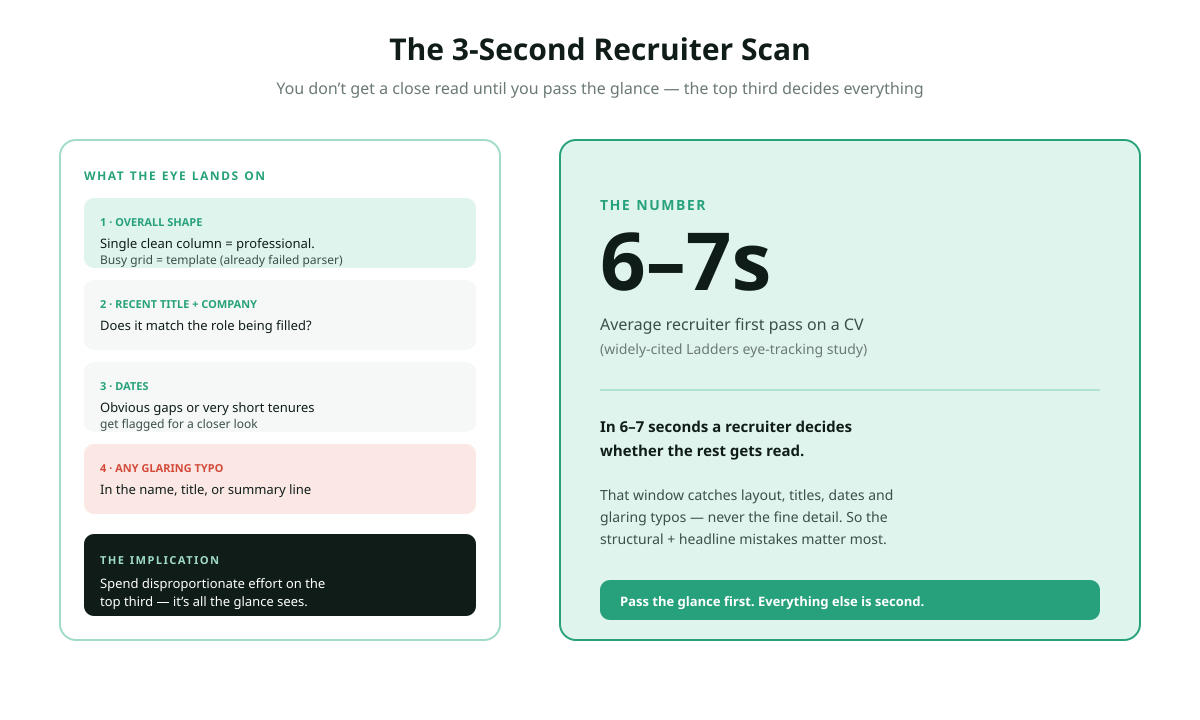
What the 3-second scan registers, in order:
- Overall shape. Single clean column reads as professional; a busy two-column grid reads as a template and, worse, has already failed the parser.
- Most recent job title + company. Does it match the role being filled?
- Dates. Obvious gaps or very short tenures get flagged for a closer look.
- Any glaring typo in the name, title, or summary line.
According to widely cited recruiter surveys, the average first pass on a CV is measured in single-digit seconds — the often-quoted Ladders eye-tracking study put it around 6–7 seconds. The practical implication is unchanged in 2026: the top third of your CV and its overall structure decide whether the rest gets read.
You do not get a close read until you pass the glance. Spend disproportionate effort on the top third of the CV — the layout, the summary line, the most recent title — because that is all the 3-second scan ever sees.
The fix-forward table: mistake → why → fix
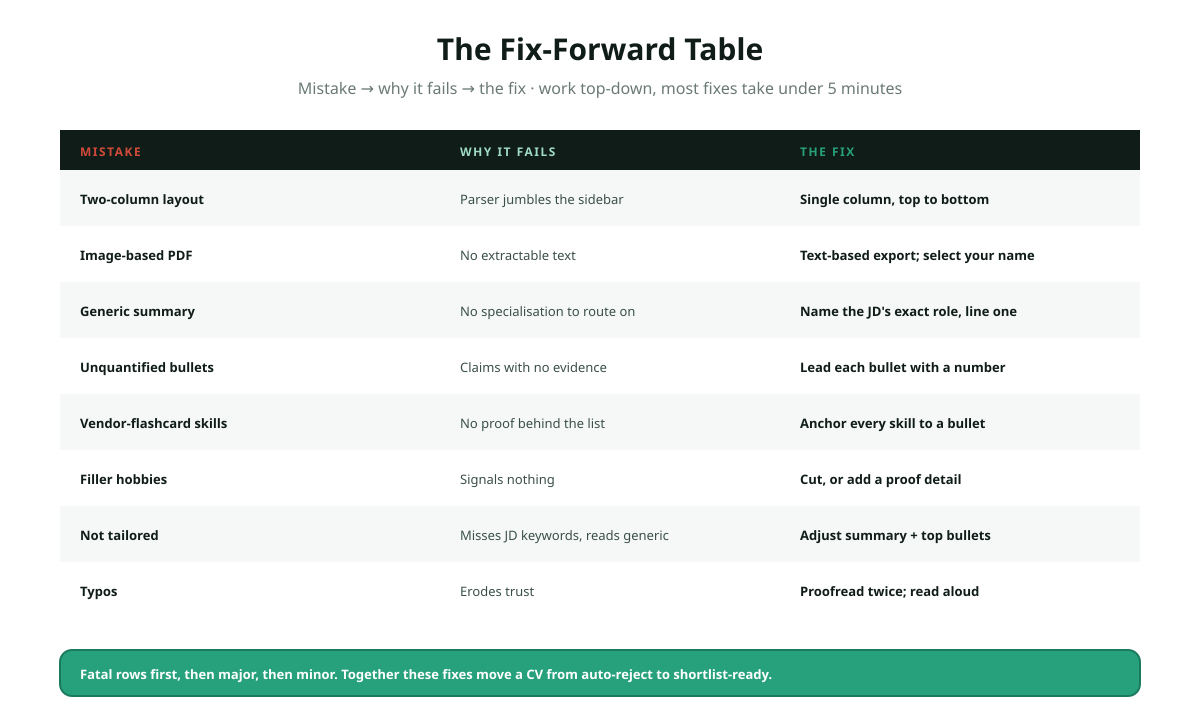
The fix-forward table pairs each common CV mistake with why it fails and the exact fix, so you can work through them in one pass. Every fix links to the guide that covers the method in full — use this as the hub and follow the link for depth.
| Mistake | Why it fails | The fix |
|---|---|---|
| Two-column layout | Parser jumbles the sidebar into the body | Single column, top to bottom |
| Image-based PDF | No extractable text | Export text-based PDF; test by selecting your name |
| Generic summary | No specialisation to route on | Name the JD's exact role in line one |
| Unquantified bullets | Claims with no evidence | Lead each bullet with a number |
| Vendor-flashcard skills | No proof behind the list | Anchor every skill to an experience bullet |
| Filler hobbies | Signals nothing | Cut, or add a proof detail |
| Not tailored | Misses JD keywords + reads generic | Adjust summary + top bullets per application |
| Typos | Erodes trust | Proofread twice; read aloud; use a checker |
Work top-down: the fatal rows first, then major, then minor. Most of these fixes take under five minutes each, and together they move a CV from auto-reject to shortlist-ready.
Mistakes specific to first-job and career-change CVs
First-job and career-change CVs have their own common mistakes — chiefly hiding the lack of direct experience instead of translating what they do have. The fix is not to inflate; it is to prove transferable value with the evidence that already exists. These candidates lose more often to poor framing than to a genuine experience gap.
- Leading with an apology. "Although I have limited experience…" primes doubt. Lead with the strongest proven result instead. See the CV with no experience guide.
- Untranslated old-role language. A career-changer who leaves skills in their old industry's jargon forces the recruiter to do the translation. Do it for them — the method is in the transferable skills guide.
- A functional (skills-first) layout. It now reads as hiding a gap. Use reverse-chronological or hybrid instead.
- Ignoring non-work evidence. Studies, volunteering and side projects are legitimate proof of transferable skills for a first CV — omitting them wastes real evidence.
How to catch your own mistakes before you send
The most reliable way to catch your own CV mistakes is a structured three-pass review: one pass for structure, one for content, one for polish. Reading top-to-bottom once catches almost nothing, because your eye fills in what it expects. Separate passes force you to check different things.
- Structure pass: Is it single-column? Text-based PDF (can you select your name)? Standard section names? Right length for your tier?
- Content pass: Does the summary name a specialisation? Does every bullet lead with a number? Is every listed skill anchored by a bullet?
- Polish pass: Read it aloud for typos and tense. Check the email address, the dates, and the consistency of formatting.
Run the structure pass first — it catches the fatal mistakes that make the other two passes irrelevant.
Next step
The fastest way to catch every mistake in this guide in one go is to build or paste your CV into the CVWon CV builder: it flags two-column layouts, unanchored skills, unquantified bullets and missing specialisation automatically, and exports a clean text-based PDF that clears the parser gate. Start with the structure pass, then work down the severity matrix.
Frequently Asked Questions
What is the most common CV mistake in 2026?
The most common and most costly is a two-column or sidebar layout, because the classic ATS parser reads it left-to-right and jumbles the sidebar into your main text, producing unreadable output. It is fatal — the CV never becomes clean text for a human to read. The fix is a single-column, top-to-bottom layout exported as a text-based PDF.
Do typos really get your CV rejected?
A single typo rarely triggers an automatic reject, but it erodes trust, and several together read as carelessness a recruiter extrapolates to your work. Typos are a minor mistake in isolation and a major one in aggregate. Proofread twice, read the CV aloud, and check the name, email and dates specifically.
How long should a CV be to avoid the length mistake?
Match length to your tier: one page under five years of experience, two pages for senior or manager level, two to three for executive. A three-page non-executive CV and a one-page senior CV both mis-signal. Length is not seniority; scope-per-bullet is. The full tier rule is in our CV format guide.
Which CV mistakes cause an automatic rejection?
Five are effectively fatal: a two-column layout, an image-based or design-tool PDF, no specialisation in the summary, zero quantified bullets, and unproven skill claims such as floating AI-tool labels. The first two fail the classic ATS parser; the last three fail the 2026 LLM ranking layer. Fix these before any minor polish.
Is it a mistake to use a CV template from Canva or a design tool?
It can be fatal if the template is two-column or exports the text as vector paths (an image-based PDF). Both make the CV un-parseable. If you use a design tool, choose a single-column layout and confirm the exported PDF has selectable text — try to highlight and copy your name. If you can't, the CV is invisible to the parser.
How do I know if my CV has a fatal mistake?
Run a two-minute check: is the layout a single column, can you select and copy the text from the PDF, does the summary name a specific role, and does every experience bullet contain a number? A "no" to any of these is a fatal mistake. These four checks catch the mistakes that auto-reject you before content quality matters.
What CV mistakes do first-time job seekers make most?
The biggest is hiding the lack of experience — leading with an apology or a skills-first functional layout — instead of translating studies, volunteering and side projects into proof of transferable skills. First-job candidates lose more often to weak framing than to a genuine gap. Our CV with no experience guide shows the fix.
Does not tailoring my CV to the job count as a mistake?
Yes, a major one. A generic CV misses the job description's exact keywords at the ATS gate and reads as spray-and-pray to the human recruiter. You don't need to rewrite the whole CV per application — adjust the summary line and reorder the top two or three bullets to match the role's priorities.
How many mistakes can a CV have before it's rejected?
One fatal mistake is usually enough, because it either auto-rejects at the parser or drops you to the bottom of the ranking. Major and minor mistakes work cumulatively — two or three together push a borderline CV into the "maybe" pile. Triage by severity: eliminate every fatal mistake first, then reduce the majors, then polish the minors.
Should I list every job I've ever had?
No — that's a common length and relevance mistake. Include roles relevant to the target job and the last 10–15 years; older or unrelated roles can be summarised in a line or dropped. Reverse-chronological order should lead with your most recent, most relevant experience, since that is what the 3-second scan and the LLM layer weight most heavily.
Last reviewed on 15 August 2026 by Muneeb Awan (Founder, CVWon).
About the Author
Muneeb Awan is the founder of CVWon, an AI-powered CV builder and career platform used by professionals across the EU and Gulf regions. He writes on hiring technology, ATS mechanics and the 2026 CV playbooks that pass both filters.