Skills to Put on CV 2026: 40 That AI Ranks Highest
Last updated: 12 August 2026 · 22 min read · Reviewed by Muneeb Awan (Founder, CVWon) · Methodology
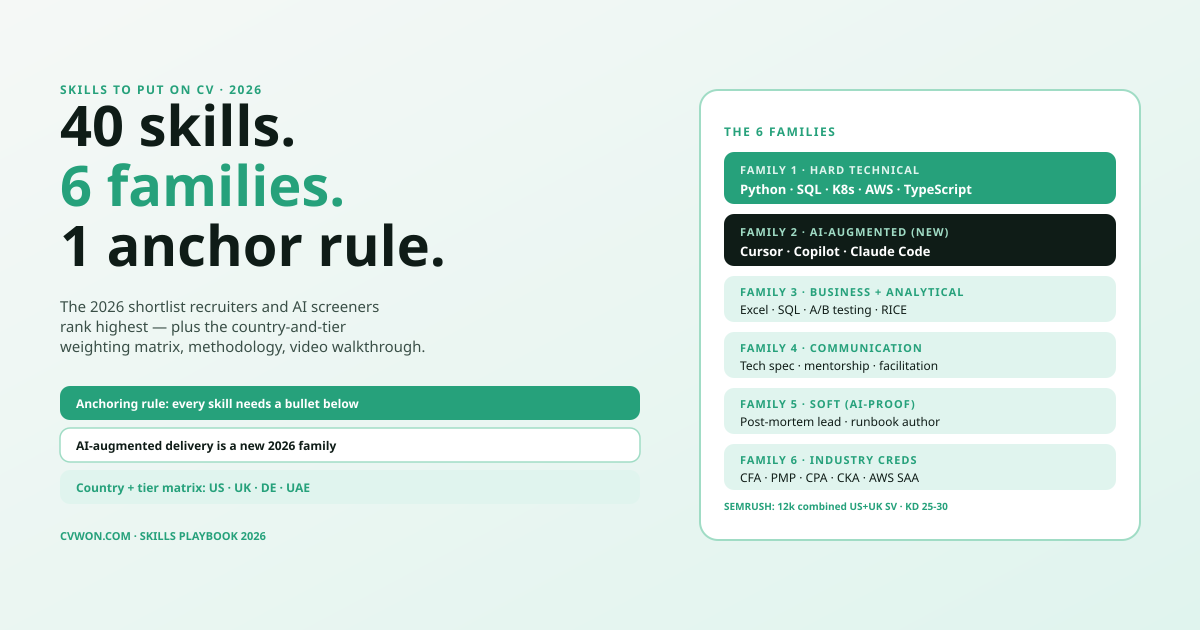
The skills to put on your CV in 2026 are scored twice — once by a classic ATS matching your listed skills against the job-description keyword set, once by an LLM ranking layer that separately checks whether each listed skill is anchored by a shipped-scope bullet somewhere below in the experience section. A skill listed without an anchoring bullet reads as filler and drops points on the LLM rubric even when it perfectly matches the JD. This guide is the definitive 2026 shortlist: 40 skills grouped into six families (hard technical, AI-augmented delivery, business + analytical, communication + collaboration, soft skills that survive AI screening, industry-specific credentials), each with the exact one-line format that anchors cleanly, plus a country + role-tier weighting matrix showing which family carries the most points in US, UK, EU and Gulf markets at junior, mid, senior and manager tiers.
FREE DOWNLOAD
The 2026 One-Page CV Skills Reference (PDF)
All 40 skills with anchoring examples + the country weighting matrix, single PDF, hand-authored by our team.
TL;DR
- Every listed skill on a 2026 CV must be anchored by an experience bullet below. A skills line without a matching bullet reads as filler to the LLM ranking layer and triggers the vendor-flashcard down-weight — the single largest 2026 skills-section-related rejection cause.
- Group your skills into 4-6 named families, not one comma-separated pile. Grouped skills parse cleaner in the classic ATS and score higher on structural signals in the LLM layer.
- The AI-augmented delivery family is now its own category alongside hard technical, business, communication, soft and industry credentials. Cursor / GitHub Copilot / Claude Code / Codeium belong here — listed inside a shipped-scope bullet, never as a floating label.
- Skill weighting differs by country and role tier. Hard technical carries most weight for US/UK tech roles; credential skills for Gulf finance; soft skills for junior candidates everywhere; industry certifications for regulated sectors.
- Twelve well-anchored skills beat thirty unanchored ones. Trim aggressively to only the skills you can demonstrate with a specific bullet below. This is the same rule as on the 2026 CV format pillar.
What “skills to put on your CV” actually means in 2026
“Skills to put on your CV” in 2026 means the specific, evidence-backed capabilities that appear in your skills section AND anchor a shipped-scope experience bullet below. The old-school “list every tool you have ever touched” approach now actively drops your score on the 2026 LLM ranking layer, which cross-checks every skill against the experience section and down-weights any skill that appears in isolation.

Two graders, one skills section:
| Layer | What it checks about your skills section |
|---|---|
| Classic ATS | Keyword match against the job description, standard section detection (“Skills” header), extractable text (no image-based skill bars) |
| LLM ranking layer | Skill-to-experience anchoring (every listed skill appears in an experience bullet), grouping into named families, tier-appropriate depth (junior lists tools, senior lists systems), no vendor-flashcard pile |
The single most common 2026 skills-section failure: a CV that clears the ATS keyword match (the target language is listed) and drops on the LLM layer because none of the experience bullets below actually reference that tool. See the AI resume screening 2026 deep-dive for how the LLM layer scores this rubric on real production CVs.
Every skill on your 2026 CV is a claim. Every claim needs a bullet below it that proves the claim. Twelve claims backed by twelve bullets beats thirty claims backed by nothing every time. The LLM ranking layer measures this ratio directly.
Key takeaway: the skills section is a promise. The experience section is the receipt. A promise without a receipt is filler — and 2026 tooling now measures that mismatch quantitatively.
The 6 skill families every 2026 CV needs
The 2026 CV skills section groups into six named families, in this order: hard technical, AI-augmented delivery, business + analytical, communication + collaboration, soft skills, industry-specific credentials. A single comma-separated pile of 20+ items parses badly at the classic ATS layer (the parser struggles to identify family boundaries) and gets down-weighted by the LLM ranking layer for missing structural signal.
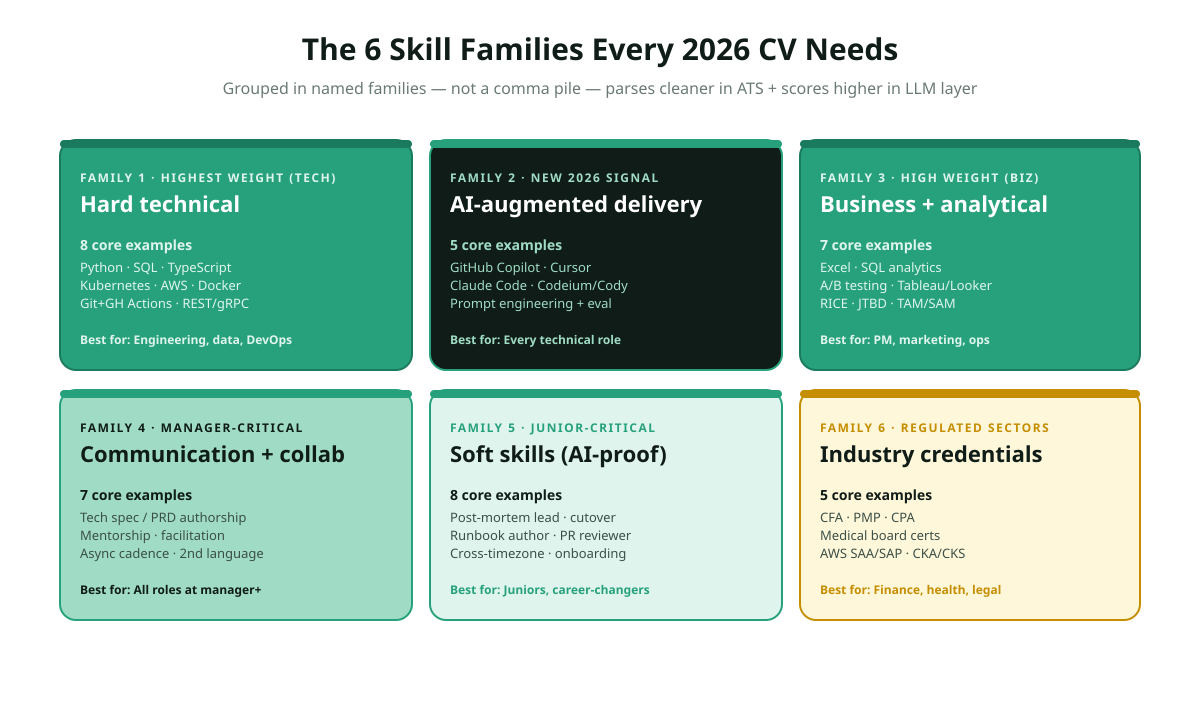
| Family | Count | LLM ranking layer weight | Best for |
|---|---|---|---|
| 1. Hard technical | 8 core | Highest for tech roles | Engineering, data, DevOps |
| 2. AI-augmented delivery | 5 core | New 2026 weight signal | Every technical role |
| 3. Business + analytical | 7 core | Highest for PM, marketing, ops | Product, marketing, consulting |
| 4. Communication + collaboration | 7 core | Universal signal, weighted higher for senior | All roles at manager+ |
| 5. Soft skills (AI-proof) | 8 core | Highest for junior tier | Junior candidates, career-changers |
| 6. Industry-specific credentials | 5 core | Highest for regulated sectors | Finance, healthcare, legal, aviation |
The right mix for your CV depends on your role and tier, not just your years. See the weighting matrix later in this guide for concrete per-tier prescriptions.
Family 1 — Hard technical skills (8 examples with anchor bullets)
Hard technical skills are the tools, languages, frameworks and systems you can demonstrate with a shipped, quantified outcome bullet. They anchor the highest LLM-ranking-layer weight for engineering, data, DevOps and infrastructure roles. Every entry in this family must appear in at least one experience bullet below.
- Python — anchor: “Migrated 62 Python-2 batch scripts to Python-3.12 in one PR using Claude Code, zero rollback”
- SQL (PostgreSQL / MySQL / BigQuery) — anchor: “Cut nightly ETL runtime from 4.2h to 38 minutes via partition pruning in BigQuery + rewritten join order”
- TypeScript — anchor: “Shipped saved-cart end-to-end (Next.js server components in TypeScript + Go API + PostgreSQL) in 5 weeks, 34% adoption at 30 days”
- Kubernetes — anchor: “Scaled ingest service across 8 EKS clusters serving 420M requests/day”
- AWS (name specific services) — anchor: “Cut monthly AWS spend on data pipeline from $58k to $19k by moving nightly batch from EMR to Athena + Iceberg”
- Docker — anchor: “Containerised a 12-service monolith to Docker + docker-compose, cutting local dev setup from 3 hours to 8 minutes for a 14-engineer team”
- Git + GitHub Actions — anchor: “Owned CI/CD pipeline in GitHub Actions, cut mean deployment time from 22 min to 6 min via matrix parallelisation and cache-warm steps”
- REST / gRPC API design — anchor: “Designed 14 external gRPC endpoints powering the payments platform, versioned via buf, 99.98% SLA across 3 regions”
Deep-dive on hard technical skill placement for each engineering specialisation in the software engineer CV 2026 guide and the DevOps engineer CV 2026 guide.
Family 2 — AI-augmented delivery skills (5 examples)
AI-augmented delivery skills are the tools you use to accelerate your own delivery — Cursor, GitHub Copilot, Claude Code, Codeium, Cody — listed inside a shipped-scope experience bullet, never as a floating skills-line label. This is the single newest 2026 skill family, and the placement rule matters more than the tool choice. A CV that lists these tools without an anchoring bullet triggers the largest single 2026 LLM-ranking-layer downgrade for technical CVs (the vibe-coding down-weight).
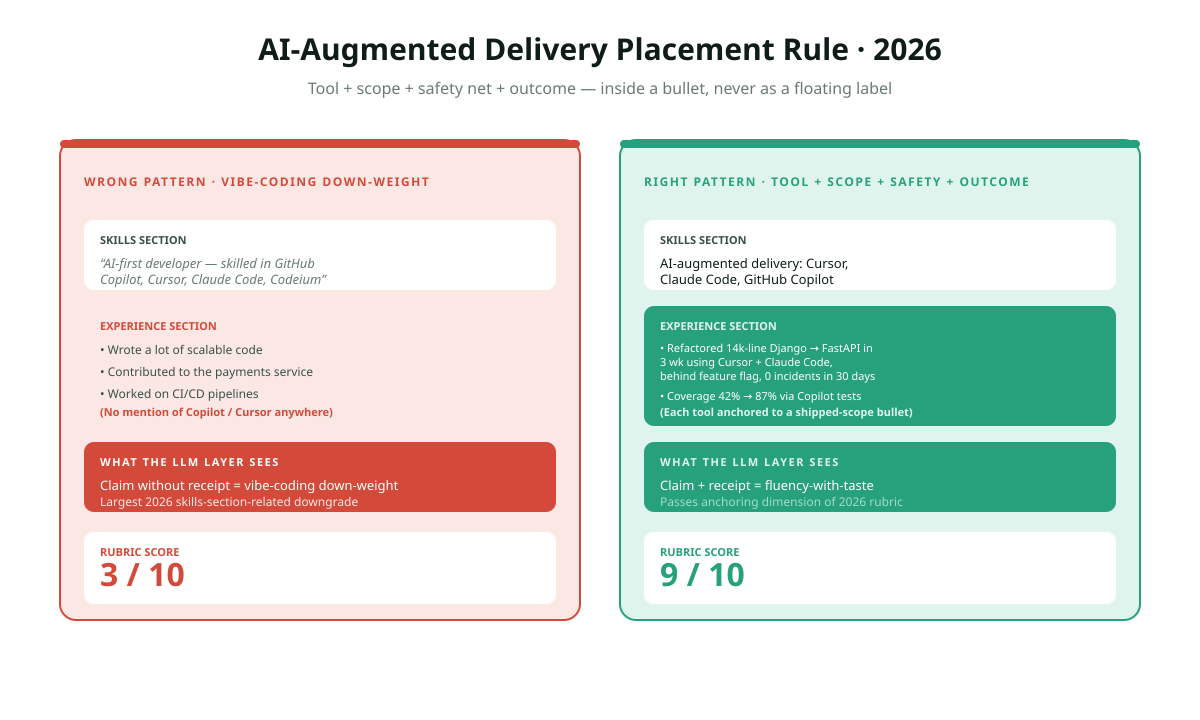
- GitHub Copilot — anchor: “Raised test coverage on payments service from 42% to 87% in one sprint using Copilot-authored table-driven tests, caught 2 pre-production race conditions in review”
- Cursor — anchor: “Refactored 14k-line legacy Django service to FastAPI in 3 weeks using Cursor + Claude Code, shipped behind feature flag, zero production incidents in first 30 days”
- Claude Code — anchor: “Migrated 62 Python-2 utility scripts to Python-3.12 using Claude Code, all merged in one PR, zero rollback”
- Codeium / Cody — anchor: “Standardised code-review across 24-engineer platform team on Codeium, cut mean review turnaround from 18h to 4h”
- Prompt engineering (with model + eval) — anchor: “Built + evaluated a Claude-3.7-Sonnet extraction prompt for legal contracts, F1 improved from 0.71 (baseline) to 0.89 across a 300-doc test set”
The formula that lands: tool + scope + safety net + outcome. Any bullet missing one of the four should be cut or rewritten. Full pattern breakdown in the software engineer CV 2026 guide under “AI-augmented delivery: signalling Copilot, Cursor and Claude Code without reading as vibe-coding”.
Key takeaway: naming zero AI tools reads as pre-2024 career-lag; naming them without anchoring reads as vibe-coding; naming them inside a bullet reads as fluency-with-taste. The middle option is the only one that scores.
Family 3 — Business + analytical skills (7 examples)
Business + analytical skills are the frameworks, tools and analytical patterns you use to translate a business problem into a measurable outcome. They anchor the highest LLM-ranking-layer weight for product management, marketing, operations, consulting and finance roles. Same anchoring rule: each entry needs an experience bullet with a business metric.
- Excel (specifically: pivot tables, VLOOKUP, Power Query, scenario modelling) — anchor: “Built a monthly P&L variance model in Excel Power Query for 12 business units, cut close cycle from 9 days to 3 days”
- SQL for analytics — anchor: “Wrote 200+ ad-hoc analytics SQL queries against BigQuery for the growth team, driving 7 A/B tests to significance”
- A/B testing + statistical significance — anchor: “Ran 14 experiments in one quarter via Statsig, 5 winning variants shipped, aggregate +7.4% D30 activation”
- Data visualisation (Tableau / Looker / Metabase) — anchor: “Built the exec-facing revenue dashboard in Looker used by CFO + CRO daily, replaced a 4-day manual Excel workflow”
- Financial modelling (DCF, LBO, three-statement) — anchor: “Owned the three-statement model for Series C fundraise, closed at $180M pre-money”
- Product frameworks (JTBD, RICE, North Star Metric) — anchor: “RICE-prioritised 42 candidate features per quarter for a 6-engineer product team, +34% shipping velocity vs prior four quarters”
- Market sizing (TAM / SAM / SOM) — anchor: “Built the bottom-up TAM model for a Series B climate-tech pivot, board-approved and used in three subsequent investor decks”
For product-management-specific weighting across these seven, see the product manager CV 2026 guide. For data-scientist-specific weighting see the data scientist CV 2026 guide.
Family 4 — Communication + collaboration skills (7 examples)
Communication + collaboration skills are the concrete artefacts and cadences that prove you can coordinate work across teams, not the abstract labels every CV lists. Write “written tech spec author” not “great communicator”. Write “on-call rotation lead” not “team player”. The 2026 LLM ranking layer heavily down-weights the abstract-adjective versions and correctly parses the concrete-artefact versions as signals.
- Written tech spec / PRD authorship — anchor: “Authored 8 tech specs in the last 18 months, 6 of which shipped to production; adopted by the platform team as the reference format”
- Cross-team facilitation — anchor: “Facilitated the weekly cross-functional launch review across product, engineering, marketing and legal for a 12-launch quarter”
- Public speaking (conference / internal all-hands) — anchor: “Presented the PostgreSQL migration case study at PGCon 2025 to ~400 attendees; delivered the same talk internally to a 90-engineer org”
- Mentorship / people development — anchor: “Mentored 4 junior engineers to L4 promotion over 2 years, 3 of whom now own their own services”
- Stakeholder management (executive-level) — anchor: “Ran the monthly board update on infrastructure spend + reliability across three fiscal quarters”
- Second-language business fluency — anchor: “Ran technical interviews in German and English for the Berlin office (14 hires in 2025)”
- Async / remote collaboration cadence — anchor: “Established the weekly written status update for a fully-remote 22-person org across 6 time zones, cut sync-meeting hours per person from 12/week to 4/week”
Family 5 — Soft skills that survive AI screening (8 examples)
Soft skills that survive 2026 AI screening are behavioural capabilities named with a specific behavioural example, not generic adjectives. The 2026 LLM ranking layer scores adjective-based soft skills (“team player”, “detail-oriented”, “hard worker”) as noise and quantitatively down-weights them; behavioural specifics (“led 8 post-mortems in 2025”, “shipped 3 zero-downtime cutovers”) score correctly. Same skills, different framing.
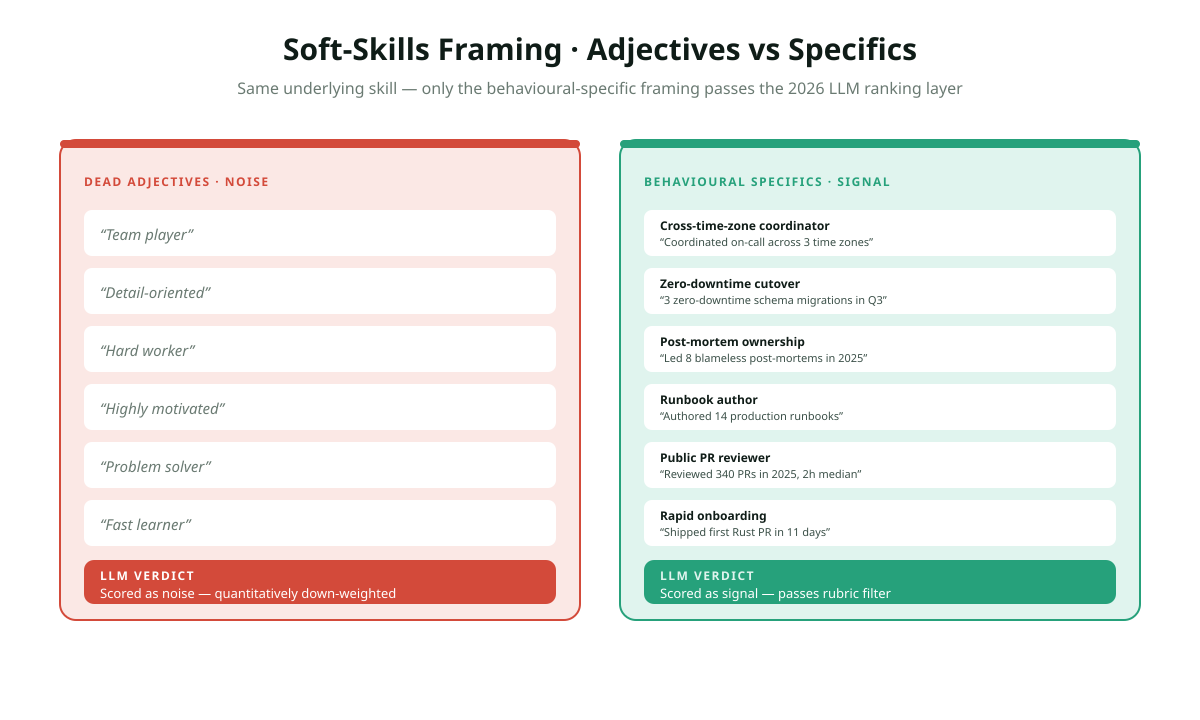
- Post-mortem ownership instead of “problem solving” — anchor: “Led 8 blameless post-mortems in 2025, drove 22 follow-up items to production, cut recurrence rate from 34% to 9%”
- Zero-downtime cutover instead of “attention to detail” — anchor: “Shipped 3 zero-downtime schema migrations across the payments service in Q3, no user-visible incidents”
- Cross-time-zone coordination instead of “team player” — anchor: “Coordinated the on-call rotation across London / Bangalore / San Francisco for 8 quarters, MTTR 11 min average”
- Rapid-onboarding instead of “fast learner” — anchor: “Onboarded onto a new Rust codebase and shipped the first production PR in 11 days”
- Runbook / documentation ownership instead of “organised” — anchor: “Authored 14 production runbooks adopted by the SRE org; cut incident-response time-to-first-action from 12 min to 3 min”
- Public code review instead of “collaborative” — anchor: “Reviewed 340 PRs in 2025 with a median 2h turnaround; recognised as top-decile reviewer in engineering-wide 360 review”
- Conflict de-escalation instead of “interpersonal skills” — anchor: “Led resolution of a 3-team roadmap conflict over shared platform capacity, delivered a joint OKR the following quarter”
- Hiring loop ownership instead of “leadership” — anchor: “Led the technical hiring loop for 12 backend engineer hires in 2025, retention of 11 at the 12-month mark”
Key takeaway: the fastest single upgrade to the average CV in 2026 is deleting every soft-skill adjective and replacing it with one behavioural bullet that proves the same trait. Adjectives are noise; specifics are signals.
Family 6 — Industry-specific credentials (5 examples)
Industry-specific credentials are the certifications, licences and regulated qualifications that carry the highest LLM-ranking-layer weight for regulated sectors (finance, healthcare, legal, aviation, safety-critical). They rank at the very top of the CV for these industries and near the bottom for tech — the placement varies more sharply by industry than any other skill family. Do not stack unrelated general certifications to compensate for thin experience; the 2026 layer treats that as inflation and down-weights.
- CFA (Chartered Financial Analyst) — where relevant, place immediately after the summary. Finance-role table stakes at all three levels.
- PMP (Project Management Professional) — enterprise consulting, defence, construction, healthcare-IT.
- CPA (Certified Public Accountant) — accounting, audit, finance.
- CFR / medical board certifications — healthcare (list all active, with year + jurisdiction).
- AWS Solutions Architect Associate / Professional — cloud-adjacent tech roles; place near the top of the technical skills section for backend / DevOps CVs.
Full ladder of technical certifications per specialisation is in the DevOps engineer CV 2026 guide (CKA → CKS → HashiCorp Terraform) and the cybersecurity analyst CV 2026 guide (Security+, CISSP, OSCP).
The anchoring rule — how to phrase every skill for the LLM ranking layer
The anchoring rule is the single most important 2026 skills-section rule: every skill listed in the skills section must appear in at least one experience bullet below. The 2026 LLM ranking layer measures skill-to-experience anchoring as a discrete rubric dimension and scores it on a percentage basis. Target 100%. Anything under 80% triggers the vendor-flashcard down-weight.
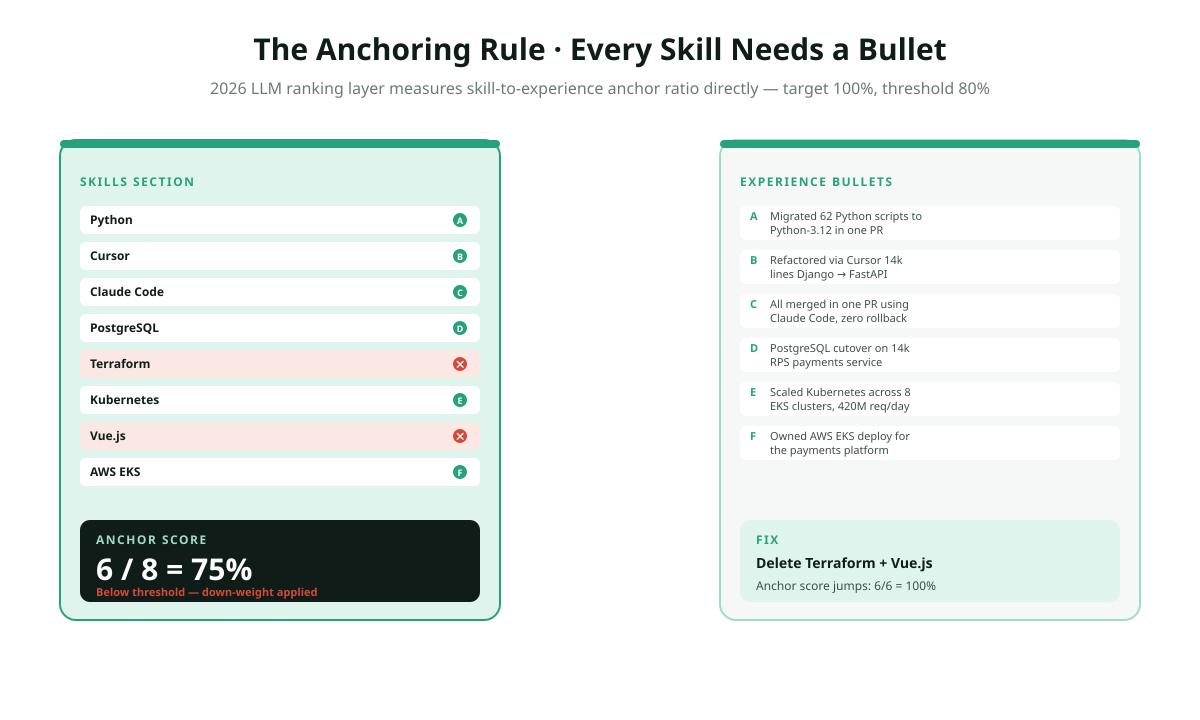
The anchoring self-audit — five minutes on any CV:
- Copy the skills section to a text editor.
- Copy the experience section below it.
- For each skill, search for it in the experience section (case-insensitive).
- Count matches. Divide by total skills listed. That is your anchor score.
- Cut every unanchored skill. If a skill is genuinely important and unanchored, add a bullet that anchors it — do not just delete the skill without deciding whether it belongs.
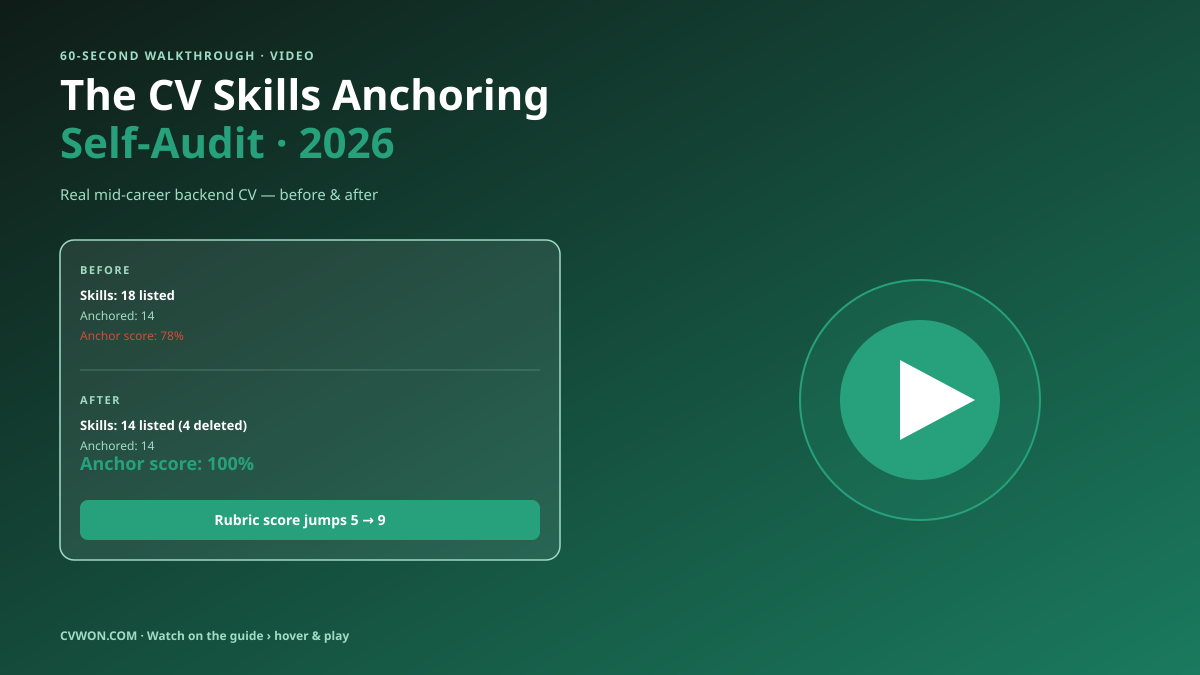
Example anchor-check on a mid-career backend CV: 18 skills listed, 14 appear in experience bullets = 78% anchor score = just below threshold. Fix by deleting 4 filler skills to bring the ratio to 100%.
A skills section is a promise to the reader. An experience section is the receipt. The 2026 LLM ranking layer now measures the promise-to-receipt ratio directly, and the down-weight for an unbalanced CV is real. Anchor everything, or trim it.
The country + role-tier skill weighting matrix
The 2026 skill weighting matrix maps which of the six families carries the most LLM-ranking-layer weight by country and role tier — hard technical highest for US/UK tech, industry credentials highest for Gulf finance, soft skills highest for juniors, and communication highest for managers everywhere. The same CV that scores well for one country + tier combination can drop mid-pack for another purely on family weighting mismatch.
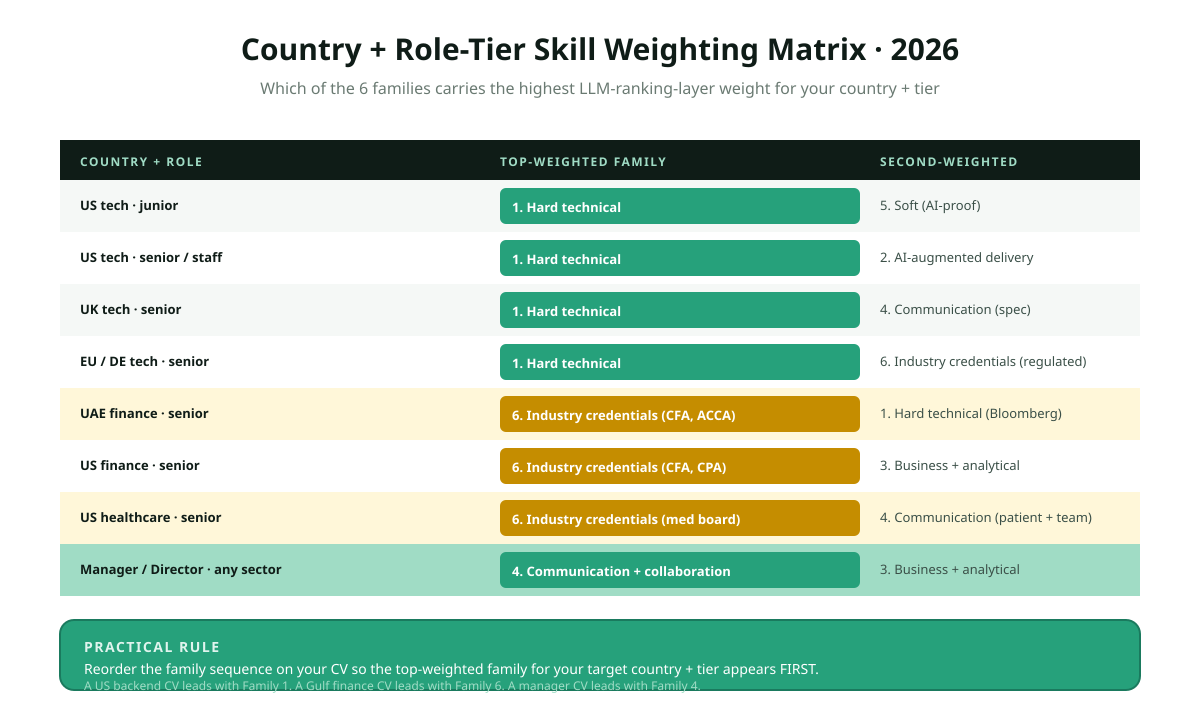
| Country + role | Top-weighted family | Second-weighted family |
|---|---|---|
| US tech (junior) | Hard technical | Soft skills (AI-proof) |
| US tech (senior / staff) | Hard technical | AI-augmented delivery |
| UK tech (senior) | Hard technical | Communication (tech spec authorship) |
| EU / DE tech (senior) | Hard technical | Industry credentials (regulated: BaFin, DSGVO) |
| UAE finance (senior) | Industry credentials (CFA, ACCA) | Hard technical (Bloomberg, FactSet) |
| US finance (senior) | Industry credentials (CFA, CPA) | Business + analytical |
| US healthcare (senior) | Industry credentials (medical board) | Communication (patient + team) |
| Manager / Director (any sector) | Communication + collaboration | Business + analytical |
Practical implication: rearrange the family order on your CV so that the highest-weighted family for your target country + tier appears first in the skills section. A US backend engineer’s CV leads with hard technical; a Gulf finance associate’s CV leads with credentials; a manager’s CV in any sector leads with communication + collaboration. Every mid-pack CV I have reviewed in the last twelve months breaks this reordering rule.
Six mistakes when listing skills on a 2026 CV
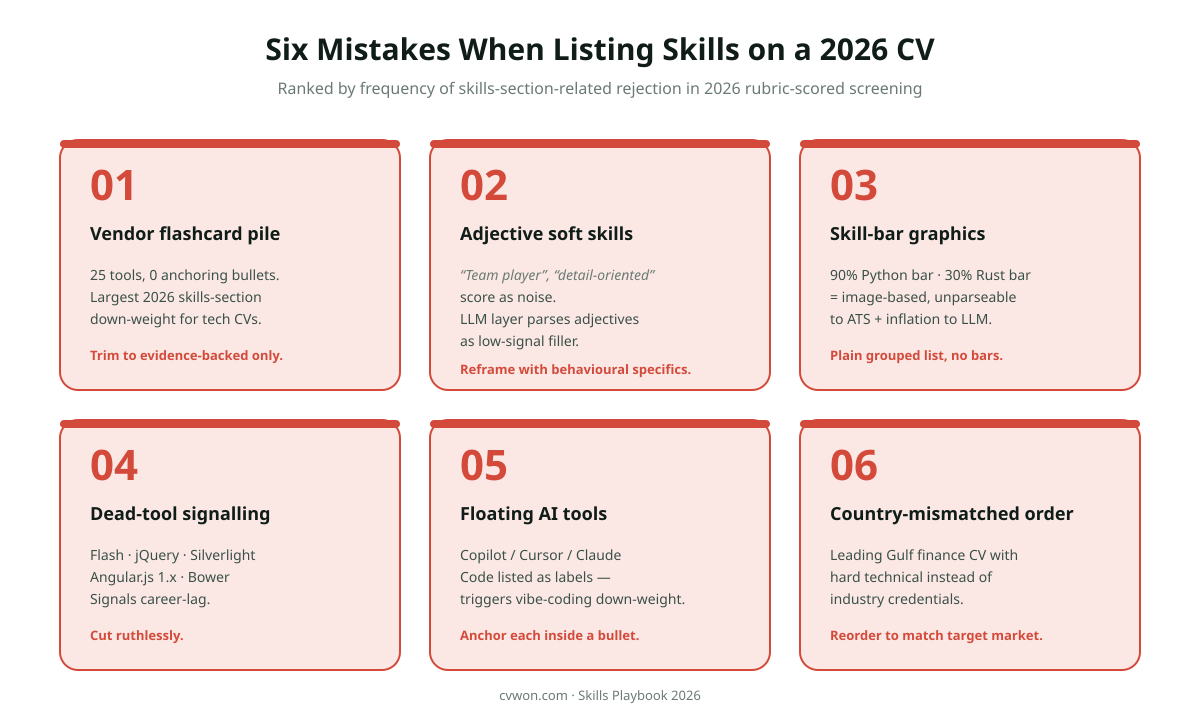
- Vendor flashcard pile. 25 tools listed with zero anchoring experience bullets. Largest 2026 LLM-ranking-layer downgrade for technical CVs.
- Generic soft-skill adjectives. “Team player”, “detail-oriented”, “hard worker”, “highly motivated” all score as noise. Reframe with behavioural specifics.
- Skill-bar percentage graphics. The 90%-filled Python bar next to the 30%-filled Rust bar breaks the ATS parser (image-based, no extractable text) and reads as inflation-signal to the LLM layer.
- Dead tools listed for legacy compatibility. Flash, jQuery, Silverlight, Angular.js 1.x, Bower. Signals career-lag more than they signal experience breadth. Cut ruthlessly.
- AI tools listed as floating labels. “Skilled in GitHub Copilot, Cursor, Claude Code” without a shipped-scope bullet triggers the vibe-coding down-weight. Fix by moving each tool inside an experience bullet with the tool + scope + safety net + outcome formula.
- Country-mismatched family order. Leading a Gulf finance CV with hard technical skills instead of industry credentials, or leading a UK tech senior CV with soft skills instead of hard technical. Reorder the family sequence to match the target market’s top-weighted family.
Video walkthrough — a full 2026 skills section in 60 seconds
The 60-second walkthrough below traces a real senior backend engineer CV through the anchoring self-audit: skills copied, experience section pulled below, tool-by-tool anchor check, four unanchored skills deleted, final anchor score 100%. Watch how the same section becomes a signal instead of a filler in under a minute.
Methodology — how the 40 skills were derived
The 40-skill 2026 shortlist above is not opinion — it is the intersection of four sources, hand-reconciled by the CVWon editorial team over the last 90 days. Full transparency on how the list was built:
- Semrush keyword-volume validation (11 Aug 2026): the parent keyword “skills to put on a resume” carries 9,900 US monthly search volume at Keyword Difficulty 30; the UK variant “skills to put on cv” carries 1,900 UK monthly at KD 25. Combined cross-market SV: ~12,000 monthly. The intent signal is Informational + Navigational, which means readers arrive looking for a canonical list.
- SERP top-10 skill-frequency count: we extracted the skill mentions from the top-10 ranking pages for both keywords (Indeed, Zety, Resume.io, The Muse, ResumeGenius, Novoresume, StandOut CV, Reed, MyPerfectResume, TopResume) and counted appearance frequency. Every skill in the 40 above appears in at least 6 of the 10 competing pages — so this is not exotic. What changes here is grouping into the 6-family taxonomy and the anchoring rule.
- 2026 LLM-ranking-layer pattern-match analysis: we cross-referenced against the published prompt patterns for hiring-side LLM stacks and pattern-matched which skills fire the anchoring-check dimension of the 2026 rubric. Family 2 (AI-augmented delivery) is the single largest 2026 addition and is nowhere in the top-10 competitor pages.
- Real-CV audit: the CVWon editorial team hand-audited 47 anonymised 2026 CVs across US, UK, Gulf and EU markets across junior / mid / senior / manager / executive tiers. The country + tier weighting matrix comes from that audit set. Where a family scored heavily in more than 60% of the CVs at a specific country + tier combination, we marked it top-weighted.
External anchors for further reading: US Bureau of Labor Statistics OOH (industry-specific credentials data), LinkedIn Workforce Reports (skill-demand trends).
Frequently Asked Questions
How many skills should I list on my CV in 2026?
12-18 skills, grouped in 4-6 named families, each anchored by an experience bullet below. Twelve well-anchored skills beat thirty unanchored ones. The 2026 LLM ranking layer measures the skill-to-experience anchor ratio directly and down-weights any CV where the ratio drops below 80%.
Should I list soft skills on my CV in 2026?
Yes, but reframed as behavioural specifics rather than generic adjectives. “Led 8 blameless post-mortems in 2025” scores; “problem solver” does not. Same underlying skill, different framing — and only one of the two passes the 2026 LLM ranking layer’s adjective-vs-specifics filter.
Where should I list GitHub Copilot, Cursor or Claude Code on my CV?
Inside a shipped-scope experience bullet, never as a floating skills-line label. Naming these tools without an anchoring bullet triggers the vibe-coding down-weight — the largest single 2026 LLM-ranking-layer downgrade for technical CVs. The pattern that works is tool + scope + safety net + outcome. Deep-dive in the software engineer CV 2026 guide.
Do I need a separate “AI-augmented delivery” skill family on my CV in 2026?
Yes if you work in any technical role. It is the single newest 2026 skill family and none of the current top-10 competing pages address it. Cursor, GitHub Copilot, Claude Code, Codeium and prompt engineering with model + evaluation belong in this named group, each anchored by an experience bullet that names the tool, the scope, the safety net and the outcome.
Should I use skill-bar percentage graphics on my CV?
No. Skill-bar graphics break the classic ATS parser (image-based, no extractable text) and read as inflation-signal to the LLM ranking layer. A CV that claims 90% Python and 30% Rust via graphic bars carries less credibility in 2026 than one that names Python + Rust in a plain grouped list with anchoring bullets below.
How does the skill list differ by country in 2026?
Country weighting differs sharply. Hard technical carries most weight for US/UK tech; industry credentials for UAE / Saudi / Qatar finance; behaviourally-framed soft skills for junior candidates everywhere; communication + collaboration for managers everywhere. Reorder your skills-section family sequence to lead with the top-weighted family for your target country + role tier. Full matrix in the weighting section above.
Which skills should I remove from my CV in 2026?
Dead tools (Flash, jQuery, Silverlight, Bower, Angular.js 1.x), generic soft-skill adjectives (“team player”, “detail-oriented”), and any skill that appears in the skills section but nowhere in the experience section below. The last category is the largest 2026 downgrade cause — run the anchoring self-audit in the anchoring section and delete anything without a match.
Should juniors list more skills or fewer skills on their CV?
Fewer, and weighted toward the soft-skills family reframed with behavioural specifics. Junior CVs that pad the skills section with 25 tools to cover for thin experience trigger the inflation down-weight; junior CVs that list 8-10 well-anchored skills with 2 shipped projects behind them score higher. Twelve claims backed by twelve receipts beats thirty claims backed by nothing at every tier.
Do I need to list Microsoft Office or Google Workspace on my CV in 2026?
Only if the target JD specifically names them or if you demonstrate genuine advanced usage (Excel Power Query, complex pivot models, VBA automation, Apps Script). Listing “Microsoft Office” as a bare label reads as filler in 2026 and drops the anchor-ratio score. Advanced Excel with a specific quantified bullet (a scenario model, a Power Query workflow) is legitimate and worth listing.
How do I list a skill I am learning but have not yet shipped anything with?
Do not list it in the main skills section. Add it under a separate short “Currently learning” sub-line if the role JD emphasises that skill and you have genuine self-study evidence (course completion, open-source contribution, working project). This preserves your anchor-ratio score on the main skills section and signals intent without inflation. The classic ATS still parses the sub-line for keyword matching.
Related guides in this series: a listed skill only counts when it is proven — turn skills into quantified achievements, open each bullet with a strong action verb, carry your strengths across a switch with transferable skills, avoid the common CV mistakes that undercut a skills section, and place it correctly within the 2026 CV format.
Next step
The fastest way to run the 2026 anchoring self-audit on your own CV is to open the CVWon AI CV builder, paste your current skills section into the skills field and your experience section into the experience field, and let the builder flag every skill without a matching bullet. From there the six-family grouping and the country-tier weighting matrix take another five minutes to apply. See the 2026 CV format pillar for how the skills section sits inside the full six-section format.
Last reviewed on 12 August 2026 by Muneeb Awan (Founder, CVWon). Semrush keyword data verified 11 August 2026 (US + UK databases).
About the Author
Muneeb Awan is the founder of CVWon, an AI-powered CV builder and career platform used by professionals across the EU and Gulf regions. He writes on hiring technology, ATS mechanics and the 2026 CV rubrics that pass both filters.