Achievements on CV 2026: Turn Duties Into Results
Last updated: 16 August 2026 · 16 min read · Reviewed by Muneeb Awan (Founder, CVWon)
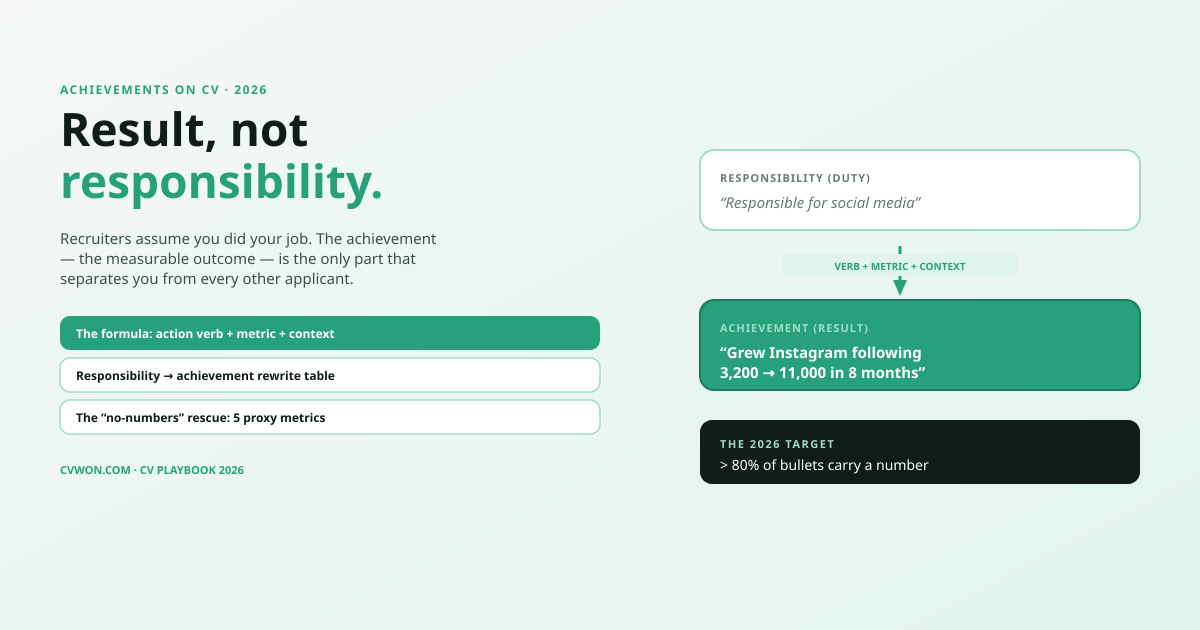
An achievement on a CV is a result you produced — not a duty you were assigned — written as an action verb plus a metric plus the context that makes it real. "Responsible for social media" is a duty; "grew Instagram following 3,200 to 11,000 in eight months" is an achievement. The difference decides whether a recruiter and the 2026 LLM ranking layer treat your bullet as evidence or filler. This guide gives you a repeatable achievement formula, a responsibility-to-achievement rewrite table, and the "no-numbers" rescue for quantifying work you think has no metrics — so every bullet on your CV earns its place.
TL;DR
- An achievement is a result, not a responsibility. "Responsible for X" is a duty; "did X, which produced Y measurable outcome" is an achievement.
- Use the achievement formula: action verb + metric + context. "Cut invoice errors 40% by rebuilding the checking process across a 6-person team."
- Quantify everything — and you almost always can. If you have no obvious number, use a proxy metric: frequency, scale, time saved, percentage, or a before/after comparison.
- The 2026 LLM ranking layer wants over 80% of your bullets to carry a number. Achievements are how you hit that; unquantified duties drag the score down.
- Lead every experience bullet with the outcome, put 3–5 achievements per recent role, and reserve a short "Key Achievements" line only if it adds evidence the roles don't.
What counts as an achievement on a CV?
An achievement on a CV is a specific result you personally produced, ideally quantified — distinct from a responsibility, which only describes what you were meant to do. The test is outcome versus task: if the bullet describes what you were supposed to do, it's a duty; if it describes what changed because you did it, it's an achievement. Recruiters skim duties and stop on achievements.

Consider the same work described two ways. "Responsible for customer complaints" tells the reader nothing about how well you did it. "Resolved 30+ complaints per week at a 96% first-contact rate" proves competence with a number. Identical job; one version is invisible, the other is evidence. This is exactly the anchoring principle the 2026 LLM ranking layer scores, as covered in our AI resume screening 2026 guide.
A responsibility says "this was my job". An achievement says "here is what changed because I did it". Recruiters already assume you did your job — the achievement is the only part that separates you from every other applicant who held the same title.
Key takeaway: before writing any bullet, ask "what changed because of this?" If you can answer with a number or a concrete outcome, you have an achievement. If you can only restate the task, it's a duty — rewrite it.
The achievement formula: action verb + metric + context
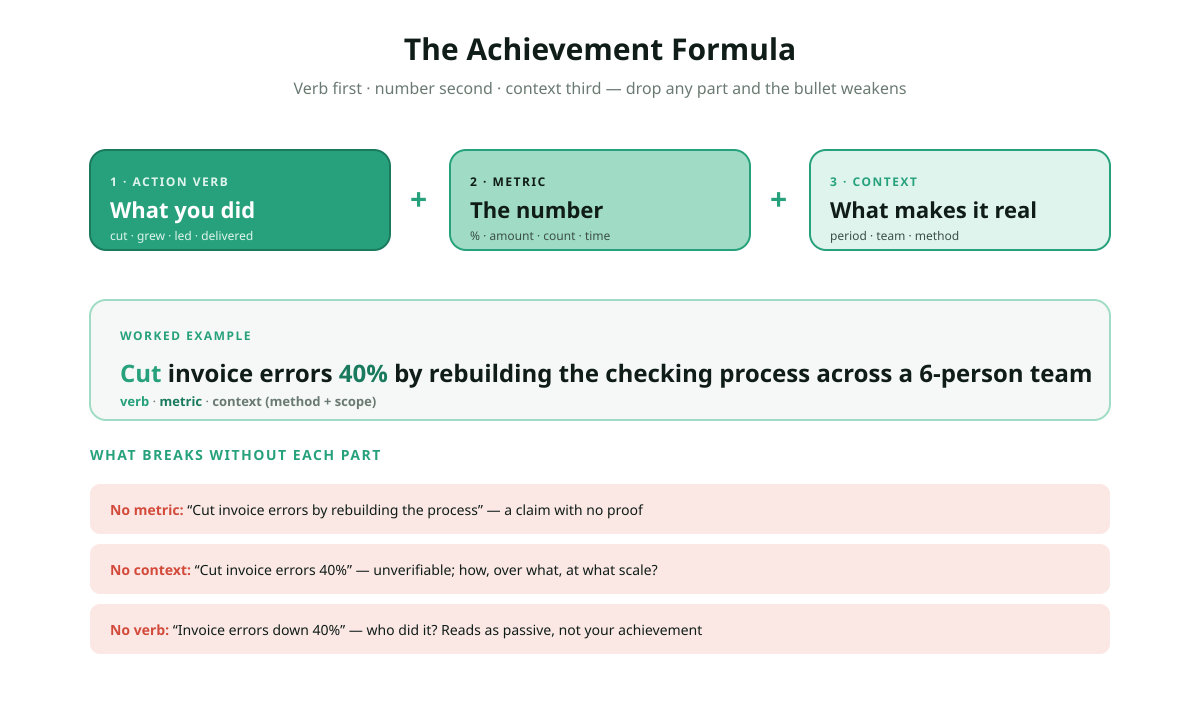
The achievement formula is: a strong action verb, plus a metric, plus the context that gives the number meaning. This is the repeatable structure most guides never hand you — they show finished examples but not the pattern, so you can't apply it to your own work. Follow the formula and any task becomes a quantified achievement.
The three parts:
- Action verb — what you did, in the past tense, leading the bullet: cut, grew, built, led, delivered, reduced, launched.
- Metric — the number that proves the result: a percentage, an amount, a count, a time saved.
- Context — the scope or method that makes the number believable: over what period, across what team, using what approach.
Applied: "Cut invoice errors 40% by rebuilding the checking process across a 6-person team." The verb (cut) leads, the metric (40%) proves it, and the context (rebuilding the process, 6-person team) makes it credible and shows how. Drop any one part and the bullet weakens — a verb with no metric is a claim, a metric with no context is unverifiable.
Key takeaway: write the verb first, attach the number second, add the context third. If a bullet is missing the number, it is a responsibility wearing an action verb — go find the metric using the rescue method below.
Responsibilities vs achievements: the rewrite table
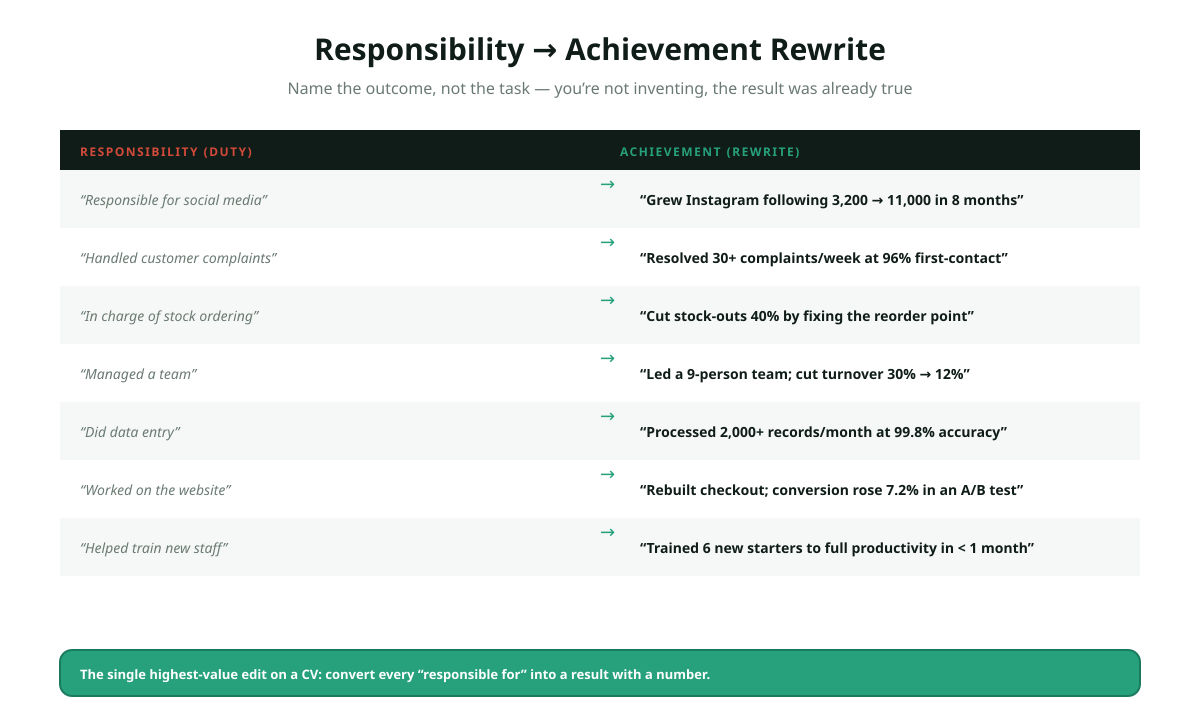
Turning a responsibility into an achievement means replacing the "responsible for" framing with a result and a number. The conversion is mechanical once you see it: name the task's outcome instead of the task itself. The table below shows the same work in both forms, so you can pattern-match your own duties.
| Responsibility (duty) | Achievement (rewrite) |
|---|---|
| "Responsible for social media" | "Grew Instagram following 3,200 → 11,000 in 8 months" |
| "Handled customer complaints" | "Resolved 30+ complaints/week at a 96% first-contact rate" |
| "In charge of stock ordering" | "Cut stock-outs 40% by fixing the reorder point" |
| "Managed a team" | "Led a 9-person team; cut staff turnover from 30% to 12%" |
| "Did data entry" | "Processed 2,000+ records/month at 99.8% accuracy" |
| "Worked on the website" | "Rebuilt the checkout page; conversion rose 7.2% in an A/B test" |
| "Helped train new staff" | "Trained 6 new starters to full productivity in under a month" |
The pattern in every row: the duty names the task, the achievement names the result and attaches a number. You are not inventing anything — the outcome was already true; you are simply stating it instead of the task. This is the single highest-value edit you can make to a CV, and it feeds directly into the quantified-bullet density the LLM layer rewards, as detailed in the common CV mistakes guide.
The "no-numbers" rescue: how to quantify anything
The "no-numbers" rescue is a set of proxy metrics you can use when a result has no obvious figure — frequency, scale, time, percentage, and comparison. Most people who believe their work "can't be measured" simply haven't checked these five angles. Almost any task carries at least one of them.
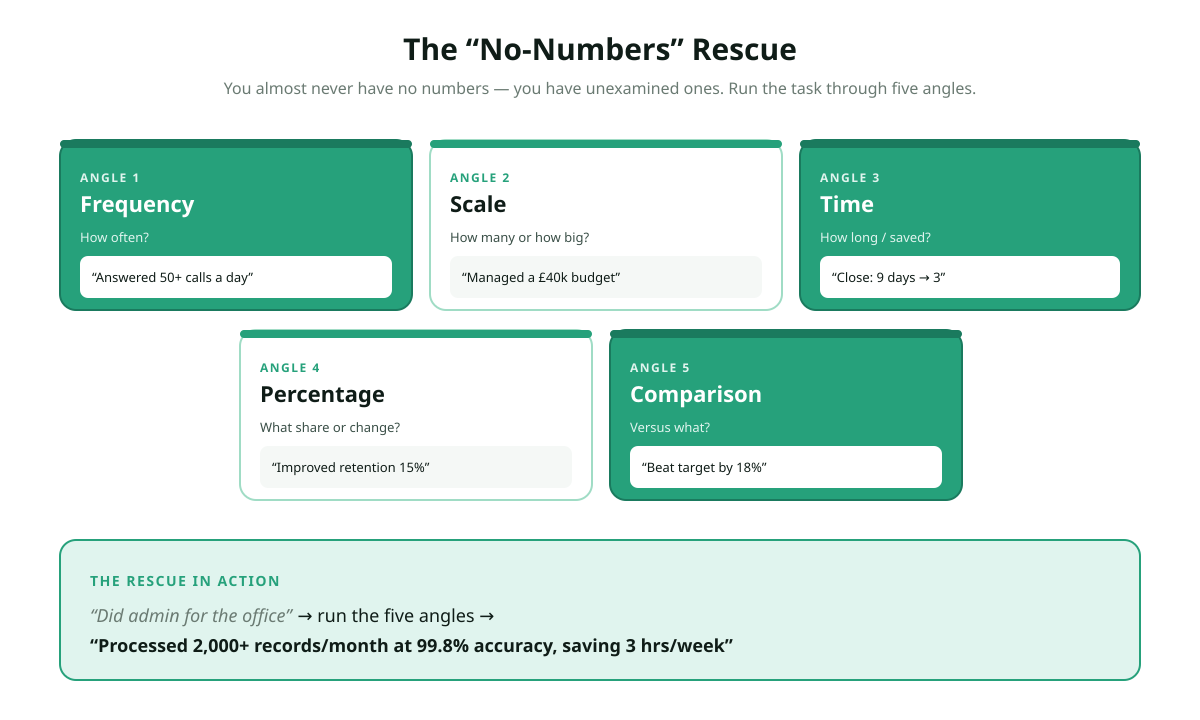
The five proxy angles, with how to apply each:
- Frequency — how often? "Answered 50+ calls a day." "Published 3 articles a week."
- Scale — how many or how big? "Managed a £40k budget." "Supported 200+ users."
- Time — how long, or how much time saved? "Cut the monthly close from 9 days to 3." "Delivered 2 weeks early."
- Percentage — what share or what change? "Improved retention 15%." "Owned 30% of the product roadmap."
- Comparison — versus what? "Beat target by 18%." "Top performer of 12 on the team."
You almost never have "no numbers" — you have unexamined ones. Run any task through frequency, scale, time, percentage and comparison, and at least one will produce a figure. The number was always there; you just had not written it down.
If you are early in your career and genuinely thin on work metrics, the same proxies apply to studies, volunteering and side projects — a society role, a fundraising total, a project's user count all count. Our CV with no experience guide shows how to build achievements from non-work evidence.
Action verbs that make achievements land
An action verb is the first word of an achievement bullet, and the strongest ones name a concrete result rather than a vague effort. "Responsible for" and "helped with" are weak openers because they describe involvement, not impact. Lead with a verb that implies a measurable change and the bullet reads as an achievement before the number even arrives.
| Weak opener | Strong action verbs by type |
|---|---|
| "Responsible for" | Improved: increased, grew, boosted, accelerated, raised |
| "Helped with" | Reduced: cut, lowered, slashed, eliminated, streamlined |
| "Worked on" | Built: launched, delivered, designed, developed, shipped |
| "Involved in" | Led: managed, directed, coordinated, mentored, drove |
| "Dealt with" | Won: achieved, secured, exceeded, ranked, awarded |
Key takeaway: delete every "responsible for", "helped with" and "worked on" from your CV and replace each with a result verb from the table. The rewrite forces you to name what you actually achieved, which is the point.
Where to put achievements on your CV
Achievements belong primarily inside your experience bullets, secondarily in the summary, and only optionally in a dedicated "Key Achievements" section. The mistake is quarantining achievements in a separate box while leaving the experience section full of duties. Achievements should be the experience section, not an appendix to it — consistent with the six-section structure in our 2026 CV format guide.
- Experience bullets (primary): 3–5 achievement bullets per recent role, each led by an outcome. This is where most of your achievements live.
- Summary (1 line): your single strongest achievement, as proof of the headline claim. "Operations lead who cut fulfilment time 35% across two warehouses."
- Key Achievements section (optional): only for senior candidates whose biggest wins span multiple roles, or where a standout result deserves top billing. Keep it to 3 lines.
Do not build a "Key Achievements" box and then repeat weaker duties below it — that signals the box is padding. Every experience bullet should be strong enough to belong there.
How many achievements, by role and tier
The right number of achievements scales with seniority: more per role as you get more senior, because each role carries more scope and results. A graduate proves potential with a few sharp achievements; a director proves impact with achievements at every role. The guiding ratio is the LLM layer's target — over 80% of your bullets should carry a number.
| Tier | Achievements per recent role | Emphasis |
|---|---|---|
| First job / graduate | 2–3 (incl. studies, projects) | Potential, initiative, learning speed |
| Mid-career | 3–5 | Consistent, quantified impact |
| Senior / manager | 4–6 | Scope, team results, cost/revenue |
| Executive | 4–6 + a summary headline | Strategy, P&L, org-level outcomes |
Older or less relevant roles need fewer — one or two achievements each, or a single summary line. Weight the achievement count toward your most recent, most relevant roles, since that is where both the 3-second scan and the LLM layer look first.
20 achievement examples by function
The 20 achievements below follow the formula — action verb, metric, context — grouped by function so you can adapt the closest match. Swap in your own numbers; keep the structure.
Sales & marketing
- Exceeded quarterly sales target by 18% across a 120-SKU range.
- Grew organic traffic 60% in 6 months via a content overhaul.
- Generated £240k in new pipeline from a single campaign.
- Lifted email open rate from 14% to 27% by rewriting subject lines.
Operations & admin
- Cut the monthly close from 9 days to 3 via a rebuilt process.
- Reduced supplier costs 12% by renegotiating 8 contracts.
- Processed 2,000+ records/month at 99.8% accuracy.
- Cleared a 3-month backlog in 6 weeks with no added headcount.
Customer & service
- Resolved 30+ complaints/week at a 96% first-contact rate.
- Raised CSAT from 3.9 to 4.6 over two quarters.
- Cut average handling time 22% while holding quality scores.
- Retained 40 at-risk accounts worth £180k annually.
Team & leadership
- Led a 9-person team; cut turnover from 30% to 12%.
- Mentored 4 juniors to promotion within 2 years.
- Delivered a cross-team project 2 weeks early with zero slippage.
- Trained 6 new starters to full productivity in under a month.
Technical & project
- Rebuilt the checkout page; conversion rose 7.2% in an A/B test.
- Cut page load from 3.8s to 1.4s, lifting mobile conversion.
- Automated a manual report, saving 3 hours a week per analyst.
- Migrated 2,000 records with zero data loss over one weekend.
Mistakes that turn achievements back into filler
The common mistake with achievements is stripping out the very detail that makes them credible — the number, the context, or the specificity. A vague achievement is just a duty in disguise. Avoid the five below to keep every bullet working as evidence.
- No number. "Improved sales significantly" is a claim; "improved sales 18%" is an achievement. Always attach the figure — use the rescue if you must.
- Vague scope. "Led a large team" — how large? Name the count.
- Taking team credit as solo. Inflated claims collapse in interviews. Frame your part honestly: "co-led", "contributed to a 20% lift".
- Listing duties dressed as achievements. An action verb on a task is still a task if there's no outcome.
- Burying the result. Lead with the outcome, not the method. "Cut errors 40% by rebuilding the process", not "rebuilt the process, which cut errors 40%".
For the full picture of what else drops a CV at the screening gates, see the common CV mistakes guide; for how achievements sit alongside your skills, the skills to put on CV guide covers the anchoring rule.
Next step
The fastest way to turn your duties into achievements is to run each experience bullet through the formula inside the CVWon CV builder: it prompts you for the action verb, the metric and the context on every line, flags bullets with no number, and suggests proxy metrics when you're stuck. Start with your most recent role and rewrite top-down.
Frequently Asked Questions
What counts as an achievement on a CV?
An achievement is a specific result you produced, ideally quantified — distinct from a responsibility, which only names the task. If a bullet says what you were meant to do, it's a duty; if it says what changed because you did it, it's an achievement. "Resolved 30+ complaints per week at 96% first-contact" is an achievement; "handled complaints" is not.
How do I write achievements if I have no numbers?
Use a proxy metric. Run the task through five angles — frequency (how often), scale (how many or how big), time (how long or how much saved), percentage (what share or change), and comparison (versus target or before). Almost any task produces a figure through at least one of these. The number was usually there; you just hadn't measured it.
What is the difference between a responsibility and an achievement?
A responsibility describes what you were assigned to do; an achievement describes the result you produced. "Responsible for stock ordering" is a responsibility; "cut stock-outs 40% by fixing the reorder point" is an achievement. Recruiters assume you did your job, so the achievement — the measurable outcome — is the part that actually differentiates you.
How many achievements should I list per job on my CV?
Three to five per recent role for mid-career candidates, two to three for graduates, and four to six for senior or executive roles. Older or less relevant roles need only one or two. The guiding target is the 2026 LLM ranking layer's preference for over 80% of bullets to carry a number, so lead with achievements rather than duties.
Where should achievements go on a CV?
Primarily inside your experience bullets, with your single strongest achievement echoed in the summary line. A separate "Key Achievements" section is optional and best reserved for senior candidates whose biggest wins span multiple roles. Avoid quarantining achievements in a box while leaving the experience section full of duties — the achievements should be the experience section.
What action verbs are best for achievements?
Result-oriented verbs that imply a measurable change: increased, grew, cut, reduced, launched, delivered, led, exceeded, secured. Avoid weak openers like "responsible for", "helped with" and "worked on", which describe involvement rather than impact. Leading with a strong verb makes a bullet read as an achievement before the number even appears.
Should I include a separate "Key Achievements" section?
Only if it adds evidence your experience bullets don't — typically for senior candidates whose standout results span several roles. Keep it to about three lines and never repeat weaker duties beneath it. For most candidates, strong achievement bullets inside each role work better than a separate box, which can read as padding if the roles below it are thin.
Do achievements really matter for ATS and AI screening?
Yes. The classic ATS matches keywords, but the 2026 LLM ranking layer specifically checks quantified-bullet density and treats numbered achievements as evidence, while scoring unquantified duties as filler. Achievements are how you meet the layer's preference for over 80% of bullets to carry a metric. Our AI resume screening guide covers the mechanics.
Can I use achievements from studies or volunteering?
Yes, especially early in your career. A fundraising total, a society membership you grew, a project's user count or a grade improvement are all legitimate achievements when quantified with the same formula. Studies, volunteering and side projects are valid sources of measurable results — the CV with no experience guide shows how to build a full CV from them.
How do I quantify an achievement without exaggerating?
State only the number that was true and frame your actual role honestly. If the result was a team effort, use "co-led" or "contributed to a 20% lift" rather than claiming it solo. Inflated or unverifiable achievements collapse under a single interview question, so a smaller honest number always beats a larger fragile one. Precision reads as more credible than roundness.
Last reviewed on 16 August 2026 by Muneeb Awan (Founder, CVWon).
About the Author
Muneeb Awan is the founder of CVWon, an AI-powered CV builder and career platform used by professionals across the EU and Gulf regions. He writes on hiring technology, ATS mechanics and the 2026 CV playbooks that pass both filters.