How to Write a CV With No Experience in 2026 (First Job & Career-Change Guide)
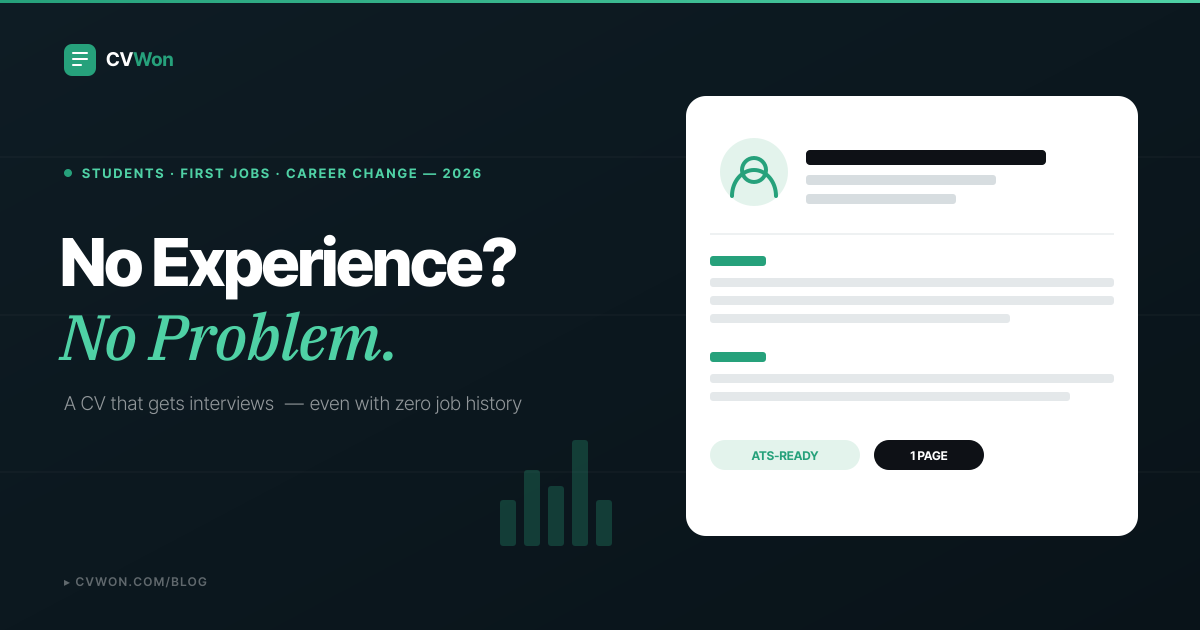
You do not need work experience to write a strong CV. You need a CV that leads with what you actually have — education, skills, and real proof of effort — instead of an empty "Experience" section. The CV format that works best with no experience puts your skills and education first, replaces work history with projects, volunteering or coursework, and proves your value with specific numbers instead of a vague list of interests.
This guide gives you that exact structure, section by section, plus a table for translating things you have actually done — a class project, a part-time job, a club, a family business — into language recruiters and applicant tracking systems reward. Every example below is something you can copy, adapt and paste today, then test with our free ATS score checker before you send it anywhere.
Do You Actually Have "No Experience"?
Before you write a single line, work out which situation actually describes you — the advice is different for each, and most guides lump all three together.
- The true first-timer. A student or recent graduate with no paid job at all. Your CV will lean hardest on education, projects and any unpaid activity.
- The career-changer. You have years of work experience — just not in the field you are now targeting. You are not "inexperienced"; you are experienced in the wrong column. Your job is to re-frame transferable skills, not invent new ones.
- The experience-blind candidate. You have done plenty — volunteering, freelance gigs, running a club, helping a family business — but you have never labelled it as "experience," so it never made it onto a CV.
If you are a career-changer, spend extra time on the professional summary and skills section below, since your existing work history still belongs on the CV — it is simply reframed around transferable skills instead of industry-specific ones. If you are a true first-timer or experience-blind, the translation table further down is the single most useful section in this guide.
The Best CV Format When You Have No Work History
Skip the purely "functional" or "skills-only" format, even though it is the most commonly recommended option online. Many recruiters and modern applicant tracking systems are trained to expect a chronological structure, and a CV with no dates at all can read as if you are hiding something — a career gap, a firing, or simply inexperience wearing a disguise.
The better option is a skills-forward hybrid: reverse-chronological in structure, but reordered so Education and Skills appear before (or immediately after) a short summary, and any Experience-equivalent section — projects, volunteering, internships — is presented with the same achievement-focused bullet style as a "real" job. You keep the format recruiters expect while leading with your actual strengths.
| Format | Best for | Risk |
|---|---|---|
| Skills-forward hybrid (recommended) | Students, first jobs, career-changers | None — familiar structure, ATS-safe |
| Pure functional / skills-only | Rarely — large, unexplained gaps | Recruiters may assume you are hiding something; harder for ATS to parse dates |
| Standard reverse-chronological | Anyone with 1+ relevant roles already | Emphasises a short or empty work history |
Whichever you use, a template built for this removes the guesswork — start from a role-specific option in our full CV template library rather than fighting a blank page.
How Long Should a No-Experience CV Be?
One page. With no work history to fill a second page, padding it out with generic interests or irrelevant details reads as filler, not effort — and it dilutes the strong material you do have. A tight, well-organised single page beats two thin ones every time. The exception is if you are a career-changer with a genuinely long, relevant employment history; in that case, keep it to what is transferable and cut older, unrelated roles rather than force two pages of padding.
Your CV Structure, Section by Section
Use this order from top to bottom. Each section is doing a specific job — cutting or reordering them is the most common reason a no-experience CV underperforms.
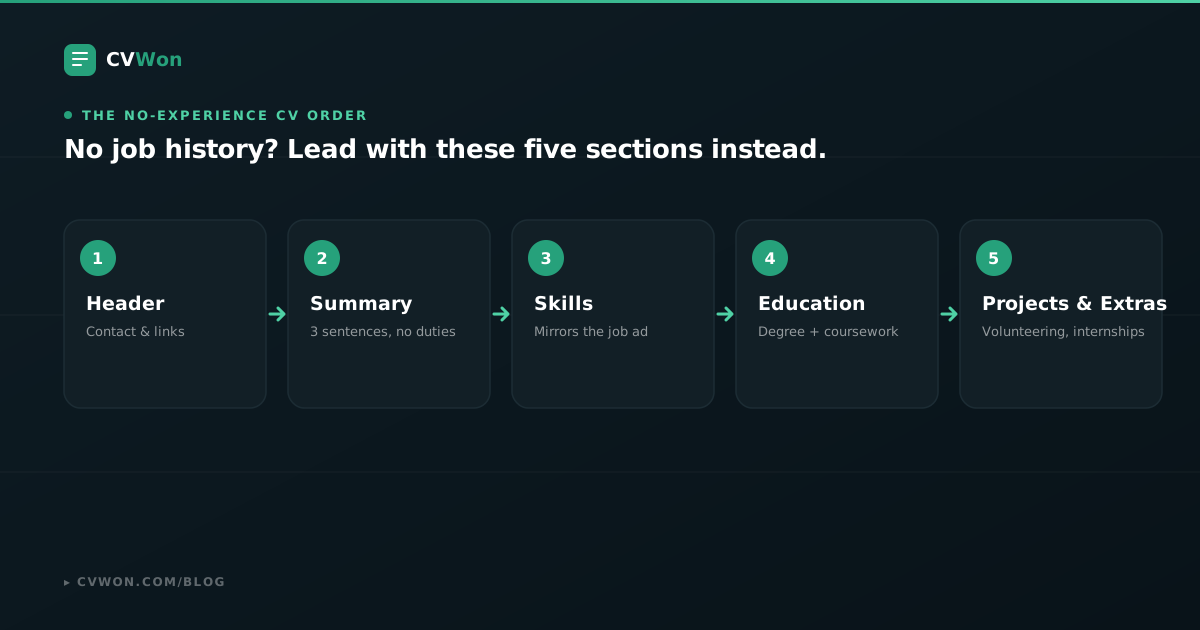
- Header — full name, phone, a professional email address, city, and links to LinkedIn or a portfolio if relevant.
- Professional summary — three to four sentences positioning you for the specific role (full formula and examples below).
- Skills — a keyword-rich block mirroring the job posting (see the next section).
- Education — degree or current study, institution, graduation year, and relevant coursework, projects or academic honours.
- Experience-equivalent — internships, part-time jobs, volunteering, freelance work, class projects or extracurricular leadership, written with the same achievement-first bullets as a paid role.
- Certifications & extras — online courses, languages, technical tools, or relevant memberships.
Notice what moved: Education and Skills come before your patchy "experience," because that is genuinely your strongest material right now. As real jobs accumulate, this order flips back to the standard experience-first CV within a year or two.
The Skills Section: Your Most Important Asset
With no work history to prove your fit, your skills section carries more weight than it would on any other CV. Split it into two groups:
- Hard skills — tools, software, languages, technical methods (e.g. "Excel," "Adobe Photoshop," "conversational Spanish," "basic SQL").
- Soft skills — but only ones you can immediately back up with a bullet elsewhere on the CV. Listing "leadership" or "hard worker" with nothing to support it is filler; listing it next to a bullet about captaining a team or running a fundraiser is proof.
Pull your exact list from the job description. Applicant tracking systems and recruiters both scan for the specific terms the employer used — if the posting says "customer service" and you wrote "client support," add both. Six to eight targeted skills beats a generic wall of twenty. Before you finalise the list, run your draft CV against a real posting with our job description analyser to see exactly which keywords you are still missing.
Turning "Non-Job" Experience Into CV Language
This is the section that changes outcomes. Almost everyone has done things that translate directly into CV-ready achievements — the only step missing is writing them in the language recruiters expect.
| What you actually did | How to write it on your CV |
|---|---|
| Led a group project at school or university | "Coordinated a 4-person team to deliver the project on a fixed deadline, dividing tasks and merging individual work into one submission." |
| Ran a club or team's social media account | "Managed a social media account for a 40-member club, planning a content calendar and growing engagement by 340 followers in one semester." |
| Organised a family event, trip or fundraiser | "Planned logistics and a fixed budget for a 30-person event, coordinating vendors and schedule from start to finish." |
| Babysat, tutored or coached younger siblings | "Provided one-on-one tutoring for two students, managing a weekly schedule and tracking progress toward specific grade goals." |
| Helped out at a family business, unpaid | "Supported daily operations at a family retail business, including inventory tracking, customer service and cash handling." |
| Wrote for a school paper, blog or class publication | "Researched and wrote 12 articles on assigned topics, consistently meeting weekly editorial deadlines." |
| Captained or organised a sports team | "Led a 15-player team, organising practice schedules and motivating members to a top-three league finish." |
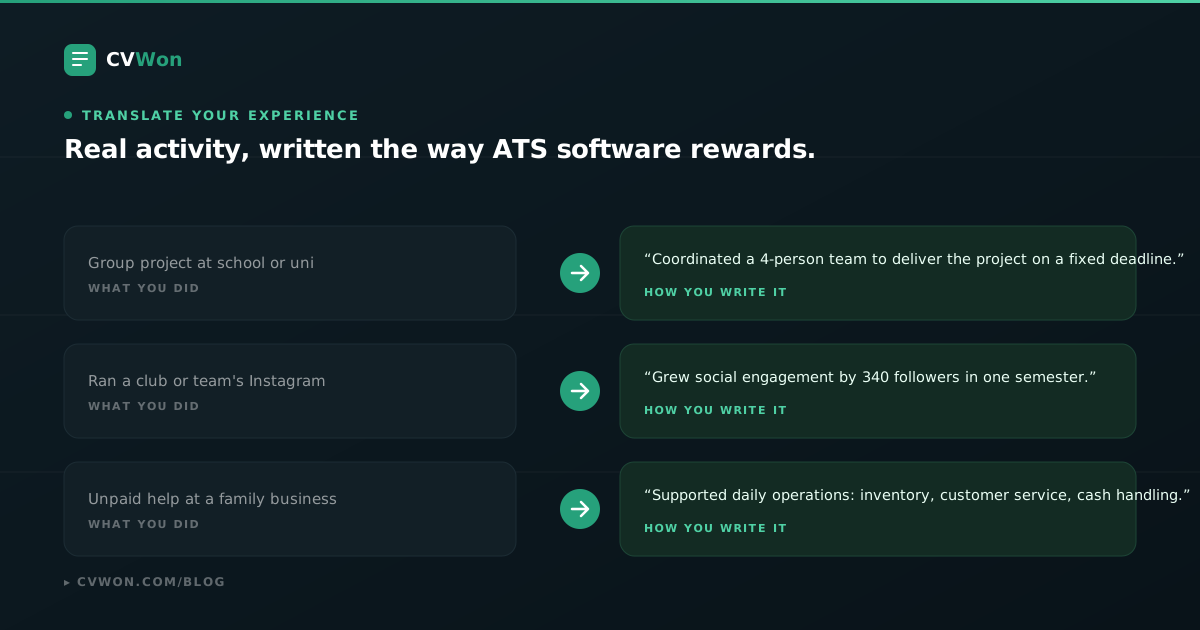
Notice the pattern in every "after" version: a specific number, a clear action verb, and a concrete outcome. That formula is the entire secret to a strong no-experience CV.
How to Write a Professional Summary With No Experience
Your summary is prime real estate — the first thing a human reads and a dense keyword zone for the ATS. In three to four sentences, cover: who you are, your strongest proof point (a project, a course, a transferable skill), and what you are looking for. Skip the outdated "objective statement" style ("Seeking a challenging position where I can grow") — it says nothing about your value and wastes the best space on the page.
Three examples, by persona:
First-timer / student: "Recent Marketing graduate (BA, University of Leeds) with hands-on experience running social campaigns for two student organisations and a four-month retail role in customer service. Comfortable with Canva, basic analytics and fast-paced environments. Seeking an entry-level marketing role where I can apply my organisational and content skills."
Career-changer: "Former high school teacher transitioning into UX design after completing a six-month, project-based UX certification. Skilled at breaking down complex information for different audiences — a skill built over five years in the classroom — and now applied across three self-directed case studies, including a full app redesign."
Returning to work: "Detail-oriented professional returning to the workforce after a three-year career break spent managing a household and volunteering as treasurer for a 200-member community association, handling budgets, correspondence and vendor coordination. Looking to bring the same organisation and reliability to an administrative role."
If summaries are your weak spot, our CV personal statement examples break the formula down further across more industries.
Real Before-and-After Bullet Examples
Every bullet on your CV should follow the same pattern: action verb, what you did, measurable result. Here is that pattern applied to the kind of activities a no-experience CV actually has to work with.
Weak: "Was part of the marketing club at school."
Strong: "Member of a 15-person university marketing club; co-created a social campaign that grew the club's Instagram following by 340 followers in one semester."
Weak: "Responsible for customer service duties during my part-time job."
Strong: "Handled 50+ customer interactions per shift at a busy retail store, resolving complaints on the spot and earning 'Employee of the Month' twice."
Weak: "Helped organise a charity event."
Strong: "Co-organised a campus fundraiser with 12 volunteers, raising $2,400 for a local shelter and managing on-the-day logistics."
Weak: "Did a group project in my final year."
Strong: "Led a 4-person capstone project analysing customer churn data, presenting findings to a 3-person faculty panel and earning a top-decile grade."
Notice that none of these require a "real" job — a club, a fundraiser and a class project all become legitimate achievements once they follow the same number-driven structure a hiring manager expects from a work-experience bullet. If you would rather start from a finished example than build bullets from scratch, browse a customer service CV example or an administrative assistant CV example for entry-level roles written this way.
Beating the ATS With a Thin Work History
A short CV is more vulnerable to an ATS rejection, not less — there is less content available to match against the keywords a system is scanning for, so every word needs to count. The essentials:
- Use a single-column layout with standard section headings ("Skills," "Education," "Experience") — avoid the two-column, icon-heavy templates that look modern but frequently get scrambled by parsers.
- Mirror the job description's exact keywords in your skills section and summary, rather than close synonyms.
- Spell out acronyms at least once, and keep dates in a consistent month/year format.
- Save as a PDF or DOCX with a clean filename such as "FirstName-LastName-CV.pdf" — avoid scanned images or design-tool exports that strip out selectable text.
We cover every one of these rules in more depth in our complete guide to beating ATS systems. Before you apply anywhere, run your finished CV through the free ATS score checker to see your compatibility score and specific fixes — aim for 80% or higher.
Common Mistakes That Sink No-Experience CVs
- Padding with irrelevant details. A full list of hobbies or unrelated personal facts reads as filler, not effort.
- An apologetic tone. Never open with "I don't have much experience, but..." — it draws attention to the exact thing you are trying to offset.
- A generic objective statement. "Seeking a challenging opportunity to grow" tells a recruiter nothing about your value. Use a proper summary instead.
- Graphic-heavy, multi-column templates. They look impressive but are frequently scrambled by ATS parsers, and can bury your strongest material in a sidebar recruiters skim past.
- Listing duties instead of outcomes — even in a class project or volunteer role. "Was involved in the bake sale" is a duty; "Managed a $300 budget across a 2-day bake sale, raising $900 for the school library" is an outcome.
- An unprofessional email address or missing contact details. Use firstname.lastname@ format if your usual address is not client-appropriate.
- Sending the same CV everywhere instead of adjusting keywords per posting — the single fastest way to a low ATS match score.
- Skipping the proofread. With less content to judge you on, a typo carries proportionally more weight.
Does the Format Change by Country?
The core structure above works globally, but personal-detail conventions vary more than most guides admit. US and Canadian CVs omit a photo and personal details entirely to avoid bias in hiring. UK and much of the EU are more relaxed about a small photo, though it is optional rather than expected. Gulf employers are the other end of the spectrum — a professional photo, nationality and visa status are genuinely expected on a UAE CV, for example, and we break that market down in detail in our guide to writing a CV for UAE jobs. If you are applying internationally, check local norms before you finalise the header — it is a five-minute check that avoids looking out of step with the market.
Pairing Your CV With a Cover Letter (and LinkedIn)
A cover letter matters more with no experience, not less — it is the one place you can directly address the gap a recruiter will notice, explain your motivation, and point to your strongest translated achievement in a way a bulleted CV cannot. Keep it to three short paragraphs: why this company specifically, your single strongest proof point, and your availability. Our 2026 cover letter guide gives you a structure you can adapt in minutes.
Before you apply, make sure your LinkedIn profile tells the same story as your CV — same job title framing, same headline skills, same summary angle. Recruiters routinely check both, and a mismatch (or a mostly-empty profile) undercuts a strong CV. Our complete LinkedIn optimization guide walks through exactly how to fix that.
Your No-Experience CV Checklist
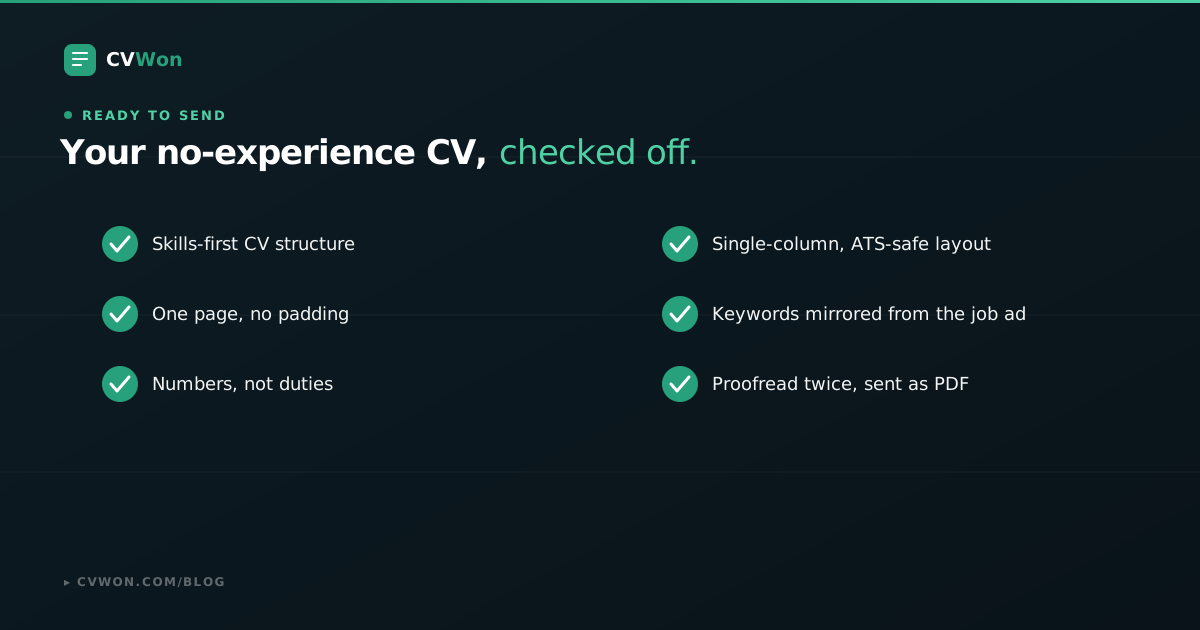
Run through this before every application:
- Summary leads with your strongest proof point, not an apology or a generic objective.
- Skills section mirrors the exact keywords in the job posting.
- Education, projects and any unpaid activity are written as achievements, not descriptions.
- Every bullet follows action verb + what you did + measurable result.
- One page, with no filler content added to look longer.
- Single-column, ATS-safe layout with standard section headings.
- Saved as a PDF or DOCX with a clean, professional filename.
- Scored 80%+ on the ATS checker before submitting.
- Cover letter and LinkedIn profile tell the same story as the CV.
Frequently Asked Questions
Can I really get a job with a CV that has no work experience?
Yes. Employers hiring for entry-level and junior roles expect little or no work history and instead screen for demonstrated skills, motivation and potential. A CV that leads with education, projects and transferable skills — backed by specific, quantified achievements — competes fully against CVs with a short work history.
What is the best CV format when you have no experience?
A skills-forward hybrid: a standard reverse-chronological structure, reordered so your Skills and Education sections appear before a thin or empty Experience section. It keeps the format recruiters and ATS software expect while leading with your genuine strengths.
Should I use a functional (skills-only) CV format?
Generally, no. A purely functional format with no dates can read as if you are hiding a gap, and many applicant tracking systems parse it less reliably than a chronological structure. A skills-forward hybrid gets you the same benefit without the downside.
What do I put on a CV if I've never had a job?
Lead with education, coursework and academic projects, then add any unpaid activity that shows initiative — volunteering, clubs, freelance work, helping a family business, or organising an event. Written with specific numbers and outcomes, these carry real weight with recruiters.
How long should a CV be with no experience?
One page. Without enough material to fill a second page honestly, padding it out with generic interests or irrelevant details reads as filler and dilutes your strongest content.
What skills should I list if I have no work experience?
Six to eight skills split between hard skills (software, tools, languages) and soft skills you can immediately back up with a bullet elsewhere on the CV. Pull the exact terminology from the job description rather than close synonyms.
Do I need a professional summary if I have no experience?
Yes — it is more important, not less. In three to four sentences it should state who you are, your strongest proof point, and what you are looking for, replacing the outdated "seeking a challenging opportunity" objective statement.
Does volunteer work count as experience on a CV?
Yes. Volunteering, internships, freelance projects and club leadership all count as legitimate experience when written with the same achievement-focused, quantified bullet style you would use for a paid role.
Will my CV get rejected by ATS if I have no experience?
Not because of the lack of experience itself, but a short CV has less content to match against a job posting's keywords, so formatting mistakes matter more. Use a single-column layout, mirror the exact keywords from the posting, and test the finished CV with a free ATS checker before applying.
Should a career-changer follow the same advice as a student with no experience?
Partly. A career-changer still lists their full work history, but reframes it around transferable skills rather than industry-specific ones. A true first-timer has no work history to reframe, so they lean more heavily on education, projects and unpaid activity.
Do I need a cover letter if I have no experience?
Yes, and it matters more than usual. A cover letter is the one place you can directly address a thin work history, explain your motivation for the role, and expand on your strongest achievement in a way a bulleted CV cannot.
Should I lie or exaggerate to cover a lack of experience?
No. Inflated titles or invented responsibilities are easy for a recruiter to probe in an interview and can cost you the offer or the job later. Translating real activity — a class project, a club, volunteering — into achievement-focused language is honest and effective; fabrication is not.
How is a no-experience CV different in the UK, US or Gulf region?
The core structure is the same everywhere, but personal-detail conventions differ. US and Canadian CVs omit a photo and personal details to avoid hiring bias; the UK and EU are more relaxed about an optional small photo; Gulf employers generally expect a professional photo, nationality and visa status. Check local norms before finalising your header if you are applying internationally.
Write the CV That Gets You Your First Interview
A thin work history is not a weakness you need to hide — it is a formatting problem you can solve. Lead with your skills and education, translate what you have actually done into achievement-focused language, keep it to one page, and make sure the finished document is ATS-safe. Every recruiter reading entry-level applications already expects a short CV; what sets yours apart is how deliberately it is built.
Ready to put it into practice? Build your CV now with our AI-powered builder, start from a role-specific CV template such as our customer service or receptionist templates, and run the finished document through the free ATS score checker before you apply. Once your CV is ready, our common interview questions guide helps you prepare for what comes next — and when an offer lands, our salary negotiation guide covers exactly what to say before you sign.
About the Author
Founder and CEO of CVWon, an AI-powered career platform used by 10M+ professionals in 80+ countries. Writing about ATS optimisation, career development, and HR technology.