How to Write a CV for Jobs in the UAE: The 2026 Guide (Dubai & Abu Dhabi)
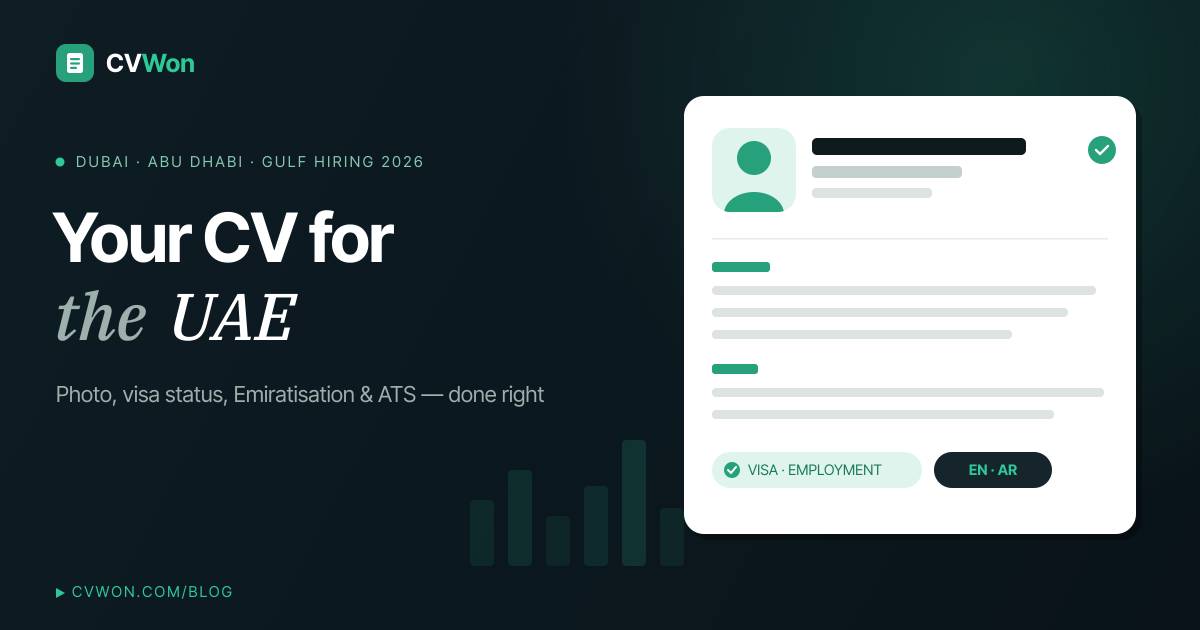
Applying for a job in Dubai, Abu Dhabi or anywhere in the Gulf means playing by a different set of rules. A CV that wins interviews in London or New York can quietly stall in the UAE — not because you are unqualified, but because Emirati recruiters, HR managers and applicant tracking systems expect information a Western CV deliberately leaves out. A UAE CV should include a professional photo, your nationality and current visa status, and be tailored to a market shaped by Emiratisation targets and the Golden Visa.
This 2026 guide walks you through the exact CV format UAE employers expect this year — what belongs at the top, how to write experience that survives an ATS scan, how Emiratisation and visa status change the way you position yourself, and the mistakes that get applications binned before a human ever reads them. Everything below is written for the real Gulf hiring market, then made testable with a free ATS score checker before you apply.
Is a UAE CV Different From a Western CV?
Yes — meaningfully. The UAE labour market is one of the most international on earth, with roughly nine in ten private-sector workers being expatriates from over 200 nationalities. That diversity is exactly why local hiring norms diverge from British or American conventions: recruiters need to screen for details that are irrelevant back home but decisive here, such as your visa status, nationality and language mix.
The single biggest mental shift is this: in the US and UK, a CV omits personal information to prevent bias. In the UAE, a CV that omits a photo, nationality and visa status often reads as incomplete, and can slow down a recruiter who needs those facts to assess hiring cost and timeline. Neither approach is "correct" — they are simply different markets. If you are still deciding which document you even need, our guide to the difference between a CV and a resume clears up the terminology first.
Here is how the two formats compare at a glance:
| Element | UAE / Gulf CV | US / UK CV |
|---|---|---|
| Photo | Expected — professional headshot, top corner | Omitted (bias concerns) |
| Nationality | Included — affects visa & Emiratisation | Never included |
| Visa / residency status | Included — employment, visit, Golden or cancelled | Not applicable |
| Date of birth / marital status | Commonly included | Omitted |
| Length | 2 pages is normal and accepted | 1 page (US) / 2 pages (UK) preferred |
| Languages | Critical — English essential, Arabic a strong asset | Optional |
| Availability / notice period | Expected — signals how fast you can start | Rarely stated |
Everything else — reverse-chronological experience, quantified achievements, clean formatting, keyword relevance — works the same way it does globally. You are not rewriting your career; you are re-framing it for a specific audience. To skip the formatting guesswork entirely, our UAE-specific CV templates are already structured for exactly these conventions.
The UAE CV Format Recruiters Expect in 2026
A strong UAE CV follows a predictable, scannable order. Recruiters in Dubai and Abu Dhabi review hundreds of applications per role, so predictability is a feature, not a limitation. Use this structure from top to bottom:
- Header with personal details — full name, professional photo, UAE mobile number (+971 if you are already here), email, city of residence, nationality, and visa status.
- Professional summary — three to four sentences positioning you for the specific role, including your years of experience and a headline achievement.
- Key skills — a tight, keyword-rich block of technical and sector skills that mirrors the job description.
- Work experience — reverse chronological, each role with company, location, dates (month and year), and four to six achievement bullets with numbers.
- Education — degree, institution, graduation year, and whether the qualification is attested (this matters for regulated roles).
- Languages — with a proficiency level for each (Native, Fluent, Professional, Basic).
- Certifications & licences — professional memberships, UAE-recognised licences, and safety or compliance credentials.
- Additional details — availability / notice period, driving licence, and references (or "available on request").
Keep the design single-column and clean. Save the two-column, icon-heavy "creative" layouts for a portfolio — as we explain below, they wreck your chances with the applicant tracking systems that Gulf employers increasingly rely on. If your field is design or media, a template like our marketing manager CV shows how to look modern without confusing the parser.
Personal Details: Photo, Nationality & Visa Status
The header is where the UAE CV diverges most sharply from Western advice, so get it right.
Photo. Include a high-quality, professional headshot — plain background, business attire, neutral expression. Avoid selfies, holiday photos or heavy filters. Place it in the top corner so it does not interfere with text parsing. A polished photo is expected across most private-sector roles in the Emirates.
Nationality. State it plainly. Because visa sponsorship costs and Emiratisation rules are tied to nationality, recruiters use this to plan the hire. There is no advantage in hiding it.
Visa & residency status. This is the detail overseas applicants most often forget, and it matters enormously. Clearly label one of the following:
- Employment visa (transferable) — you are already sponsored and can often move with an NOC.
- Visit / tourist visa — you are in the country and available for interviews now.
- Golden Visa — a major advantage; you need no employer sponsorship (more on this below).
- Cancelled visa / on notice — state your availability date.
- Overseas — willing to relocate — be explicit that you will move, and how quickly.
Contact details. If you are in the UAE, use a local +971 number and a UAE city. If you are abroad, keep an international number but state your relocation intent in the summary so a recruiter does not screen you out on location alone.
Writing a Professional Summary for the Gulf
Your professional summary is prime real estate — it is the first thing a human reads and a dense keyword zone for the ATS. In three to four sentences, state your job title, years of experience, one or two headline achievements with numbers, and your value to a UAE employer specifically.
Compare a weak, generic opener with a Gulf-tuned one:
Before: "Experienced sales professional looking for a challenging opportunity in a reputable organisation."
After: "Sales Manager with 8 years' experience across the UAE and KSA FMCG markets, consistently exceeding annual targets by 20–35%. Fluent in English and Arabic, holder of a UAE driving licence, and available to join within 30 days."
The second version names the role, quantifies performance, signals regional knowledge, and answers the practical questions (languages, licence, availability) a Gulf recruiter is already asking. If summaries are your weak spot, our CV personal statement examples break down the formula in more depth.
Work Experience and Quantified Achievements
List roles in reverse chronological order. For each, include your job title, the employer, the city and country, and employment dates in month/year format — ATS software needs those dates to calculate your total experience, and gaps or vague ranges are a common reason profiles get down-ranked.
Then write achievements, not duties. Every bullet should ideally follow a simple pattern: action verb, what you did, and a measurable result. Numbers travel across languages and cultures, and they are what both recruiters and parsers reward.
- Weak: "Responsible for managing the sales team."
- Strong: "Led a 12-person sales team across Dubai and Sharjah, growing regional revenue from AED 4.2M to AED 6.8M in 18 months."
Where relevant, add context that resonates locally: experience with GCC clients, regional expansion, multi-nationality team leadership, or knowledge of local regulations. A civil engineer should reference project values and authorities like Dubai Municipality; a nurse should reference DHA, DOH or MOH licensing. Profession-specific templates make this easier — see our civil engineer, registered nurse, accountant and construction project manager CV templates, or browse the full library of profession-specific CVs.
Skills, Languages & Certifications
Skills. Include a dedicated skills section that mirrors the exact terminology in the job posting — this is your highest-value keyword zone. Group skills logically (for example, "Software: SAP, Oracle, Advanced Excel" and "Sector: IFRS, VAT compliance, financial modelling"). List only skills you genuinely hold; modern parsers cross-check them against your experience.
Languages. In the UAE, languages are not a footnote — they are a qualification. English is essential for almost every professional role. Arabic is a significant advantage, particularly for government, semi-government, banking, legal and customer-facing positions, and it is often decisive for roles linked to Emiratisation. List every language with an honest proficiency level. If you speak Hindi, Urdu, Tagalog, French or Russian, include them; the Gulf's customer base is genuinely multilingual.
Certifications & attestation. Professional licences and memberships carry weight — PMP, CFA, ACCA, CIPD, healthcare licences (DHA/DOH/MOH), and trade certifications (NEBOSH, IOSH). For many regulated and government roles your degree must be attested by the UAE Ministry of Foreign Affairs, so note where your qualifications are already attested. It removes a question mark from your file.
Emiratisation, the Golden Visa & Your CV
Two policy forces shape the 2026 hiring market, and both should influence how you position yourself.
Emiratisation (Nafis). Under the UAE Cabinet's Emiratisation policy, private-sector companies with 50 or more employees must raise the share of UAE nationals in skilled roles by 2% each year, targeting 10% by the end of 2026, with penalties of AED 9,000 per month for each unfilled position. What this means for your CV depends on who you are. If you are an Emirati national, say so prominently — you are in high demand, and employers can access Nafis salary support of up to AED 8,000 per month, so make your nationality and any Nafis eligibility impossible to miss. If you are an expatriate, target private, free-zone and specialist roles where your specific expertise is the deciding factor, and lead with the skills that make you hard to replace. You can read the official rules on the UAE Government portal.
The Golden Visa. If you hold a 10-year Golden Visa — or qualify for one — put it on your CV. It signals stability and removes sponsorship cost and paperwork for the employer, which is a genuine competitive edge. Following the April 2026 expansion, eligibility now reaches more professionals, including nurses, teachers, and specialists in data science, AI, healthcare and clean-energy engineering earning at least AED 30,000 per month, alongside the established investor and specialist routes. Details are on the official Golden Visa page. Even if you are not yet eligible, knowing the thresholds helps you frame your salary expectations and long-term intent.
Beating the ATS in the Gulf
Do not assume the Gulf is behind on hiring technology — it is not. Large regional employers such as airlines, banks, telecoms, retail groups and government entities run applicant tracking systems like Taleo, SuccessFactors and Workday, and job boards popular in the region feed structured data into them. If your CV is not machine-readable, it may be filtered out before any recruiter sees your photo or your achievements.
The core rules are universal, and we cover them in depth in our complete guide to beating ATS systems. The essentials:
- Use a single-column layout with standard section headings ("Work Experience," "Education," "Skills").
- Avoid tables, text boxes, icons and graphics for core content — parsers read them unreliably or skip them.
- Keep your photo as a simple image in a corner, and keep all critical text outside headers and footers.
- Mirror the job description's exact keywords, and spell out acronyms once — "Wage Protection System (WPS)."
- Submit as a PDF or DOCX with a clean filename such as "FirstName-LastName-CV.pdf."
Before you apply anywhere, run your CV through our free ATS score checker to see your compatibility score and specific fixes, and use the job description analyser to extract the exact keywords a given posting is screening for. Aim for a score of 80% or higher before you hit submit.
Applying: Free Zone vs Mainland, WPS & Cover Letters
A little context about how UAE employment works will sharpen your applications. Employers are broadly split between mainland companies (licensed by the emirate's economic department and subject to MOHRE labour rules and Emiratisation) and free-zone companies (licensed by one of the 40-plus free zones, with their own employment frameworks). Both are legitimate; the distinction affects visa sponsorship and, sometimes, Emiratisation exposure. Salaries in the private sector are typically paid through the government's Wage Protection System (WPS), so referencing your understanding of local employment norms signals that you are a low-friction hire.
On cover letters: they are still expected for professional and senior roles, especially via email applications. Keep it to three short paragraphs — why this company, your most relevant proof point, and your availability and visa status. Our 2026 cover letter guide gives you a structure you can adapt in minutes. When you apply through LinkedIn or a job portal, still attach a tailored CV rather than relying on your profile alone.
Common UAE CV Mistakes to Avoid
These are the errors that most often cost qualified candidates an interview in the Emirates:
- Omitting visa status. Recruiters need it to plan the hire; leaving it out creates friction and can push your CV to the bottom of the pile.
- Using a Western no-photo, no-personal-details format. It can read as incomplete to a Gulf recruiter who expects a photo, nationality and languages.
- A casual or missing photo. A selfie undermines an otherwise strong CV; no photo at all raises questions.
- Creative multi-column templates. They look impressive but are frequently scrambled by ATS parsers.
- Vague, duty-based bullets. "Responsible for…" with no numbers is forgettable and unquantifiable.
- Ignoring Arabic and other languages. Under-listing languages throws away a real Gulf advantage.
- One generic CV for every role. Failing to tailor keywords to each posting is the fastest way to a low ATS score.
- No availability or notice period. Employers want to know when you can start; silence invites assumptions.
Your UAE CV Checklist for 2026
Run through this before every application:
- Professional headshot in a top corner, business attire, plain background.
- Header includes nationality, visa status, UAE contact details and languages.
- Professional summary names the role, quantifies experience, and states availability.
- Skills section mirrors the job posting's exact keywords.
- Experience bullets use action verbs and measurable results (with AED figures where possible).
- Dates are in month/year format with no unexplained gaps.
- Certifications, licences and attestation status are listed.
- Single-column, ATS-safe layout saved as PDF or DOCX with a clean filename.
- Two pages maximum, tailored to the specific role.
- Scored 80%+ on the ATS checker before submitting.
Frequently Asked Questions
Should I put a photo on my CV for UAE jobs?
Yes. Unlike the US and UK, UAE employers expect a professional headshot on your CV. Use a plain background and business attire, place it in a top corner, and avoid selfies or filtered images so it looks polished and does not interfere with ATS text parsing.
Do I need to include my visa status on a UAE CV?
Yes. Clearly stating whether you hold an employment visa, visit visa, Golden Visa or cancelled visa — or are overseas and willing to relocate — helps recruiters plan the hire. Omitting it is one of the most common reasons applications from strong candidates stall.
How long should a UAE CV be?
Two pages is standard and fully accepted in the UAE, giving you room for a photo, personal details and quantified achievements. Keep it tight and relevant; three pages or more is usually too long unless you are in an academic or highly senior technical role.
Is Arabic required to get a job in Dubai or Abu Dhabi?
For most private-sector and free-zone roles, English is sufficient and Arabic is not required. However, Arabic is a significant advantage — and sometimes essential — for government, semi-government, banking, legal and customer-facing roles, so always list it if you speak any.
What is the best CV format for the UAE?
A clean, single-column, reverse-chronological format with a header (photo and personal details), professional summary, key skills, work experience, education, languages and certifications. This structure is both recruiter-friendly and safe for the applicant tracking systems large Gulf employers use.
Do UAE employers use applicant tracking systems (ATS)?
Yes. Major UAE airlines, banks, telecoms, retail groups and government entities use ATS platforms such as Taleo, SuccessFactors and Workday. Use a single-column layout, standard headings and job-specific keywords, then test your CV with a free ATS checker before applying.
How does Emiratisation affect my job application?
Emiratisation requires private companies with 50+ employees to increase Emirati hiring in skilled roles by 2% a year toward 10% by the end of 2026. Emirati nationals should highlight their nationality and Nafis eligibility prominently; expatriates should target roles where specialist expertise is the deciding factor.
Should I mention my Golden Visa on my CV?
Absolutely. A Golden Visa signals stability and removes sponsorship cost and paperwork for the employer, which is a real advantage. State it in your header near your visa status so recruiters see it immediately.
Can I apply for UAE jobs from outside the country?
Yes, many candidates are hired from abroad. State clearly that you are willing to relocate and how quickly you can join, keep an international contact number, and emphasise skills that are in short supply locally so an employer sees the value in sponsoring your move.
Do I need to attest my degree for UAE jobs?
For many regulated, government and semi-government roles, your degree must be attested by the UAE Ministry of Foreign Affairs. Even where it is not mandatory, noting that your qualifications are already attested removes a hurdle and reassures the employer.
What salary should I put on my UAE CV?
Do not state a current or expected salary on the CV itself. Salaries in the UAE are negotiated separately and often requested in the application form or interview. Keep the CV focused on achievements, and discuss compensation once mutual interest is established.
Build a UAE-Ready CV That Gets Interviews
Winning a role in the UAE is not about a flashy design or a longer CV — it is about giving Gulf recruiters and their software exactly what they expect: a clear photo, honest personal and visa details, quantified achievements, the right languages, and a clean layout that survives an ATS scan. Frame your experience for this market, respect the 2026 realities of Emiratisation and the Golden Visa, and you turn a generic application into a genuine contender.
Ready to put it into practice? Build your UAE CV now with our AI-powered builder, start from a purpose-built UAE CV template, and run the finished document through the free ATS score checker before you apply. Do that, and you will be ahead of the vast majority of candidates competing for the same Dubai and Abu Dhabi roles.
About the Author
Founder and CEO of CVWon, an AI-powered career platform used by 10M+ professionals in 80+ countries. Writing about ATS optimisation, career development, and HR technology.