CV Format 2026: Layout ATS + LLM Screeners Reward
Last updated: 11 August 2026 · 21 min read · Reviewed by Muneeb Awan (Founder, CVWon)
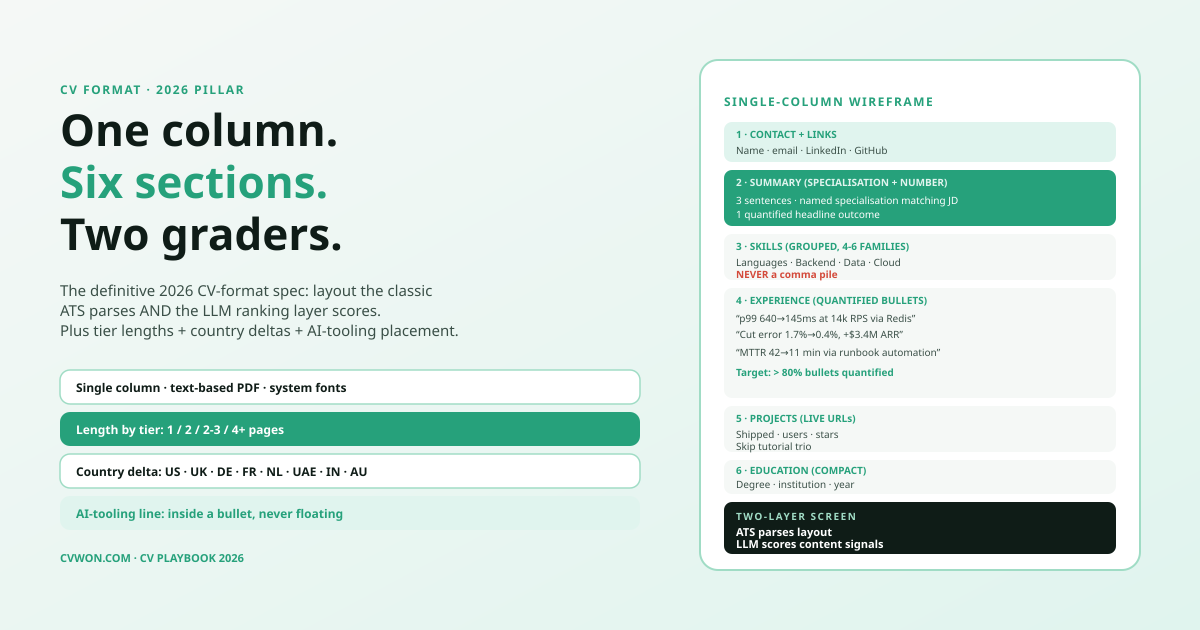
The right CV format in 2026 is judged by two screening layers, not one — a classic ATS parses your layout for text extractability while a separate LLM ranking layer scores your section order, quantified-bullet density, specialisation clarity and skill-to-experience anchoring regardless of layout. A CV that clears the ATS but reads as unstructured to the LLM layer still lands mid-pack. The single-column, top-to-bottom, text-based-PDF layout is the only format that consistently clears both, and the 2026 changes to page-length rules, country conventions and AI-tooling line placement matter more than the classic chronological-vs-functional-vs-combination debate every guide still leads with. This is the definitive 2026 CV format guide: the two-layer screening rubric, the six-section order, the tier-based length rule, the country-delta matrix for US / UK / EU / Gulf / India / Australia, the font-and-file-format checklist, and five specific format mistakes that break 2026 parsing.
TL;DR
- Single-column, top-to-bottom, text-based PDF from a real editor is the only 2026 CV format that clears both the classic ATS and the LLM ranking layer. Two-column templates with sidebar skills still garble in the parser in 2026 — the persistence of this problem is the single biggest format-related rejection cause.
- Six sections, in this order: contact + links, summary with specialisation and one quantified outcome, skills grouped by domain, experience with quantified bullets, projects with live URLs, education. Reordering — especially putting skills at the top or education above experience for mid-career candidates — is a 2026 red flag.
- Length rule by tier, not by years: 1 page under 5 years shipped experience, 2 pages senior / staff / manager, 2-3 pages executive, 4+ pages academic and medical. Never 3 pages for a non-executive tech CV in 2026.
- The chronological format is the correct 2026 default for 90% of candidates. Functional (skills-first) format now signals hiding-a-gap to both the LLM ranking layer and human recruiters and should be avoided except in narrow career-change cases.
- CV format conventions differ sharply by country in 2026: photo (Germany yes, US no, UK no, Gulf yes), page count, personal details block, references. Copy-pasting a US resume format into a Gulf application drops you at gate one.
What “CV format” actually means in 2026 (two-layer definition)
“CV format” in 2026 means two things that used to be one: the visual layout that a classic ATS parses text out of, and the structural signals that a separate LLM ranking layer scores independently of layout. Almost every “best CV format 2026” guide still treats format as one problem — ATS-friendly-or-not — and misses the second layer entirely. That is why formatting advice that used to work in 2022-2024 quietly stopped ranking candidates in 2026.

The two layers, side by side:
| Layer | What it scores | What breaks it |
|---|---|---|
| Classic ATS (parsing layer) | Text extractability, keyword matching against the JD, section detection, contact fields | Two-column sidebars, image-based section headers, custom fonts, tables in the body, non-standard PDF |
| LLM ranking layer (2026 addition) | Specialisation clarity in the summary, quantified-bullet density, skill-to-experience anchoring, tier-appropriate scope vocabulary | Generic summary, unquantified bullets, vendor-flashcard skills without matching experience, mismatched title scope |
The two layers overlap on some signals (a broken parse fails both), but the LLM layer is content-sensitive in a way the classic ATS is not. A cleanly parsed CV with a generic summary and unquantified bullets clears the first gate and drops at the second. The 2026 CV format has to satisfy both. See our deep-dive on the LLM layer specifically in AI resume screening 2026: how the LLM hiring stack works.
The 2026 CV format problem is not “which layout parses cleanly”. It is “which layout parses cleanly AND signals structured, quantified, specialisation-clear content to the second scoring layer”. Solve for one and you land mid-pack. Solve for both and you clear the shortlist gate.
Key takeaway: assume two graders, not one. The correct 2026 CV format is the intersection of what parses cleanly and what scores well on structured content signals.
The three CV format types — and which one to use in 2026
There are three named CV format types in 2026 — chronological, functional, and combination — and the correct default choice for roughly 90% of candidates is chronological. The functional (skills-first) format now actively signals hiding-a-gap to both human recruiters and the LLM ranking layer and should be avoided outside a narrow career-change case.
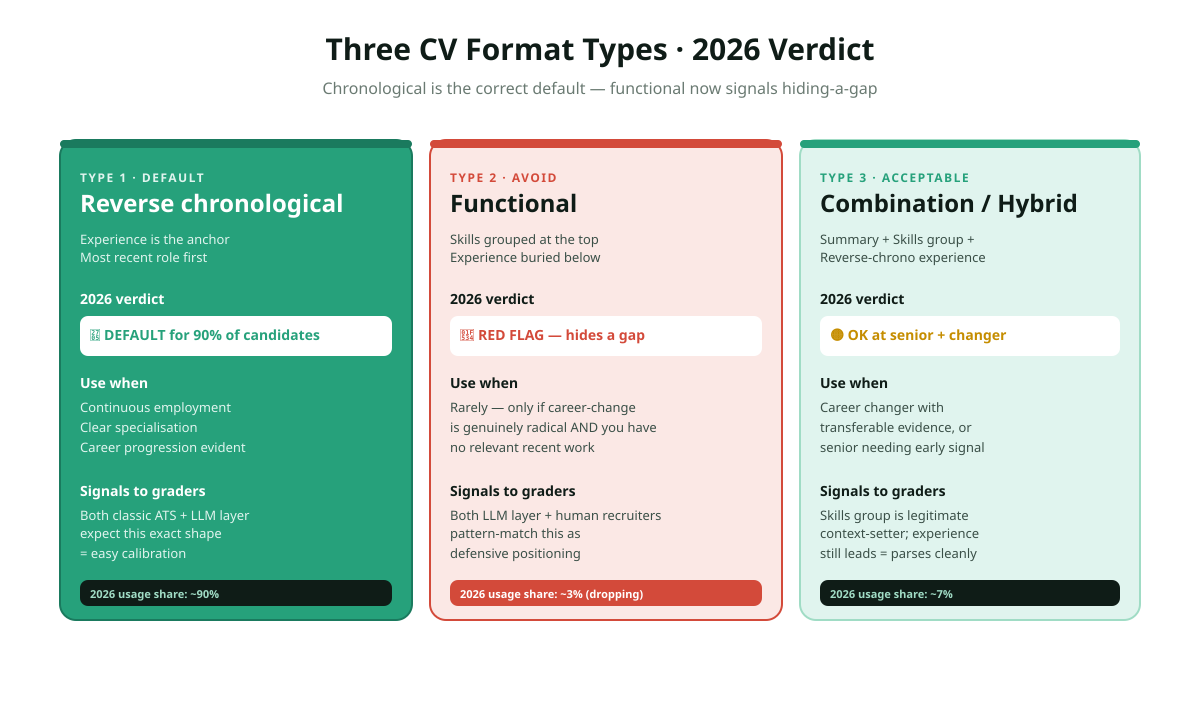
| Format type | What it prioritises | 2026 verdict | When to use |
|---|---|---|---|
| Reverse chronological | Experience as the anchor, most recent first | ✅ Default choice for 90% of candidates | Continuous employment, clear specialisation, career progression evident |
| Functional (skills-first) | Skills grouped at the top, experience buried below or listed by title only | 🔴 Red flag — reads as hiding a gap | Rarely — only if the career-change is genuinely radical and you have no relevant recent work |
| Combination / Hybrid | Strong summary + skills group + reverse-chronological experience | 🟡 Acceptable at senior + career-changer | Career changer with transferable evidence, senior candidate with strong specialisation to signal early |
The 2026 shift: the functional format used to be the recommended tool for career-changers and gap candidates. Both the LLM ranking layer and modern recruiters now pattern-match “skills at the top, experience buried” as the shape of a defensive CV, and the response is more sceptical, not more sympathetic. If you have a gap, name it briefly and use the chronological or hybrid format — do not hide the sequence.
Key takeaway: pick reverse chronological by default. Reach for hybrid only if you have a specialisation you need to signal in the first section (senior + career-changer). Skip functional in 2026.
The 2026 six-section order every CV needs
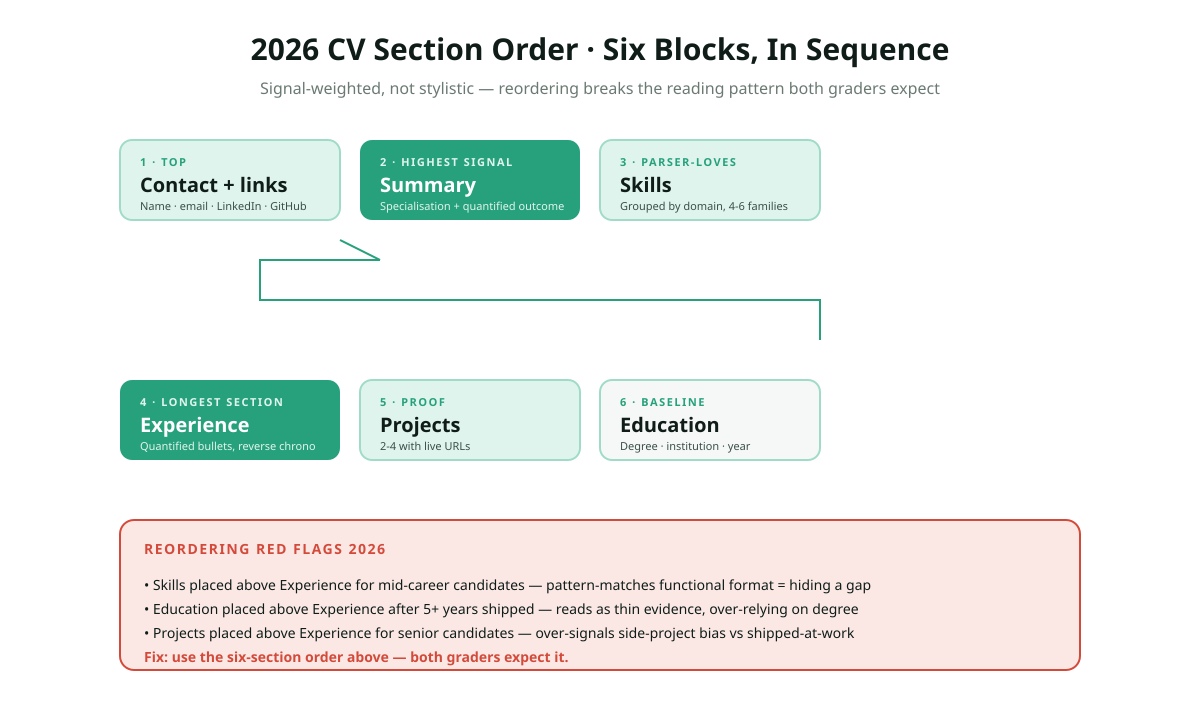
The 2026 CV format is six sections in this exact order: contact + links, summary with specialisation, skills grouped by domain, experience with quantified bullets, projects with live URLs, education. Reordering the sections — especially putting skills above experience for mid-career candidates or education above experience after five years shipped — is a 2026 format-level red flag that both the classic ATS and the LLM ranking layer pattern-match negatively.
Section 1 — Contact + links (2-3 lines)
Name, city + country (not full address), email, phone, LinkedIn URL, GitHub URL if technical role. The GitHub URL is now the second line recruiters click on technical CVs in 2026 — see the software engineer CV 2026 guide for the empty-vs-missing GitHub rule.
Section 2 — Summary (2-3 sentences, specialisation-anchored)
Named specialisation matching the JD title, years of shipped experience, one quantified headline outcome. This is the single most-weighted section in 2026 for both the classic ATS keyword match and the LLM ranking layer specialisation-clarity check.
Section 3 — Skills (grouped by domain, 4-6 groups)
Group your skills into 4-6 named families rather than one comma-separated pile. A single-column comma pile parses badly in the classic ATS and gets down-weighted by the LLM ranking layer. Every skill listed must appear anchored by an experience bullet somewhere below.
Section 4 — Experience (reverse chronological, quantified bullets)
Company, title, dates, one-line company descriptor, then 4-6 bullets per role. Lead each bullet with the outcome number, not the activity. Target > 80% quantified-bullet density (percentage of bullets with a system-or-business number).
Section 5 — Projects (2-4 with live URLs)
Not toy tutorials. Shipped side projects, open source contributions or hackathon wins with a live URL and a one-line traffic or user number. Junior candidates weight this section higher (2-4 projects); senior candidates can cut to 1-2 flagship links.
Section 6 — Education (compact)
Degree + institution + year. Under 5 years shipped: include GPA if strong. Over 5 years shipped: cut GPA. Certifications sit here only if directly relevant to the target role.
Key takeaway: the section order is not stylistic. It is signal-weighted. Contact first (routing), summary second (specialisation), skills third (parser), experience fourth (evidence), projects fifth (proof), education sixth (baseline). Reordering breaks the reading pattern both graders expect.
Length rules by role tier (not by years)
The 2026 CV length rule is tier-based, not years-based: 1 page for junior IC, 2 pages for senior / staff / manager, 2-3 pages for executive, 4+ pages for academic and medical. The old “one page under 5 years, two pages otherwise” heuristic still holds directionally but under-serves several 2026 tiers. Overshooting the tier reads as inflated; undershooting reads as under-signalled.
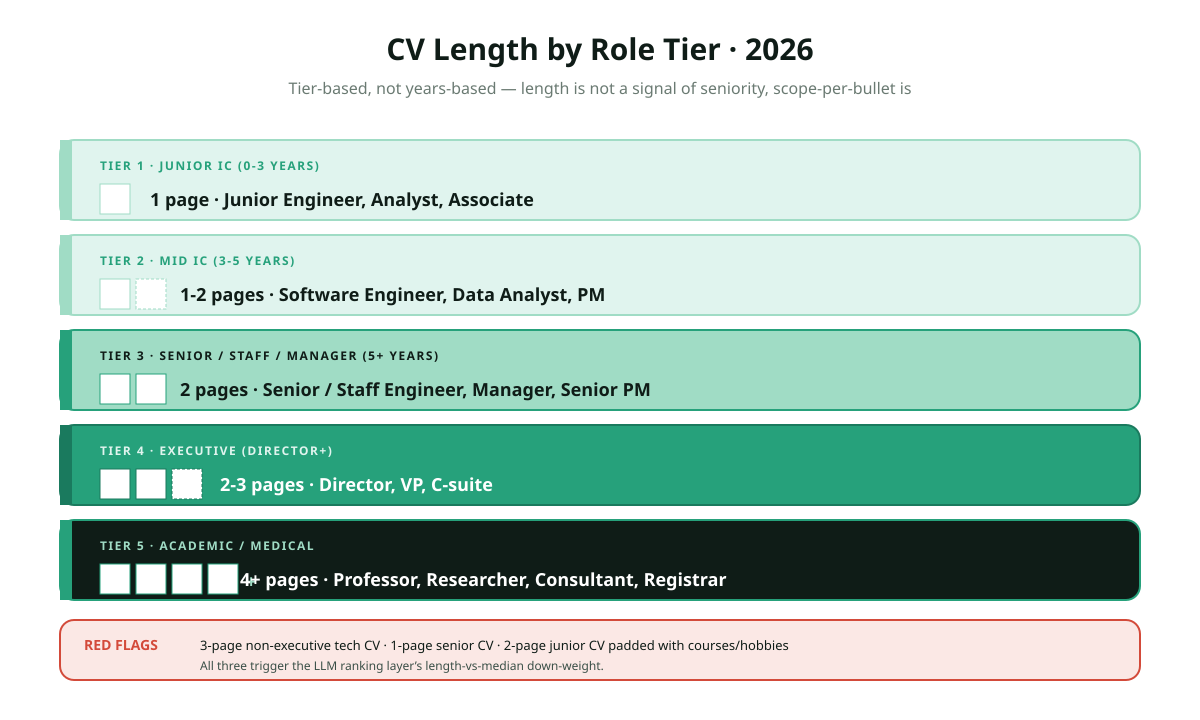
| Tier | Target length | Example titles |
|---|---|---|
| Junior IC (0-3 years) | 1 page | Junior Engineer, Analyst, Associate |
| Mid IC (3-5 years) | 1-2 pages | Software Engineer, Data Analyst, PM |
| Senior IC / Staff / Manager | 2 pages | Senior / Staff Engineer, Manager, Senior PM |
| Executive (Director+) | 2-3 pages | Director, VP, C-suite |
| Academic | 4+ pages (CV, not resume) | Assistant / Associate / Full Professor, Researcher |
| Medical | 4+ pages (with publications) | Consultant, Registrar, Specialist |
Three specific 2026 length red flags to avoid:
- Three-page non-executive tech CV. The 2026 LLM ranking layer down-weights three-page CVs against the two-page median in the same rubric slot. If your Staff Engineer CV spills to three pages, cut — length is not a signal of seniority; scope-per-bullet is.
- Single-page senior CV. A Senior Engineer with 7 years of shipped experience compressed onto one page reads as under-detailed and forces the LLM ranking layer to score you on a thin evidence set. Use two pages.
- Two-page junior CV. Padding a 2-year experience section with coursework and hobbies to fill two pages triggers the recruiter’s inflated-signal pattern-match. Use one page.
The 2026 country CV-format delta matrix (US / UK / EU / Gulf / India / Australia)
CV format conventions differ sharply by country in 2026 — photo, page count, personal-details block, references and DOB conventions each have distinct regional rules. Copy-pasting a US resume format into a Gulf application drops you at gate one; sending a UK CV to a German employer that expects a Lebenslauf format lands mid-pack. Match the target country’s convention before you send.
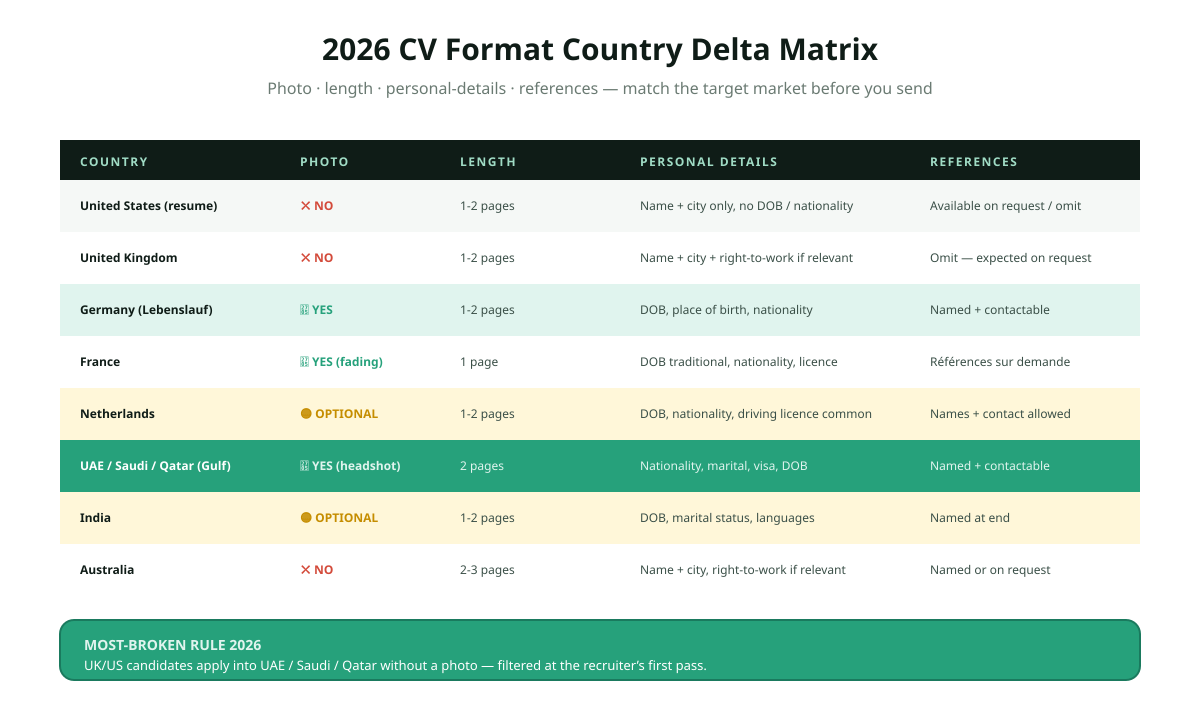
| Country | Photo | Length | Personal details | References |
|---|---|---|---|---|
| United States (resume) | ❌ No | 1-2 pages | Name + city only, no DOB / nationality | “Available on request” or omit |
| United Kingdom (CV) | ❌ No | 1-2 pages | Name + city + right-to-work status if relevant | Omit — expected on request |
| Germany (Lebenslauf) | ✅ Yes (professional) | 1-2 pages | DOB, place of birth, nationality, marital status optional | Contactable references at the end |
| France | ✅ Yes (optional, trend fading) | 1 page | DOB traditionally, nationality, driving licence | “Références sur demande” |
| Netherlands | 🟡 Optional (professional if used) | 1-2 pages | DOB, nationality, driving licence common | Names + contact allowed |
| UAE / Saudi / Qatar (Gulf) | ✅ Yes (professional headshot) | 2 pages | Nationality, marital status, visa status, DOB | Referees named + contactable |
| India | 🟡 Optional | 1-2 pages | DOB, marital status, languages spoken | Referees named at the end |
| Australia | ❌ No | 2-3 pages | Name + city, right-to-work if relevant | Referees named or on request |
The most-broken rule in 2026 is the UAE / Saudi / Qatar photo requirement — UK and US candidates applying into the Gulf regularly send photo-less CVs and get filtered out at the recruiter’s first pass. Add a professional headshot for Gulf applications. Deep-dive on the Gulf application specifics in our how to write a CV for jobs in the UAE guide.
Key takeaway: the country delta is not cosmetic. Photo, DOB, and page-count expectations are hard filters at the recruiter’s first pass in-region. Match the target market’s format before you send.
Two-layer screening: what the ATS rewards vs what the LLM layer rewards
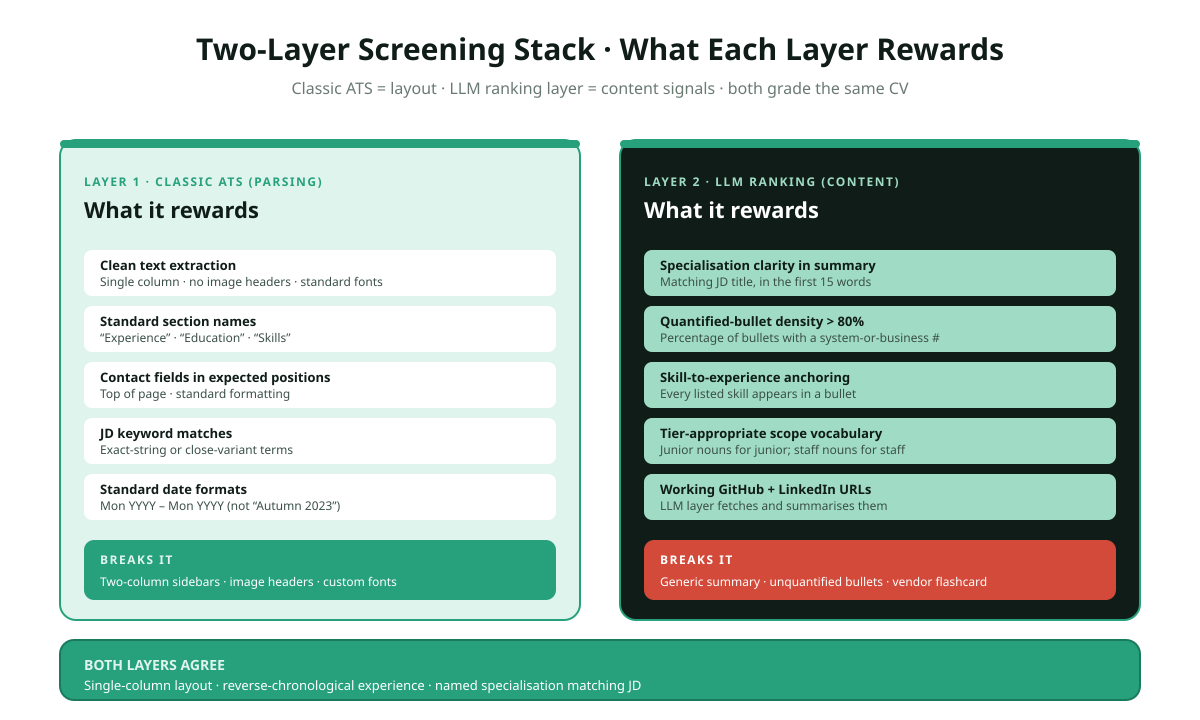
The two-layer screening stack that scores 2026 CVs applies partly overlapping and partly distinct format rewards. The classic ATS still cares mostly about parsing cleanliness and keyword matching. The LLM ranking layer applies a content-sensitive rubric that scores signals independent of layout. Understanding which layer weights which signal is how you optimise both.
What the classic ATS rewards
- Clean text extraction (single column, no image headers, standard fonts, standard PDF)
- Standard section names (Experience / Education / Skills — not “My Journey” or “What I Do”)
- Contact fields in expected positions (top of page, standard formatting)
- Keyword matches against the JD (exact-string or close-variant)
- Standard date formats (Mon YYYY – Mon YYYY, not “Autumn 2023”)
What the LLM ranking layer separately rewards
- Specialisation clarity in the first 15 words of the summary
- Quantified-bullet density > 80% of experience bullets
- Skill-to-experience anchoring (every listed skill appears in a bullet)
- Tier-appropriate scope vocabulary (junior nouns for junior roles, staff nouns for staff roles)
- Working GitHub URL and LinkedIn URL — the LLM layer will fetch and summarise them
What both layers reward
- Single-column layout (parses cleanly, reads structured)
- Reverse-chronological experience section (both graders expect this shape)
- Named specialisation matching the JD (keyword match + LLM routing)
The most common 2026 CV that clears the ATS and fails the LLM layer: single-column, cleanly-formatted, generic “Software Engineer” summary, unquantified experience bullets, 25-tool vendor-flashcard skills section. Parses beautifully. Scores 4/10 on the LLM rubric. Lands mid-pack.
Why single-column is the only 2026 layout that clears both filters
The single-column, top-to-bottom, text-based PDF is the only 2026 CV layout that consistently clears both the classic ATS and the LLM ranking layer. Two-column templates with sidebar skills remain the single largest format-related rejection cause in 2026 — the “pretty template” downloaded from Canva or a template marketplace still garbles in a majority of production ATS deployments and reads as low-signal jumbled text to the LLM layer that follows.
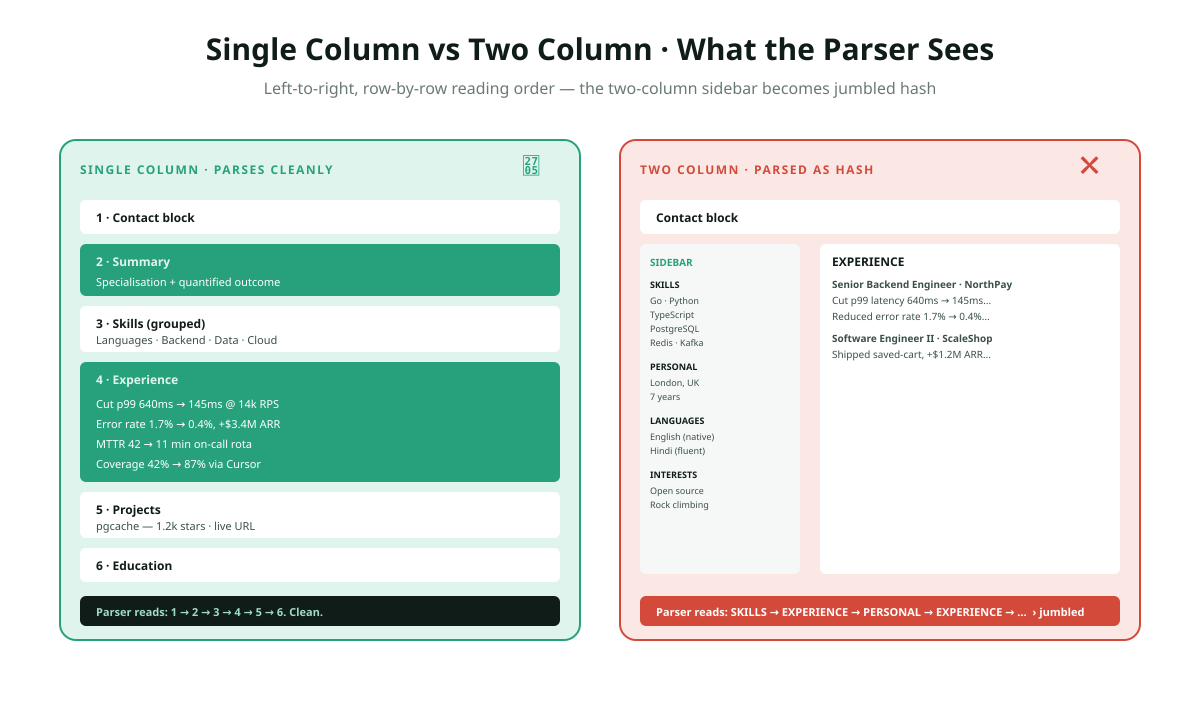
What actually happens when a two-column CV hits the classic ATS parser in 2026:
- The parser reads the page left-to-right, row-by-row.
- A sidebar in the left column pushes the parser into a different reading order than a human sees.
- Skills, personal details or summary get interleaved with the first line of your experience section.
- The resulting text stream is a hash of your CV, not your CV.
- The LLM ranking layer then reads that jumbled hash and scores content signals against it.
A single column solves this at the format level: the parser reads top to bottom, the human reads top to bottom, the LLM reads top to bottom. Three graders, one reading order. Every “my beautiful two-column template got rejected” Reddit thread from 2025 through 2026 traces to this specific mechanism.
A 2026 CV template that looks great on Behance and gets zero callbacks is not underappreciated. It is being parsed as gibberish by every screening layer it hits. Single column is not aesthetic conservatism — it is the only layout the tooling actually reads.
The AI-tooling line: where and how to place it in 2026
The AI-tooling line on a 2026 CV names the tools you use (GitHub Copilot, Cursor, Claude Code, Codeium) inside a shipped-scope experience bullet, never as a standalone skills-line label. A skills-section line reading “Skilled in GitHub Copilot and Cursor” without any matching experience bullet reads as vibe-coding and triggers the largest single 2026 LLM-ranking-layer downgrade for technical CVs.
The placement rule — tool-plus-scope-plus-safety-net-plus-outcome, inside an experience bullet:
- Name the tool (Copilot / Cursor / Claude Code / Codeium)
- Name the scope (lines refactored, coverage percent, files migrated)
- Name the safety net (feature flag, code review, zero rollback, A/B test)
- Name the outcome (performance, adoption, error rate, revenue)
Example that lands: “Refactored 14,000-line legacy Django service to FastAPI in three weeks using Cursor + Claude Code for scaffolding, shipped behind feature flag, zero production incidents in the first 30 days.”
Example that drops points: “AI-first developer — skilled in GitHub Copilot, Cursor and Claude Code.”
For the deep-dive on AI-tooling signalling patterns specific to different technical roles, see our software engineer CV 2026 guide and the AI engineer CV 2026 guide. The general rule — tool inside a shipped-scope bullet, never floating alone — applies across every technical CV in 2026.
Font, colour, file format — the technical checklist
The 2026 CV technical checklist is a short list of format-layer decisions that either clear or break the parsing stack: font, colour, file format, section header markup, contact-line structure. Every one of these has a right answer that most template downloads still get wrong.
| Element | 2026 correct answer | Common wrong answer |
|---|---|---|
| Font family | Standard system serif or sans-serif (Calibri, Arial, Helvetica, Garamond, Georgia, Inter) | Custom or fancy fonts that embed poorly in the PDF and confuse parsers |
| Font size | 10-12pt body, 14-16pt section headers, 18-22pt name | 9pt body to save space — illegible and downweights readability |
| Colour | Black body text, one accent colour for name + section headers, subtle | Full colour blocks, coloured sidebars, decorative icons |
| File format | Text-based PDF exported from Word / Google Docs / a real CV editor | Image-based PDF (scan of a printed CV) or a PDF from a design tool that embeds text as vector paths |
| File name | “Firstname Lastname CV.pdf” or “Firstname Lastname Backend Engineer CV.pdf” | “CV_final_final_v3.pdf” or “Resume.pdf” — harder to route and looks careless |
| Section headers | Plain text bold, standard names (Experience, Education, Skills) | Image-based section headers or non-standard names (“My Journey”, “What I Do”) |
| Bullet character | Standard bullet (•) or hyphen (-) | Custom icons, emoji, or Wingdings characters that render as boxes in some parsers |
| Date format | Mon YYYY – Mon YYYY (Jan 2023 – Present) | “Autumn 2023”, “Q1 2024”, non-standard formats |
The single biggest 2026 file-format failure mode: exporting a CV from a design tool (Figma, Illustrator, Sketch, some Canva templates) as PDF with text-as-vector-paths. That file looks perfect visually and is completely un-parseable at the ATS layer. Always export from a real word processor or CV editor with selectable text. Test by opening the PDF and trying to select and copy your name — if the text does not select, the CV will not parse.
Key takeaway: boring is correct at the format layer. Every deviation from a plain single-column PDF with system fonts, black text and one subtle accent colour costs you points somewhere in the two-layer stack.
Five format mistakes that break 2026 CV parsing
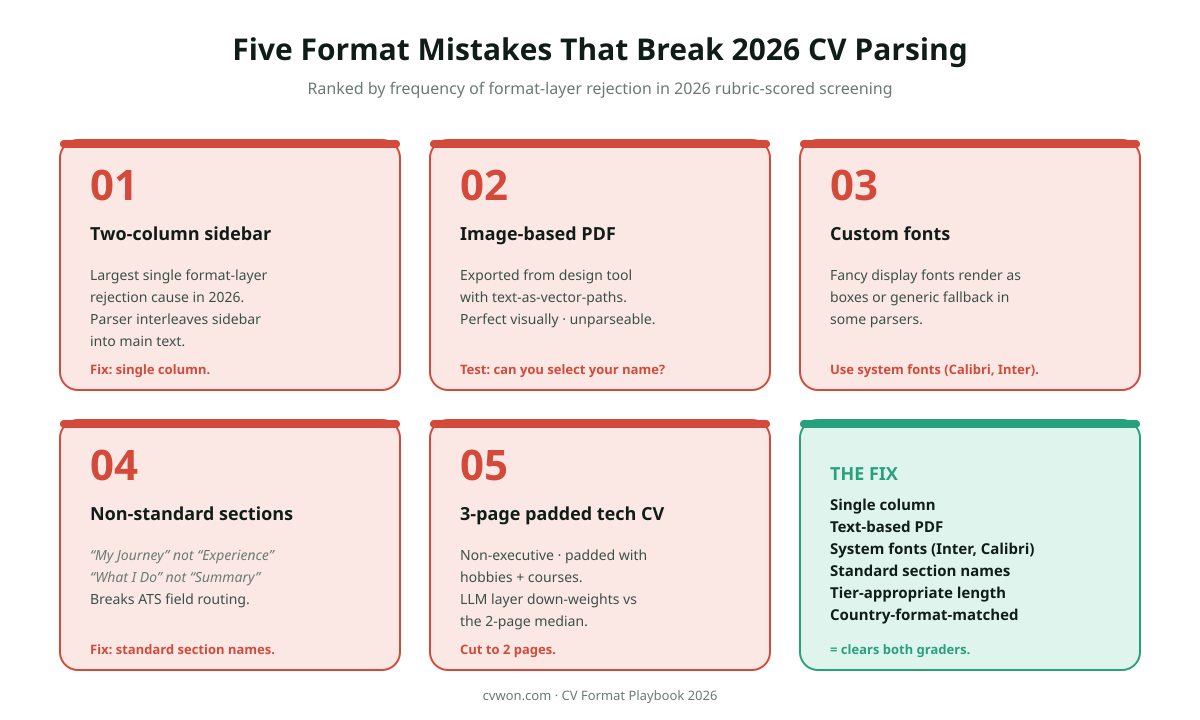
- Two-column template with sidebar skills. Largest single format-layer rejection cause in 2026. Parser reads left-to-right and interleaves the sidebar into your main text. Switch to single column, top to bottom.
- Image-based PDF exported from a design tool. Looks perfect visually, completely un-parseable at the ATS layer. Test: open the PDF and try to select and copy your name. If the text does not select, the CV is invisible to the parser.
- Custom fonts that do not embed cleanly. Fancy display fonts render as boxes or generic fallback in some parsers, destroying readability. Use system fonts (Calibri, Arial, Helvetica, Garamond, Georgia, Inter).
- Non-standard section names. “My Journey” instead of “Experience”. “What I Do” instead of “Summary”. The classic ATS relies on standard section-name detection to route content into the correct fields. Deviate and your experience section becomes a text blob.
- Three-page non-executive tech CV padded with hobbies and courses. LLM ranking layer down-weights three-page CVs at non-executive tiers. Cut to two pages. Length is not signal.
A 2026 CV format template you can copy today
The template below is the exact single-column, six-section shape that clears both the 2026 classic ATS and the LLM ranking layer. Copy the shape, replace the content with your own, keep the section order.
PRIYA SHARMA
Senior Backend Engineer · London, UK
priya.sharma@example.com · +44 7700 900123
linkedin.com/in/priyasharma-eng · github.com/priyasharma-eng
SUMMARY
Senior backend engineer, 7 years on Go + PostgreSQL at fintech scale. Own the payments service at 14k RPS, p99 145 ms, 99.98% SLA across 3 regions. Cut checkout error rate from 1.7% to 0.4% via idempotency-key redesign and retry-with-backoff. On-call rotation lead, 12-engineer team.
SKILLS
Languages: Go, Python, TypeScript, SQL · Backend: Gin, FastAPI, gRPC, GraphQL · Data: PostgreSQL, Redis, Kafka, ClickHouse · Cloud + DevOps: AWS (EKS, RDS, Lambda), Docker, Kubernetes, Terraform · Observability: Datadog, PagerDuty, OpenTelemetry · AI-augmented delivery: Cursor, Claude Code, GitHub Copilot
EXPERIENCE
Senior Backend Engineer · NorthPay (Series C fintech) · London · Mar 2023 – Present
- Cut p99 latency on payments confirmation endpoint from 640 ms to 145 ms (4.4x) at 14k RPS by moving hot-path reads to Redis + rewriting the Go handler.
- Cut checkout error rate from 1.7% to 0.4% via idempotency-key redesign and retry-with-backoff; +$3.4M annualised recovered revenue at current volume.
- Led on-call rotation for 12-engineer platform team; cut MTTR from 42 min to 11 min over 6 months via runbook automation and PagerDuty routing rules.
Software Engineer II · ScaleShop (Series B e-commerce) · London · Aug 2020 – Feb 2023
- Shipped saved-cart end-to-end (Next.js server components + Go API + PostgreSQL) in 5 weeks, 34% adoption at 30 days, +$1.2M annualised MRR.
- Scaled ingest service from 3k to 45k events per second by sharding Kafka topic + rewriting consumer batching; zero downtime behind LaunchDarkly flag.
PROJECTS
- pgcache — open-source PostgreSQL result-cache middleware in Go. 1.2k stars. github.com/priyasharma-eng/pgcache
EDUCATION
BSc Computer Science — University of Manchester — 2018
Notice the pattern: no columns, no sidebar, no icons, no colour beyond the section headers, standard section names, standard date format, every skill anchored by a bullet below, every bullet quantified. The whole CV parses cleanly at the ATS layer and scores well on the LLM ranking layer’s five dimensions. Build your own from this shape in the CVWon AI CV builder — the template gallery defaults to the single-column, six-section layout so you start from a format that already clears both filters.
Frequently Asked Questions
Is a one-page CV really required in 2026?
Only for junior candidates with under 5 years of shipped experience. Senior, staff, manager and executive candidates should use 2 pages; executives may extend to 3 pages; academic and medical CVs run 4+ pages by convention. Length is not a signal of seniority. Scope-per-bullet is. A padded 2-page junior CV reads worse than a tight 1-page one.
Should I use a chronological or functional CV format in 2026?
Chronological. The functional (skills-first) format now signals hiding-a-gap to both the LLM ranking layer and human recruiters and should be avoided outside a narrow career-change case. If you have a gap, name it briefly in the Experience section and use chronological or hybrid format. The pattern-match on skills-at-top-experience-buried is now negative.
What CV file format should I send in 2026 — PDF or Word?
Text-based PDF exported from Word, Google Docs or a real CV editor. Never send an image-based PDF, a design-tool PDF with text-as-vector-paths, or a Word document unless the application form specifically requests .docx. Test your PDF by opening it and trying to select and copy your name. If the text does not select, the parser cannot read it.
Do I need a photo on my CV in 2026?
Country-dependent. Yes in Germany, France (fading), UAE, Saudi Arabia, Qatar (professional headshot expected). No in the United States, United Kingdom, Canada, Australia (photo can trigger discrimination-avoidance filtering). Optional in Netherlands and India. Match the target market’s convention before you send.
How many pages should a senior engineer CV be in 2026?
Two pages. A senior engineer with 7+ years of shipped experience compressed onto one page reads as under-detailed and forces the LLM ranking layer to score you on a thin evidence set. A three-page non-executive tech CV, on the other hand, gets down-weighted against the two-page median. Two pages hits the target rubric length for the senior tier.
Can I use a two-column CV template if it looks nice?
No. Two-column templates with sidebar skills remain the single largest format-related rejection cause in 2026. The parser reads left-to-right and interleaves the sidebar into your main text, producing a jumbled hash that both the classic ATS and the LLM ranking layer then score against. Switch to single-column, top-to-bottom. Nice-looking is not the same as parses-cleanly.
What sections should I include on my CV in 2026?
Six, in this order: contact + links, summary with specialisation, skills grouped by domain, experience with quantified bullets, projects with live URLs, education. Reordering — especially putting skills above experience for mid-career candidates or education above experience after 5 years shipped — is a 2026 format-level red flag. Match the expected order.
How do I list AI tools like GitHub Copilot or Claude Code on my CV in 2026?
Inside a shipped-scope experience bullet, never as a standalone skills-line label. A skills-section line reading “Skilled in GitHub Copilot” without any matching experience bullet reads as vibe-coding and triggers the largest 2026 LLM-ranking-layer downgrade for technical CVs. Name the tool + the scope + the safety net + the outcome. Deep-dive in the software engineer CV 2026 guide.
What font should I use on my CV in 2026?
A standard system font: Calibri, Arial, Helvetica, Garamond, Georgia or Inter. Body text at 10-12pt, section headers at 14-16pt, name at 18-22pt. Custom or fancy display fonts embed poorly in the PDF, render as boxes or generic fallback in some parsers, and destroy readability. Boring is correct at the font layer.
Should my CV format change if I’m applying to a Gulf country like the UAE?
Yes. Gulf CV format expects a professional headshot photo, nationality, marital status, visa status and 2 pages of length. Sending a US-style photoless one-page resume to a UAE role drops you at the recruiter’s first pass. Match the Gulf convention. Full walkthrough in our how to write a CV for jobs in the UAE guide.
Go deeper on each section: once the six-section structure is right, tighten the content — group and anchor the skills section, turn duties into quantified achievements, open every bullet with a strong action verb, frame a career switch with transferable skills, decide whether hobbies and interests earn a place, and check the draft against the common CV mistakes that fail the screening gates.
Next step
The fastest way to ship a 2026-ready CV in the single-column, six-section format that clears both the classic ATS and the LLM ranking layer is to start from the CVWon AI CV builder template gallery. Every template defaults to single-column, top-to-bottom, standard section names and system fonts — so you cannot accidentally ship a two-column layout that gets parsed as gibberish. Pick the template that matches your target country’s convention (photo / no-photo variants included), paste your shipped-scope bullets, and export as a text-based PDF.
Last reviewed on 11 August 2026 by Muneeb Awan (Founder, CVWon).
About the Author
Muneeb Awan is the founder of CVWon, an AI-powered CV builder and career platform used by professionals across the EU and Gulf regions. He writes on hiring technology, ATS mechanics and the 2026 CV format rubrics that pass both filters.