Hobbies & Interests on CV 2026: Signal, Not Filler
Last updated: 14 August 2026 · 15 min read · Reviewed by Muneeb Awan (Founder, CVWon)
Hobbies and interests belong on your CV in 2026 only when each one transmits a signal relevant to the job — leadership, discipline, creativity, collaboration — and is written specifically enough to be believable. A generic line like "reading, socialising, travelling" is dead filler that wastes space and tells a recruiter nothing. This guide shows exactly which hobbies to put on a CV, the signal each transmits, when to include them versus cut them, and how to phrase a hobby so it reads as evidence instead of padding. It includes an original signal-vs-filler matrix, a red-flag list, and the by-role weighting most guides skip.
TL;DR
- Include a hobby only if it signals something the role wants — leadership, discipline, creativity, teamwork, or a relevant technical interest. If it signals nothing, cut it.
- Be specific. "Chess (county-level, 2024)" beats "chess"; "marathon runner (3 completed)" beats "running". The detail is what makes the signal believable.
- Hobbies help most for juniors, career-changers and no-experience CVs, where they fill a genuine evidence gap. On senior or space-tight CVs, drop them for experience.
- Hobbies do not rank you in ATS or AI screening — but a specific, relevant one can anchor a soft-skill claim the rest of the CV makes.
- Keep it to one line, 3–5 items max, at the very bottom. Avoid clichés, anything divisive, and anything you can't back up in an interview.
Should you put hobbies and interests on your CV in 2026?
You should put hobbies and interests on your CV in 2026 only when they transmit a signal relevant to the role and you have room after the essential sections. Hobbies are optional, not mandatory — they are the first thing to cut when space is tight and the last thing to include when they add nothing. The test is simple: does this hobby tell the recruiter something useful they can't get from the rest of the CV?

Include them when they earn their space; cut them when they don't. A hackathon-winning side project on a graduate CV signals initiative and fills a real evidence gap. "Enjoy reading and spending time with friends" on a senior manager's CV signals nothing and wastes a line that could hold an achievement. Same section, opposite value — the difference is whether the hobby carries a signal.
Recruiters do not reject a CV for weak hobbies; they simply skip the section. But a specific, relevant hobby can tip a borderline junior candidate over the line by proving a soft skill the rest of the CV only claims. Include hobbies to add evidence, never to fill space.
Key takeaway: hobbies are a bonus section, not a requirement. Include one only if it signals a role-relevant trait; otherwise the space is better spent on experience, projects, or the skills covered in our skills to put on CV 2026 guide.
The signal-vs-filler matrix: which hobbies actually count
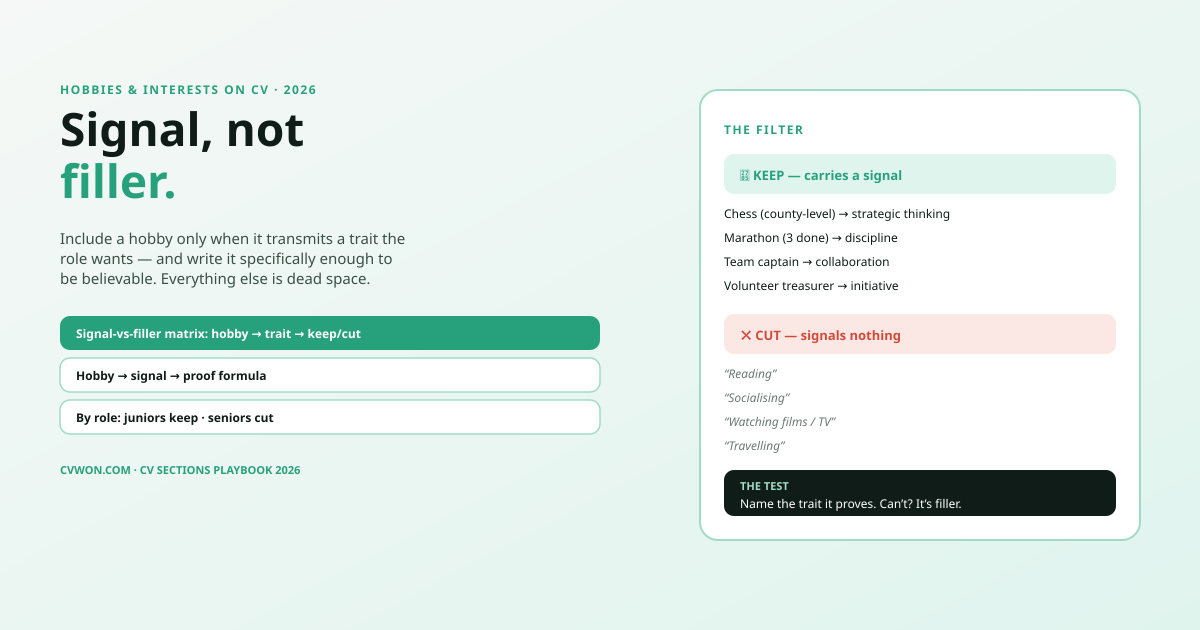
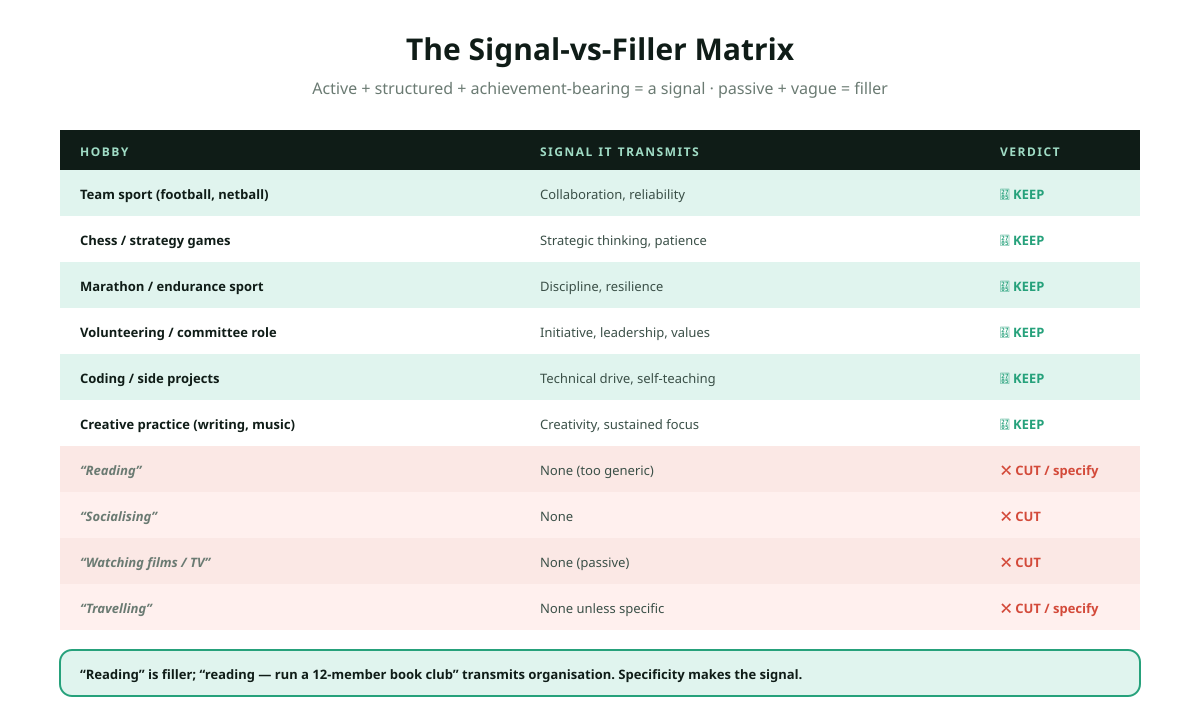
The signal-vs-filler matrix sorts hobbies by the trait they transmit to a recruiter — and flags the ones that transmit nothing. This is the step every competing guide skips: they list "good hobbies" without saying what each one actually communicates, so readers can't tell a signal from filler. The matrix below maps the hobby to its signal and gives a keep-or-cut verdict.
| Hobby | Signal it transmits | Verdict |
|---|---|---|
| Team sport (football, netball) | Collaboration, reliability, commitment | ✅ Keep |
| Chess / strategy games | Strategic thinking, patience | ✅ Keep |
| Marathon / endurance sport | Discipline, goal-setting, resilience | ✅ Keep |
| Volunteering / committee role | Initiative, leadership, values | ✅ Keep |
| Coding / building side projects | Technical drive, self-teaching | ✅ Keep (esp. tech roles) |
| Creative practice (writing, photography, music) | Creativity, sustained focus | ✅ Keep if relevant |
| "Reading" | None (too generic) | ❌ Cut or make specific |
| "Socialising / spending time with friends" | None | ❌ Cut |
| "Watching films / TV" | None (passive) | ❌ Cut |
| "Travelling" | None unless specific | ❌ Cut or make specific |
Notice the pattern: active, structured, or achievement-bearing hobbies transmit a trait; passive or vague ones do not. "Reading" is filler, but "reading — run a 12-member sci-fi book club" transmits organisation and commitment. The activity can be identical; the signal comes from specificity and structure.
Key takeaway: before listing any hobby, name the single trait it proves. If you can't name one, it's filler — cut it or make it specific enough to carry a signal.
When to include hobbies (and when to cut them) by role
Hobbies help most on junior, career-change and no-experience CVs, where they fill a genuine evidence gap, and matter least on senior CVs, where experience should own every line. The decision is not personal preference — it is a function of how much proven experience the rest of your CV already carries. The less experience, the more a relevant hobby earns its place.
| Situation | Include hobbies? | Why |
|---|---|---|
| First job / graduate | Yes — 3–5 relevant | Fills the experience gap; proves soft skills you can't yet show through work |
| Career-changer | Yes, if they bridge to the new field | A relevant hobby can evidence a transferable interest before you have paid experience in it |
| Mid-career | Optional — 1–2 max | Only if genuinely distinctive; experience should lead |
| Senior / executive | Usually cut | Space is better spent on scope, results and leadership; hobbies read as filler at this level |
| Space-constrained (1 page, full) | Cut first | Hobbies are the lowest-priority section — drop before cutting anything else |
A graduate with a hackathon win and a captaincy should absolutely list them — they are the strongest evidence on the page. A director with 15 years of P&L ownership should not spend a line on "enjoys hiking". If you are building a first CV, pair this with our CV with no experience guide, where hobbies do real work; for a sector switch, the transferable-interest angle is covered in the transferable skills for CV guide.
The hobby → signal → proof formula
The hobby → signal → proof formula turns a bare hobby into evidence: name the hobby, imply the signal, and attach a proof detail that makes it believable. A bare hobby is a claim; a hobby with a proof detail is evidence. The proof detail — a level, a number, a duration, a result — is what separates a credible interest from a padded one.
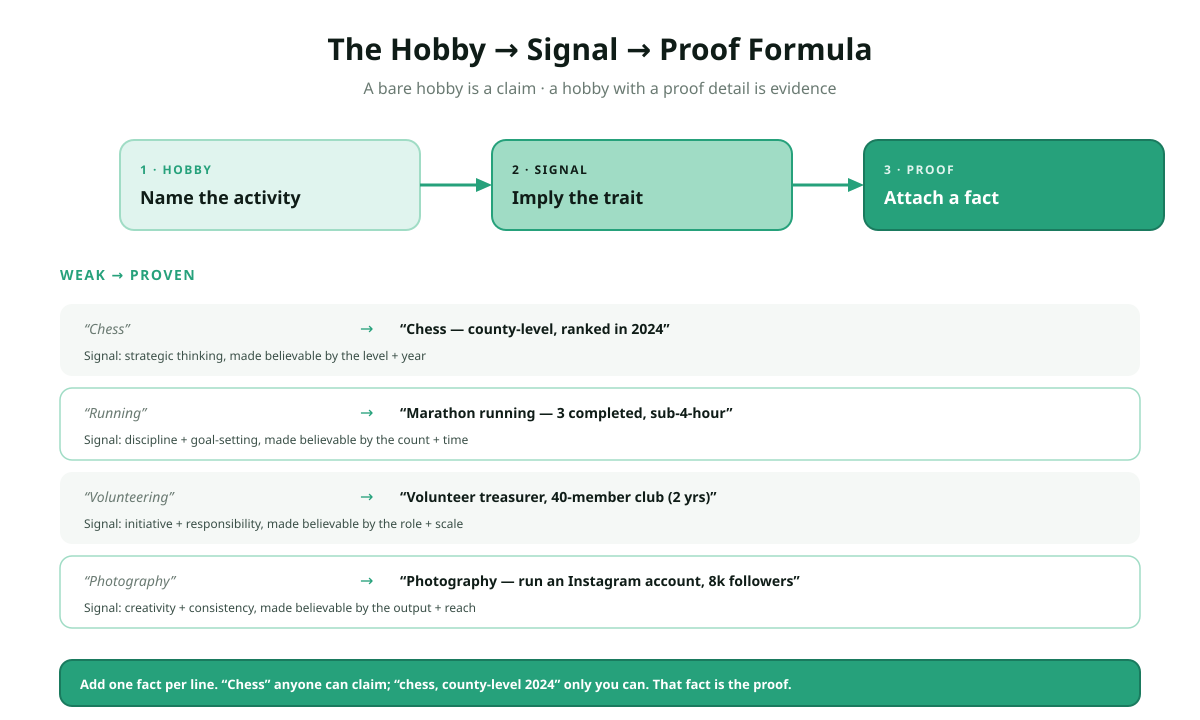
The formula, applied:
- Weak: "Chess." → Proven: "Chess — county-level, ranked in 2024."
- Weak: "Running." → Proven: "Marathon running — 3 completed, sub-4-hour."
- Weak: "Volunteering." → Proven: "Volunteer treasurer for a 40-member community club (2 years)."
- Weak: "Photography." → Proven: "Photography — run an Instagram account, 8k followers."
Each proven version carries a fact a recruiter can picture and you can discuss in an interview. This is the same anchoring principle behind the whole 2026 CV: a claim needs a receipt, whether it's a skill, an achievement, or a hobby. The skills section follows the identical rule.
The fastest upgrade to any hobbies section is to add one fact per line. "Chess" is a claim anyone can make; "chess, county-level 2024" is a fact only you can. The proof detail is what turns a hobby from filler into a small piece of evidence.
30 good hobbies and interests, by signal
The 30 hobbies below are grouped by the signal they transmit, so you can pick the ones that match the traits your target role wants. Add a proof detail to each before it goes on your CV.
Signals leadership + initiative
- Sports team captain
- Volunteer committee / society role
- Scout / cadet leader
- Organising community events
- Mentoring or tutoring
- Running a club or group
Signals discipline + resilience
- Marathon / triathlon
- Martial arts (with belt/grade)
- Long-distance cycling
- Learning an instrument (with grade)
- Competitive swimming
- Rock climbing
Signals strategic + analytical thinking
- Chess
- Competitive esports (team/ranked)
- Bridge / strategy board games
- Fantasy sports league management
- Puzzle / quiz competitions
- Personal investing / trading (declared carefully)
Signals creativity + focus
- Photography (with output)
- Creative writing / blogging
- Music production / performance
- Illustration / design
- Filmmaking / video editing
- Pottery / craft with a portfolio
Signals technical drive (great for tech roles)
- Coding side projects (with a live link)
- Open-source contributions
- Home-lab / self-hosting
- Robotics / electronics
- Hackathons
- 3D printing / maker projects
Red-flag hobbies (and the safe rewrite)
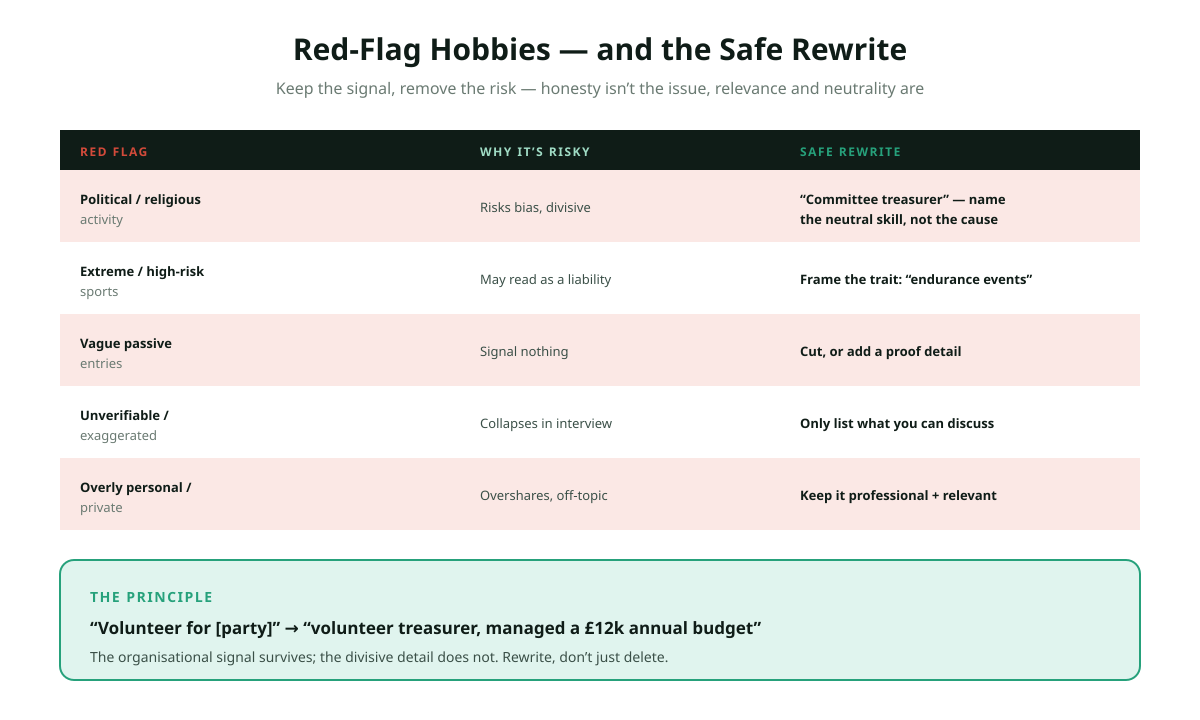
Red-flag hobbies are ones that either signal nothing, risk bias, or invite an awkward interview question — and most have a safe rewrite that keeps the signal without the risk. The goal is not to hide who you are; it is to avoid handing a screener a reason to pause on anything unrelated to the job.
| Red flag | Why it's risky | Safe rewrite |
|---|---|---|
| Political / religious activity | Risks bias, divisive | Name the neutral skill: "committee treasurer" not the organisation's cause |
| Extreme / high-risk sports | May read as a liability | Frame the trait: "endurance events" over graphic risk detail |
| Vague passive entries | Signal nothing | Cut, or make specific with a proof detail |
| Anything unverifiable / exaggerated | Collapses in interview | Only list what you can discuss credibly |
| Overly personal / private | Overshares, off-topic | Keep it professional and role-relevant |
The safe rewrite keeps the underlying signal while removing the risk. "Volunteer for [political party]" becomes "volunteer treasurer, managed a £12k annual budget" — the organisational signal survives, the divisive detail does not. Honesty is not the issue; relevance and neutrality are.
Do hobbies matter for ATS and AI screening?
Hobbies do not rank you in the classic ATS or the 2026 LLM ranking layer — but a specific, relevant one can anchor a soft-skill claim the rest of your CV makes. No screening system scores you higher for listing "hiking". What the systems reward is evidence, and a proof-backed hobby is a small, legitimate piece of evidence that supports a claim like leadership or discipline.
How each layer treats hobbies:
- Classic ATS: parses the text for keyword matches. A hobby only helps if the JD explicitly names a relevant interest (rare). Otherwise neutral.
- LLM ranking layer: looks for claims backed by evidence. A specific hobby ("captain, 11-a-side league, 3 seasons") can support a teamwork or leadership claim; a vague one is ignored. The mechanics are the same anchoring principle from our AI resume screening 2026 guide.
- Human recruiter: reads hobbies last, in seconds, mostly for culture-fit and conversation hooks — and to spot red flags.
Key takeaway: do not add hobbies expecting a ranking boost. Add a specific one only when it reinforces a soft skill you're already claiming — then it does quiet, legitimate work at all three screening stages.
Where and how to format hobbies on your CV
Hobbies go in a short, one-line section at the very bottom of the CV, after experience, skills and education — never near the top. The format is a single labelled line with 3–5 specific items, each with its proof detail. This keeps them from crowding the sections that actually decide the shortlist, in line with the section order in our 2026 CV format guide.
- Position: last section, below education. Label it "Interests" or "Hobbies & Interests".
- Length: one line, or two at most. 3–5 items.
- Format: comma-separated, each with a proof detail. "Chess (county-level), marathon running (3 completed), volunteer treasurer (2 yrs)."
- Cut first: if the CV runs long, this is the first section to trim.
Do not build a large boxed "Hobbies" feature with icons or ratings — it wastes space and, like skill-bar graphics, can confuse the ATS parser. One clean line does the job.
Next step
The fastest way to decide which hobbies earn a place on your CV is to run each one through the signal-vs-filler test inside the CVWon CV builder: it prompts you for the proof detail on each interest and drops the section into the correct place in the six-section format. Pair it with the skills to put on CV 2026 guide to make sure the section above it is pulling its weight too.
Frequently Asked Questions
Should I put hobbies and interests on my CV in 2026?
Only if they transmit a signal relevant to the role and you have space after the essential sections. Hobbies are optional and are the first section to cut when a CV runs long. Include a hobby when it proves a role-relevant trait like leadership or discipline; skip it when it signals nothing.
What are good hobbies to put on a CV?
The best hobbies signal a trait employers want: team sports (collaboration), marathons (discipline), chess (strategic thinking), volunteering (initiative), and coding side projects (technical drive). Add a proof detail to each — a level, number, or duration — so it reads as evidence rather than a bare claim.
What hobbies should you not put on a CV?
Avoid vague passive entries ("reading, watching TV, socialising"), anything political or religious, high-risk activities framed graphically, and anything you can't discuss credibly in an interview. Most have a safe rewrite: "volunteer for [political party]" becomes "committee treasurer, managed a £12k budget", keeping the organisational signal without the risk.
How many hobbies should I list on my CV?
Three to five, on a single line, for a junior or graduate CV; one to two for mid-career; usually none for senior or executive CVs. Quality beats quantity — two specific, proof-backed interests outperform six vague ones. If space is tight, cut hobbies before anything else.
Do hobbies help you get past ATS or AI screening?
No system ranks you higher simply for listing hobbies. The classic ATS only reacts to hobbies if the job description names a relevant interest, which is rare. The 2026 LLM ranking layer can, however, treat a specific proof-backed hobby as evidence that supports a soft-skill claim — so a relevant one does quiet, legitimate work.
Where should hobbies go on a CV?
In a short, one-line section at the very bottom, after experience, skills and education. Label it "Interests" or "Hobbies & Interests" and list 3–5 specific items with proof details. Never place hobbies near the top, and never build a large boxed feature with icons — one clean line is enough.
Should hobbies on a CV be specific or general?
Always specific. "Chess" is a claim; "chess (county-level, 2024)" is a fact only you can make. The proof detail — a level, number, duration or result — is what makes the signal believable and gives you something concrete to discuss in the interview. A general hobby is filler; a specific one is evidence.
Are hobbies more important on a CV with no experience?
Yes. On a first-job or no-experience CV, hobbies fill a genuine evidence gap and can prove soft skills you can't yet show through work — a captaincy proves leadership, a hackathon proves initiative. Lead with the most relevant, proof-backed interests. See our CV with no experience guide for the full first-CV approach.
Can hobbies on a CV ever hurt my application?
Yes, if they signal nothing (wasting space), risk bias (political or religious activity), read as a liability (extreme risk framed graphically), or can't survive an interview question. The fix is to keep only role-relevant, verifiable, neutral interests — and to cut the rest rather than pad the section.
Should I tailor my hobbies to the job?
Where you genuinely can, yes — lead with the interests whose signal matches the role's traits. A collaborative role rewards team-sport captaincy; a research role rewards a strategic or analytical hobby. Never invent interests to match, but do choose which of your real hobbies to feature based on what the specific job values.
Last reviewed on 14 August 2026 by Muneeb Awan (Founder, CVWon).
About the Author
Muneeb Awan is the founder of CVWon, an AI-powered CV builder and career platform used by professionals across the EU and Gulf regions. He writes on hiring technology, ATS mechanics and the 2026 CV playbooks that pass both filters.