Transferable Skills for CV 2026: Translate & Prove
Last updated: 13 August 2026 · 17 min read · Reviewed by Muneeb Awan (Founder, CVWon)
Transferable skills are abilities you carry from one role, industry or life situation into another — problem-solving, stakeholder communication, data analysis, project coordination — and on a 2026 CV they only count if each one is anchored to a concrete result from where you actually used it. A flat list of transferable skills ("strong communicator, team player, fast learner") now reads as filler to both recruiters and the LLM ranking layer that scores CVs. This guide shows exactly which transferable skills to put on your CV in 2026, how to translate a skill from your old domain into language the target role recognises, the "transfer proof" formula that makes a claim believable, and how the phrasing changes for career-changers, first-job applicants and returners. It includes an original translation matrix and a downloadable worksheet.
FREE WORKSHEET
The Transferable Skills Translation Worksheet
Map your old-role skills to target-role phrasing, with the transfer-proof formula built in.
TL;DR
- Transferable skills are abilities that carry across roles and industries — not tied to one job's tools. On a 2026 CV each must be anchored by a quantified result from where you used it.
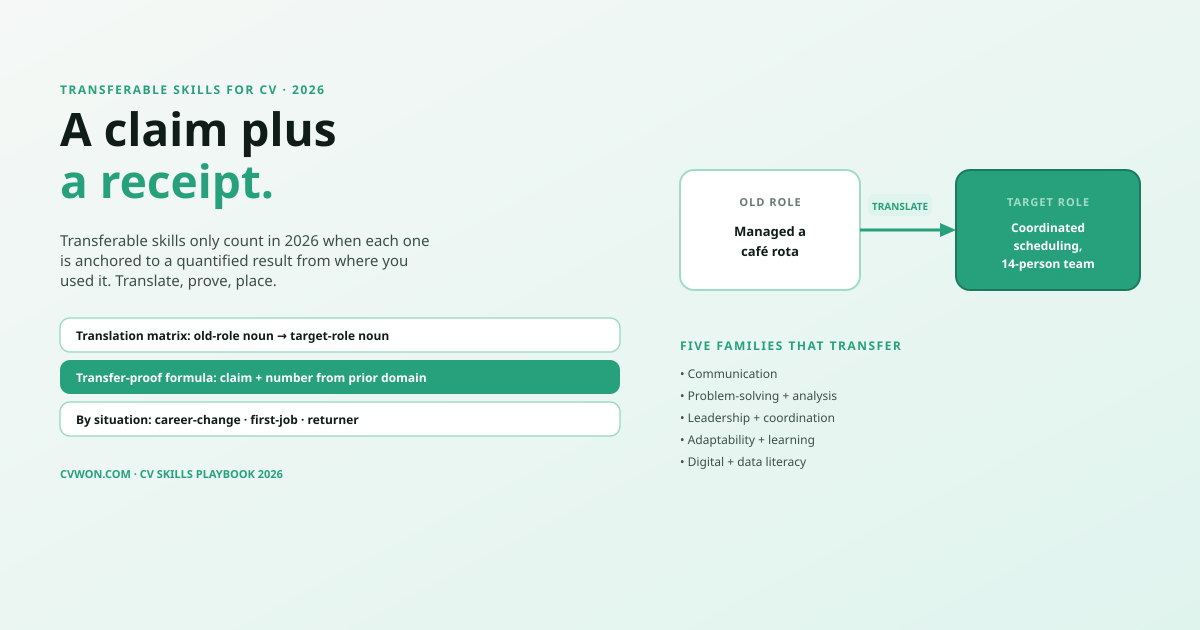
- Translate, don't list. "Managed a busy café rota" becomes "coordinated scheduling for a 14-person team" for an operations role. The skill is the same; the phrasing routes it to the target role.
- Use the transfer-proof formula: transferable-skill claim + quantified result from the prior domain. "Communication" alone is filler; "de-escalated 30+ customer complaints/week, 96% resolved without escalation" transfers.
- Five families survive AI screening in 2026: communication, problem-solving + analysis, leadership + coordination, adaptability + learning, digital + data literacy. Each needs a proof bullet.
- Phrasing differs by situation: career-changers lead with the mapped result, first-job applicants lead with the context (studies, part-time, volunteering), returners lead with recency signals.
What transferable skills are (and why they matter more in 2026)
Transferable skills are abilities you can carry from one role, industry or context into another — independent of the specific tools or sector where you first developed them. They are the bridge that lets a teacher move into corporate training, a hospitality manager move into operations, or a graduate turn coursework into a first professional role. In 2026 they matter more because hiring is less linear: career changes, layoffs and cross-industry moves are common, and a CV that only lists role-specific tools reads as narrow.

The 2026 shift is that transferable skills must be proven, not asserted. Both human recruiters and the LLM ranking layer that scores CVs (covered in our AI resume screening 2026 guide) down-weight an unproven claim like "excellent communication skills". The same skill anchored to a result — "handled 30+ customer complaints per week, 96% resolved at first contact" — scores because it carries evidence the reader can transfer to the new context.
A transferable skill on a 2026 CV is a claim plus a receipt. The claim ("problem-solving") is worthless alone; the receipt (a quantified result from where you used it) is what actually transfers. List the receipt, and the skill comes with it for free.
Key takeaway: transferable skills are not a fallback for people with "no real experience". They are the strongest asset a career-changer or first-job applicant has — but only when each one arrives with proof.
The 5 transferable-skill families that survive AI screening
The five transferable-skill families that hold weight on a 2026 CV are communication, problem-solving and analysis, leadership and coordination, adaptability and learning, and digital and data literacy. Grouping your transferable skills into these named families — rather than a flat comma list — parses cleaner in the classic ATS and signals structure to the LLM ranking layer, the same grouping logic we cover in the skills to put on CV 2026 guide.
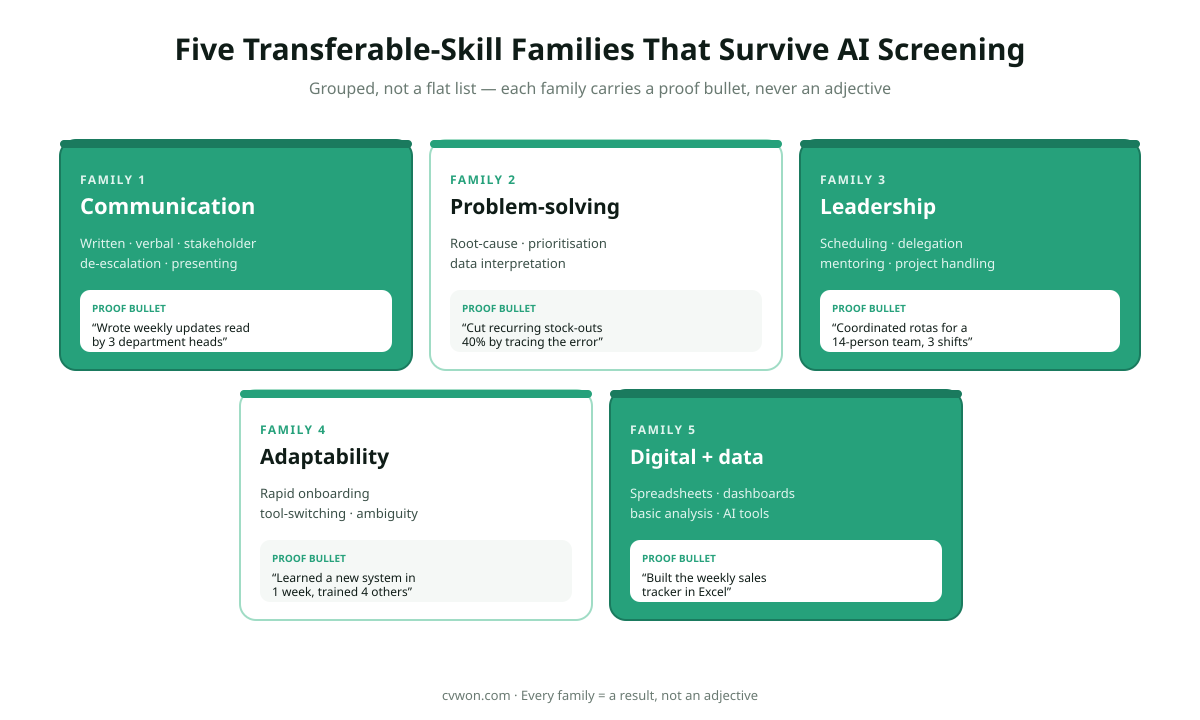
| Family | What it covers | Example proof bullet |
|---|---|---|
| Communication | Written, verbal, stakeholder, de-escalation, presenting | "Wrote weekly status updates read by 3 department heads" |
| Problem-solving + analysis | Root-cause, prioritisation, data interpretation | "Cut recurring stock-outs 40% by tracing the ordering error" |
| Leadership + coordination | Scheduling, delegation, mentoring, project handling | "Coordinated rotas for a 14-person team across 3 shifts" |
| Adaptability + learning | Rapid onboarding, tool-switching, ambiguity | "Learned a new POS + inventory system in 1 week, trained 4 others" |
| Digital + data literacy | Spreadsheets, dashboards, basic analysis, AI tools | "Built the weekly sales tracker in Excel used by the whole branch" |
Notice every example is a result, not an adjective. "Good communicator" is a claim; "wrote weekly status updates read by 3 department heads" is a communication skill with a receipt attached. The family label organises; the proof bullet convinces.
Key takeaway: pick the two or three families most relevant to your target role, and give each a proof bullet. Five vague families beat nothing, but two proven families beat five vague ones.
The transferable skills translation matrix
The transferable skills translation matrix maps how a skill phrased for your old role should be re-phrased so the target role's recruiter and ATS recognise it. This is the step every competing guide skips: they list transferable skills but never show the translation, which is the actual work a career-changer has to do. The skill does not change — the language routes it to the new context.
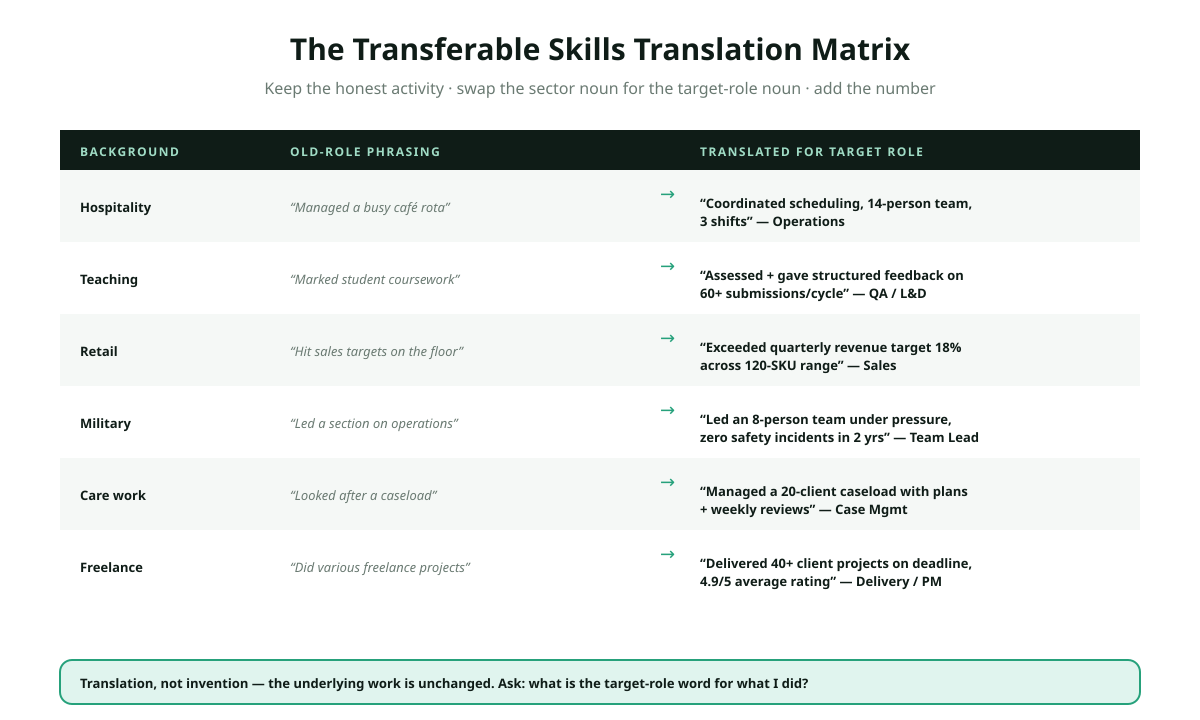
| Your background | Old-role phrasing | Translated for target role |
|---|---|---|
| Hospitality | "Managed a busy café rota" | "Coordinated scheduling for a 14-person team across 3 shifts" (Operations) |
| Teaching | "Marked student coursework" | "Assessed and gave structured feedback on 60+ submissions per cycle" (QA / L&D) |
| Retail | "Hit sales targets on the shop floor" | "Exceeded quarterly revenue target by 18% across a 120-SKU range" (Sales / Account Mgmt) |
| Military | "Led a section on operations" | "Led an 8-person team under time pressure, zero safety incidents in 2 years" (Team Lead) |
| Care work | "Looked after a caseload of clients" | "Managed a 20-client caseload with individual plans and weekly reviews" (Account / Case Mgmt) |
| Freelance / gig | "Did various freelance projects" | "Delivered 40+ client projects on deadline, 4.9/5 average rating" (Delivery / PM) |
The pattern in every row: keep the real, honest activity, then swap the sector-specific noun for the target-role noun and add a number. "Rota" becomes "scheduling"; "caseload" becomes "case management"; "shop floor" becomes "revenue target". This is translation, not invention — the underlying work is unchanged.
Key takeaway: for every transferable skill, ask "what is the target-role word for what I actually did?" then attach the number that was already true. That is the whole matrix.
The transfer-proof formula: making a claim believable
The transfer-proof formula is: transferable-skill claim + a quantified result from the domain where you used it. This is what converts a transferable skill from an assertion a recruiter distrusts into evidence they accept. The 2026 LLM ranking layer applies the same test — a transferable-skill claim with no quantified anchor is scored as filler, exactly like an unanchored hard skill.
The formula, applied:
- Weak: "Strong problem-solving skills."
- Proven: "Traced a recurring 12% stock-out to a supplier-lead-time error and fixed the reorder point — stock-outs fell to under 2%."
- Weak: "Excellent communication."
- Proven: "De-escalated 30+ customer complaints per week; 96% resolved at first contact without a manager."
- Weak: "Adaptable and quick to learn."
- Proven: "Learned a new inventory system in one week and trained four colleagues on it."
Each proven version names the skill implicitly and backs it with a number from the prior domain. The recruiter transfers the evidence to the new role themselves — you do not have to claim "this will transfer", the proof does it. This is the same anchoring principle behind the whole 2026 skills section, detailed in the skills to put on CV 2026 guide.
Recruiters do not distrust transferable skills. They distrust unproven ones. Give a career-changer's skill a number from where it was earned, and the objection disappears — the evidence carries across even when the industry does not.
How to identify your own transferable skills (5 steps)
To identify your transferable skills, extract the results you produced in past roles, then strip away the sector-specific context to find the underlying ability. Most people under-list their transferable skills because they describe their old job's tasks instead of the abilities those tasks required. The five-step method below fixes that.
- List your 10 proudest results from any role, paid or unpaid — a fixed process, a target hit, a problem solved, a person trained.
- For each, name the ability it required — not the task. "Ran the till" required accuracy under pressure and cash reconciliation; "trained new starters" required communication and structured explanation.
- Group the abilities into the five families above. Patterns appear fast — most people cluster in two or three.
- Attach the number that was already true to each ability (how many, how much, how often, what percent).
- Translate the noun to the target role using the matrix above.
Run this for 20 minutes and you will have more proven transferable skills than fit on a CV — the problem becomes selection, not scarcity. If you are building a first CV with no formal work history, pair this with our CV with no experience guide; for a full sector switch, the career change CV guide walks the whole document.
How phrasing changes: career-change vs first-job vs returner
The same transferable skill is phrased differently depending on whether you are changing careers, applying for a first job, or returning after a break — because each situation raises a different recruiter doubt. The skill and its proof stay constant; what changes is which part you lead with to pre-empt the specific objection.
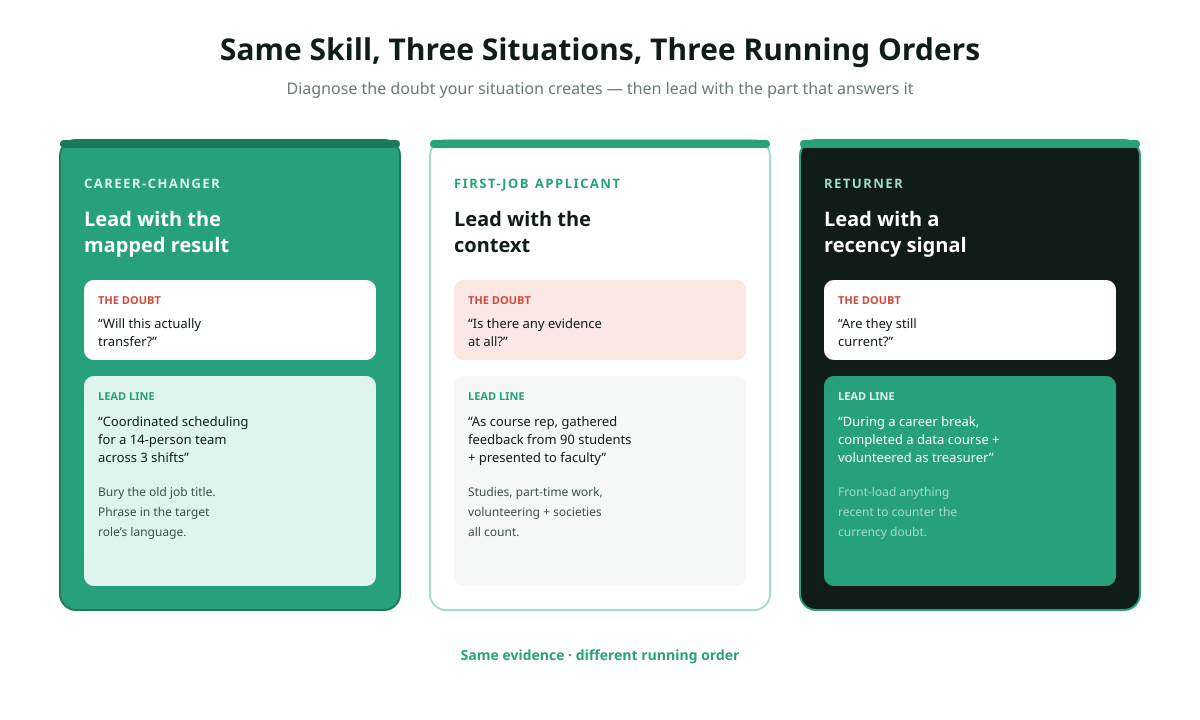
| Situation | Recruiter's doubt | Lead with |
|---|---|---|
| Career-changer | "Will this actually transfer?" | The mapped result in target-role language: "Coordinated scheduling for a 14-person team" |
| First-job applicant | "Is there any evidence at all?" | The context that produced the skill: "As course rep, gathered feedback from 90 students and presented it to faculty" |
| Returner (after a break) | "Are they still current?" | A recency signal: "During a career break, completed a data-analysis course and volunteered as treasurer for a local club" |
A career-changer buries the old job title and leads with the translated result. A first-job applicant is allowed to draw on studies, part-time work and volunteering — those are legitimate sources of transferable skills. A returner front-loads anything recent to counter the currency doubt, a tactic we expand in the employment gap CV guide.
Key takeaway: diagnose the doubt your situation creates, then lead with the part of the skill that answers it. Same evidence, different running order.
Where to put transferable skills on your CV
Transferable skills belong in three places on a 2026 CV: woven into the summary, grouped in the skills section, and — most importantly — proven inside experience or project bullets. The mistake is confining them to a standalone "Transferable Skills" list, which reads as a substitute for real evidence. They should appear as results, in the same six-section layout covered in our 2026 CV format guide.
- Summary (1 line): name the strongest transferable theme with its headline number. "Hospitality manager moving into operations — coordinated a 14-person team and cut rota conflicts 60%."
- Skills section (grouped): list the transferable families, each item echoed by a bullet below.
- Experience / projects (the proof): every transferable skill named above must appear here as a quantified result. This is where the transfer actually happens.
Do not create a floating "Transferable Skills" box of adjectives at the top. It is the transferable-skills equivalent of the vendor-flashcard skills pile — a claim with no receipt.
20 transferable skills with CV-ready example bullets
The 20 transferable skills below are the ones that appear most across 2026 job descriptions, each written as a proof bullet you can adapt. Swap in your own numbers; keep the shape (skill implied, result quantified).
Communication
- Wrote weekly written updates read by 3 department heads.
- De-escalated 30+ complaints/week, 96% resolved at first contact.
- Presented monthly results to a room of 20+ colleagues.
- Translated technical steps into plain-language guides used by 40 staff.
Problem-solving + analysis
- Traced a recurring 12% error to its root cause and removed it.
- Prioritised a 60-item backlog into a shippable weekly plan.
- Built a simple model that cut forecast error by a third.
- Reduced repeat issues 40% by fixing the process, not the symptom.
Leadership + coordination
- Coordinated rotas for a 14-person team across 3 shifts.
- Mentored 4 new starters to full productivity in under a month.
- Ran a cross-team project to deadline with zero slippage.
- Delegated a 5-person workload during a peak period, targets met.
Adaptability + learning
- Learned a new system in 1 week and trained 4 colleagues.
- Covered two roles during a staffing gap with no drop in output.
- Adopted a new tool mid-project and rolled it out to the team.
- Moved between 3 departments in a year, ramping fast each time.
Digital + data literacy
- Built the weekly sales tracker in Excel used by the whole branch.
- Maintained a dashboard that replaced a 3-hour manual report.
- Used AI tools to draft first-pass documents, cutting turnaround in half.
- Cleaned and reconciled a 2,000-row dataset each month, error-free.
Six mistakes that make transferable skills read as filler
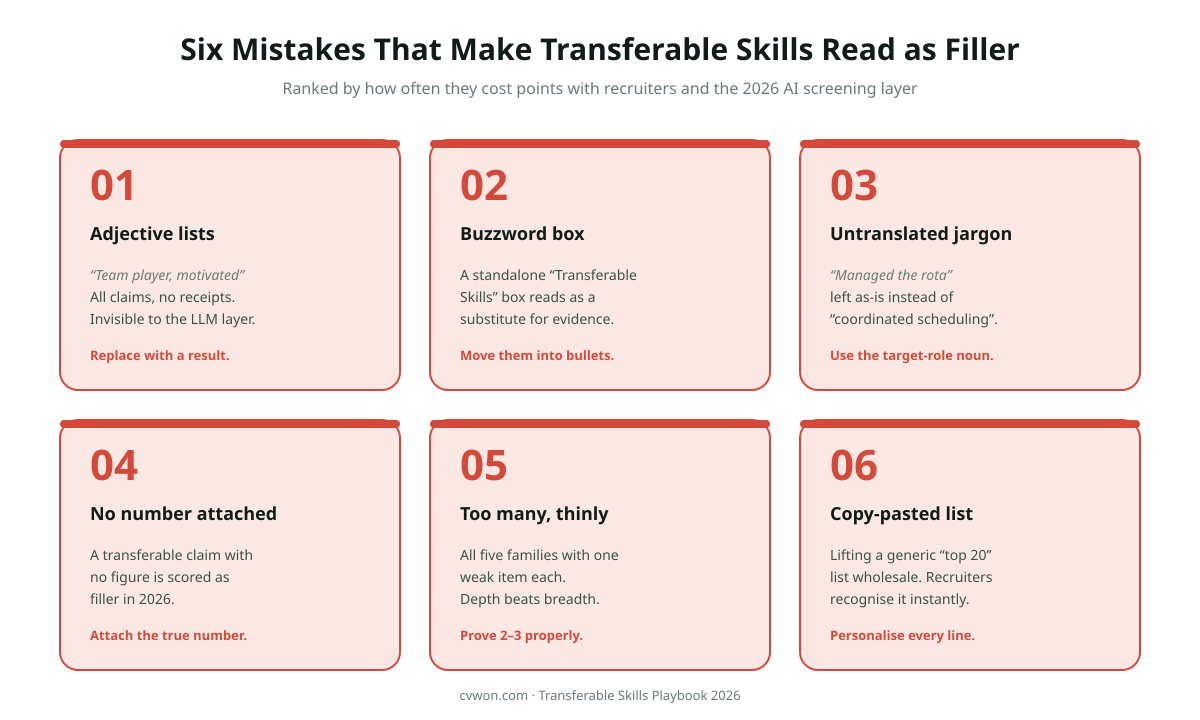
- Adjective lists with no proof. "Communicator, team player, motivated" — all claims, no receipts. Replace each with a quantified result.
- A standalone "Transferable Skills" buzzword box. Reads as a substitute for evidence. Move the skills into experience bullets.
- Untranslated old-role jargon. "Managed the rota" left as-is instead of "coordinated scheduling for a 14-person team". Translate to the target-role noun.
- No number attached. A transferable claim without a figure is scored as filler by the 2026 LLM ranking layer. Always attach the number that was already true.
- Too many families, thinly. Listing all five families with one weak item each. Pick the two or three that match the role and prove them properly.
- Copy-pasted generic list. Lifting a "top 20 transferable skills" list wholesale. Recruiters recognise it instantly — personalise every line with your real result.
Next step
The fastest way to turn your past roles into proven transferable skills is to run the five-step method above inside the CVWon CV builder: paste your proudest results, and it prompts you for the number and the target-role translation on each one, then drops them into the six-section format. Pair it with the skills to put on CV 2026 guide for the full skills section.
Frequently Asked Questions
What are transferable skills on a CV?
Transferable skills are abilities you can carry from one role or industry into another, independent of the specific tools of any single job — communication, problem-solving, leadership, adaptability and digital literacy are the main families. On a 2026 CV, each transferable skill should be anchored to a quantified result from where you used it, not listed as a standalone adjective.
What are the best transferable skills to put on a CV in 2026?
The strongest in 2026 are the ones you can prove: written and verbal communication, problem-solving and analysis, leadership and coordination, adaptability and fast learning, and digital and data literacy (including basic AI-tool use). The "best" transferable skill is always the one most relevant to the target role that you can back with a concrete number.
How do I show transferable skills if I'm changing careers?
Lead with the mapped result phrased in the target role's language, and bury the old job title. "Managed a café rota" becomes "coordinated scheduling for a 14-person team across 3 shifts". The activity is unchanged; you swap the sector-specific noun for the target-role noun and attach the number. Our career change CV guide covers the full document.
How many transferable skills should I list on my CV?
Focus on the two or three families most relevant to the target role and prove each with a bullet, rather than listing all five thinly. Depth beats breadth: two transferable skills backed by real numbers outperform eight vague adjectives. The rest of your CV real estate is better spent on experience bullets.
Where do transferable skills go on a CV?
In three places: one line in the summary, grouped in the skills section, and — most importantly — proven inside experience or project bullets as quantified results. Avoid a floating "Transferable Skills" box of adjectives at the top; it reads as a claim without evidence to both recruiters and the AI screening layer.
Are transferable skills the same as soft skills?
They overlap but are not identical. Soft skills (communication, teamwork) are always transferable, but transferable skills also include harder capabilities like data analysis, project coordination and digital-tool fluency that carry across industries. Think of transferable skills as the wider category: any ability that moves with you, whether soft or technical.
How do I prove transferable skills a recruiter might doubt?
Use the transfer-proof formula: state the skill implicitly and back it with a quantified result from the domain where you earned it. "Communication" is doubted; "de-escalated 30+ complaints per week, 96% resolved at first contact" is not. The number lets the recruiter transfer the evidence to the new role themselves — you do not have to argue that it will transfer.
Can I use transferable skills for a first job with no experience?
Yes — studies, part-time work, volunteering, sports teams and society roles all produce genuine transferable skills. A course rep who "gathered feedback from 90 students and presented it to faculty" has a proven communication skill. Lead with the context that produced the skill, since a first-job recruiter's doubt is whether any evidence exists at all. See our CV with no experience guide.
Do transferable skills help with ATS and AI screening?
Only when they are anchored and phrased in the target role's language. A classic ATS matches your skill wording against the job description, so translating "rota" to "scheduling" helps the keyword match. The 2026 LLM ranking layer separately checks whether each skill is backed by an experience bullet — an unproven transferable claim is scored as filler. Both layers reward the same thing: proof.
How do I list transferable skills after a career break?
Front-load recency. A returner's main doubt is currency, so lead any transferable skill with a recent signal — a course completed during the break, freelance work, or a volunteer role like club treasurer. "During a career break, completed a data-analysis course and managed a community group's budget" proves the skill is both real and current. The employment gap CV guide has the full approach.
Last reviewed on 13 August 2026 by Muneeb Awan (Founder, CVWon).
About the Author
Muneeb Awan is the founder of CVWon, an AI-powered CV builder and career platform used by professionals across the EU and Gulf regions. He writes on hiring technology, ATS mechanics and the 2026 CV playbooks that pass both filters.