Action Verbs for CV 2026: The Words That Land
Last updated: 21 August 2026 · 15 min read · Reviewed by Muneeb Awan (Founder, CVWon)
Action verbs for a CV are the strong, past-tense verbs that open each experience bullet and name a concrete result — led, built, cut, grew, delivered — instead of weak fillers like "responsible for" or "helped with". The verb is the first word a recruiter reads on every bullet, and it decides whether the line reads as an achievement or a duty. This guide gives you a verb bank grouped by the signal each verb sends, a weak-to-strong swap table for the phrases you should delete, the usage rules that stop verbs from weakening (tense, repetition, one per bullet), and how the verb pairs with a number to form a bullet the 2026 AI screening layer scores.
TL;DR
- Open every bullet with a strong past-tense verb. "Led", "built", "cut", "grew" — not "responsible for", "helped with", or "worked on".
- Pick the verb by the signal you want: leadership (led, directed), impact (cut, grew, delivered), analysis (analysed, evaluated), creation (built, designed, launched), or achievement (won, exceeded, secured).
- A verb alone is not enough. Strong verb + a number = a quantified achievement the recruiter and the LLM ranking layer both reward. "Led" is weak; "led a 9-person team, cut turnover 30% to 12%" is strong.
- Follow three rules: one strong verb per bullet, past tense for past roles (present for your current one), and don't repeat the same verb down the page.
- Delete the weak openers. "Responsible for", "helped", "worked on", "involved in", "dealt with" describe involvement, not impact — swap each for a result verb.
Why action verbs decide how your CV reads
An action verb is the strong, result-oriented verb that opens a CV bullet — and it sets whether the recruiter reads the line as an achievement or a duty within the first word. Recruiters skim the left edge of your experience section, where every bullet begins. A weak opener like "responsible for" signals a job description; a strong verb like "cut" signals a result. Same work, opposite impression.

The reason the verb matters so much in 2026 is that both the human recruiter and the LLM ranking layer read it as the classifier for the whole bullet. A strong verb primes the reader to expect a result and pushes you to supply the number that proves it. A weak verb lets you get away with a vague duty — which is exactly what gets skimmed past. The verb is the first word of the achievement formula covered in our achievements on CV guide: verb, then metric, then context.
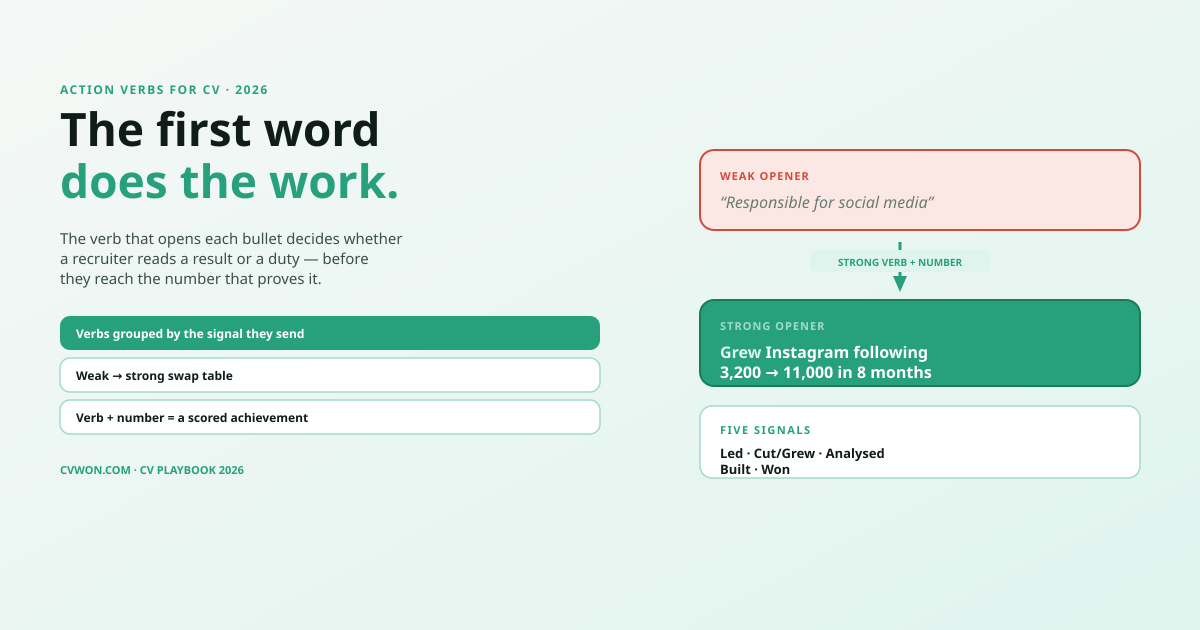
The first word of every bullet does more work than any other word on your CV. Start with "responsible for" and the recruiter reads a duty; start with "cut", "grew" or "led" and they read a result — before they reach the number that proves it.
Key takeaway: treat the first word of each bullet as a decision. Choose a strong past-tense verb that names what changed, and the rest of the bullet is forced to earn it.
Action verbs grouped by the signal they send
The most useful way to choose an action verb is by the signal it sends — leadership, impact, analysis, creation, or achievement — because the right verb depends on the trait the role wants. A generic list of 200 verbs does not help you pick; grouping them by signal does. Match the verb to the competency the job description emphasises.
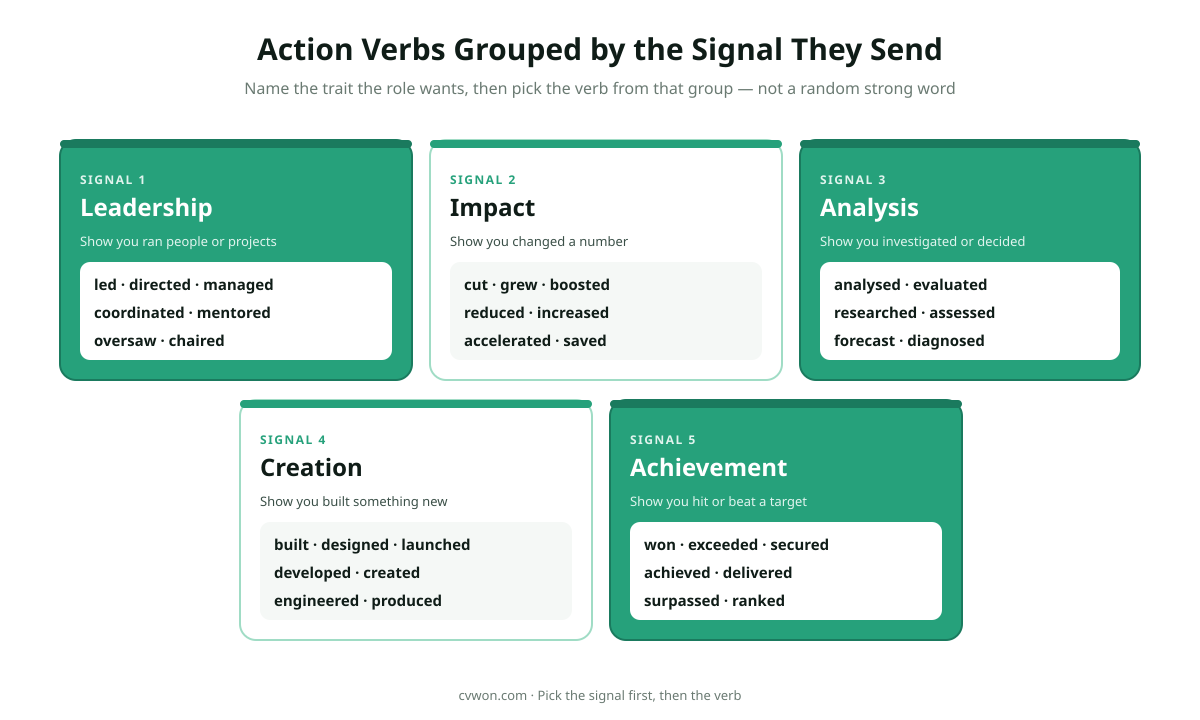
| Signal | Use when you want to show… | Verbs |
|---|---|---|
| Leadership | You ran people or projects | led, directed, managed, coordinated, mentored, oversaw, chaired |
| Impact | You changed a number | cut, grew, boosted, reduced, increased, accelerated, saved |
| Analysis | You investigated or decided | analysed, evaluated, researched, assessed, forecast, diagnosed |
| Creation | You built something new | built, designed, launched, developed, created, engineered, produced |
| Achievement | You hit or beat a target | won, exceeded, secured, achieved, delivered, surpassed, ranked |
For a leadership-heavy role, lead your bullets with leadership verbs; for an analyst role, lead with analysis verbs. Contrast "managed the reporting process" (leadership signal) with "analysed 12 months of sales data to cut forecast error 30%" (analysis + impact) — the second tells the recruiter exactly which competency you are proving. Pick the signal first, then the verb.
Key takeaway: before writing a bullet, name the trait it should prove, then choose the verb from that signal group. The verb becomes a deliberate signal, not a random strong word.
The weak-to-strong verb swap table
Turning a weak CV bullet strong usually means one edit: replacing the weak opener with a strong action verb. The weak phrases are predictable — "responsible for", "helped with", "worked on" — and each has a direct strong replacement. Run your CV through the swaps below and most bullets improve instantly.
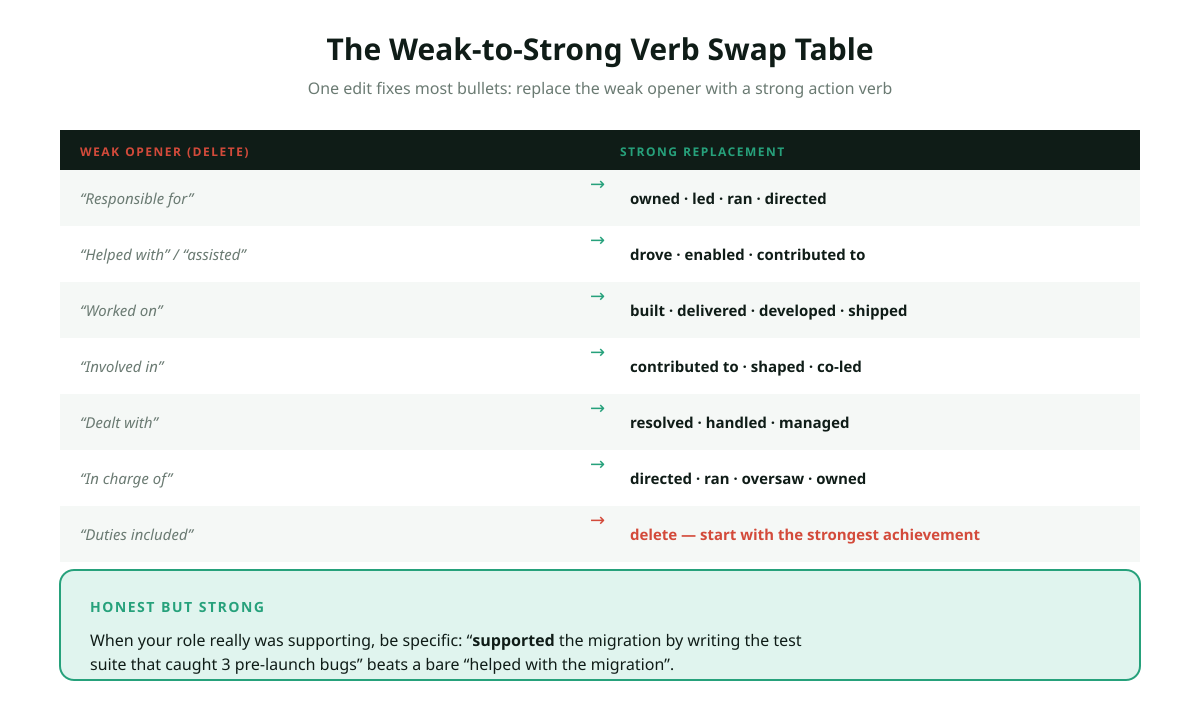
| Weak opener (delete) | Strong replacement |
|---|---|
| "Responsible for" | owned, led, ran, directed |
| "Helped with" / "assisted" | drove, enabled, supported (with a result), contributed to |
| "Worked on" | built, delivered, developed, shipped |
| "Involved in" | contributed to, shaped, co-led |
| "Dealt with" | resolved, handled, managed |
| "In charge of" | directed, ran, oversaw, owned |
| "Was tasked with" | led, delivered, executed |
| "Duties included" | (delete entirely; start with the strongest achievement) |
Notice the strongest replacements imply ownership and a result. "Owned" and "led" say the outcome was yours; "helped" says you were nearby. When your genuine role was supporting, be honest but specific: "supported the migration by writing the test suite that caught 3 pre-launch bugs" beats a bare "helped with the migration". Honesty plus specificity still reads strong.
Verb + number: how a verb becomes an achievement
A strong verb alone is not an achievement — the verb plus a number is. The verb signals a result; the number proves it. This pairing is what both a recruiter and the 2026 LLM ranking layer reward, and it is why "power words" on their own are fluff. A verb with no metric is still a claim.
Watch the same verb weaken and strengthen:
- Weak: "Led the sales team." (verb, no number)
- Strong: "Led a 6-person sales team to 118% of target for three straight quarters." (verb + number + context)
- Weak: "Improved the checkout."
- Strong: "Rebuilt the checkout flow; conversion rose 7.2% in an A/B test."
The 2026 LLM ranking layer specifically checks for quantified-bullet density — the share of your bullets that carry a number — and treats numberless "power-word" bullets as filler, as covered in our AI resume screening guide. So action verbs are necessary but not sufficient: they must lead to a metric. The full verb-plus-metric-plus-context structure is the achievement formula in the achievements on CV guide.
Power words are not magic. A strong verb with no number is a stronger-sounding claim, still unproven. The verb earns its place only when it points at a figure — a percentage, an amount, a count, a time saved.
The three verb usage rules
Three rules keep action verbs working: one strong verb per bullet, correct tense, and no repetition of the same verb down the page. Break them and even strong verbs lose force. These are the mechanics most verb-list articles skip.
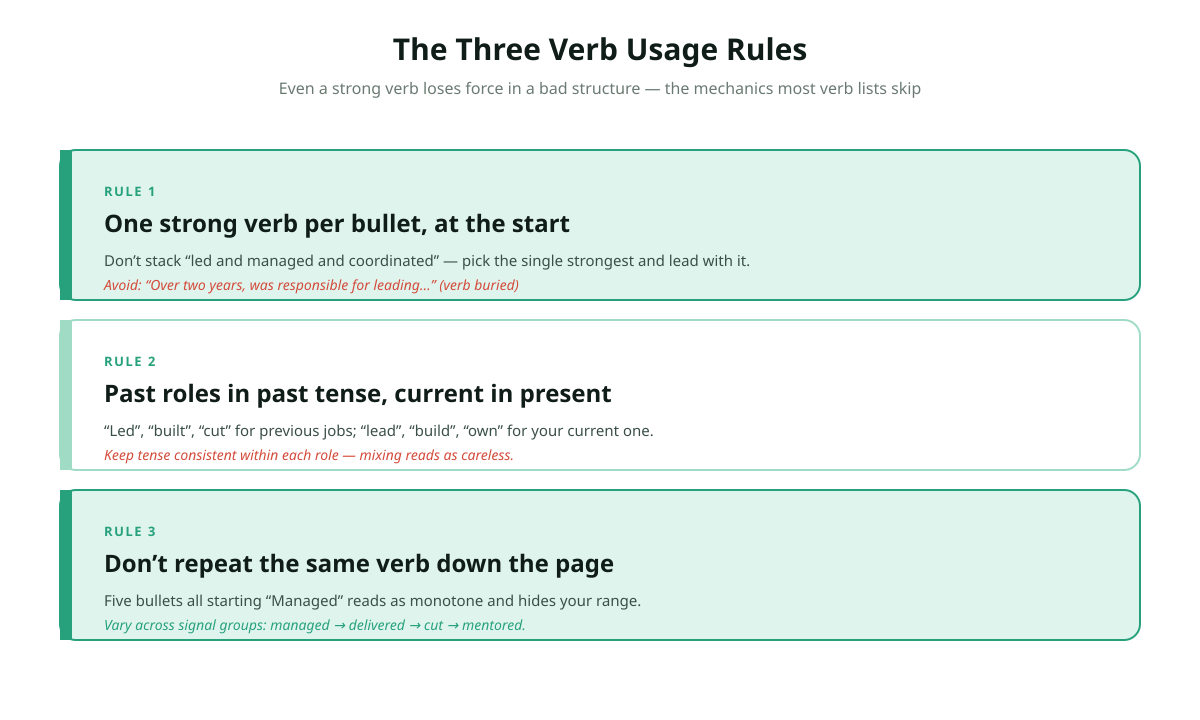
- One strong verb per bullet, at the start. Do not stack "led and managed and coordinated" — pick the single strongest and lead with it. Burying the verb mid-sentence ("Over two years, was responsible for leading…") wastes the opener.
- Tense: past roles in past tense, current role in present. "Led", "built", "cut" for previous jobs; "lead", "build", "own" for your current one. Keep it consistent within each role.
- Do not repeat the same verb. Five bullets all starting "Managed" reads as monotone and hides your range. Vary across signal groups — managed, then delivered, then cut, then mentored.
Key takeaway: a strong verb at the start, in the right tense, not repeated — that is the difference between a verb that lands and one that blurs into the next bullet.
Weak verbs and buzzwords to delete
The weakest CV language is not the wrong verb — it is the absence of one, replaced by "responsible for" or a buzzword adjective. Two categories drain a bullet: filler openers that describe involvement, and adjective buzzwords that claim a trait without proving it. Delete both.
- Filler openers: "responsible for", "helped with", "worked on", "involved in", "duties included", "tasked with". Replace with a result verb from the swap table.
- Buzzword adjectives: "hard-working", "detail-oriented", "team player", "results-driven", "go-getter". These are unprovable claims, not verbs — the same filler covered in our common CV mistakes guide. Replace with a bullet that shows the trait through a result.
- Vague verbs: "handled", "supported", "assisted", "participated" — acceptable only with a specific result attached, weak on their own.
The fastest single edit to most CVs is a find-and-delete on "responsible for" and every buzzword adjective, replacing each with a verb-plus-number bullet. Recruiters register buzzword adjectives as noise; a specific verb with evidence reads as signal.
Best action verbs by role type
The strongest action verbs shift by role, because each field rewards a different competency signal. A sales CV leans on impact and achievement verbs; an engineering CV on creation and analysis; a management CV on leadership. Lead with the verbs that match your field's core competency.
| Role type | Lead with these verbs |
|---|---|
| Sales / commercial | exceeded, grew, won, secured, closed, generated |
| Engineering / technical | built, designed, shipped, migrated, automated, cut (latency/cost) |
| Management / leadership | led, directed, mentored, scaled, restructured, delivered |
| Marketing | launched, grew, drove, ranked, boosted, positioned |
| Operations / admin | streamlined, cut, processed, coordinated, standardised |
| Analytical / finance | analysed, forecast, modelled, evaluated, reduced, reconciled |
For technical roles, pair the creation verb with a system number, as shown in our skills to put on CV guide: "cut p99 latency 640ms to 145ms". For a first CV with limited work history, the same verbs apply to studies, projects and volunteering — "led a 12-member society", "built a working app" — per the CV with no experience guide.
120 action verbs bank (by category)
Below is a working bank of strong action verbs, grouped by category so you can pick by the signal you need. Use them to replace weak openers — then attach a number to each.
Led / managed: led, directed, managed, oversaw, coordinated, chaired, headed, supervised, orchestrated, spearheaded, mentored, guided, delegated, championed, mobilised.
Improved / reduced: cut, reduced, lowered, streamlined, optimised, simplified, accelerated, minimised, eliminated, consolidated, tightened, trimmed, de-risked, automated, standardised.
Grew / increased: grew, increased, boosted, expanded, scaled, doubled, tripled, drove, raised, amplified, multiplied, accelerated, generated, lifted, advanced.
Built / created: built, created, designed, developed, launched, engineered, produced, established, founded, architected, formulated, devised, prototyped, shipped, implemented.
Analysed / evaluated: analysed, evaluated, assessed, researched, investigated, diagnosed, forecast, modelled, audited, examined, measured, quantified, mapped, benchmarked, tested.
Won / achieved: won, achieved, exceeded, surpassed, secured, delivered, attained, earned, captured, clinched, outperformed, ranked, qualified, awarded, hit.
Communicated / influenced: presented, negotiated, persuaded, advised, briefed, authored, facilitated, trained, coached, aligned, lobbied, pitched, communicated, translated, represented.
Improved process / delivered: delivered, executed, completed, shipped, deployed, rolled out, migrated, integrated, resolved, fixed, maintained, supported (with result), coordinated, processed, reconciled.
Mistakes that weaken strong verbs
The common mistake is a strong verb used weakly — buried, repeated, tense-inconsistent, or unattached to a number. A good verb in a bad structure still fails. Avoid the five below to keep every verb pulling its weight.
- Verb with no number. "Led the team" is a claim; "led a 9-person team, cut turnover 30% to 12%" is proof. Always attach a figure.
- Same verb repeated. Five "Managed" bullets read as monotone. Vary across signal groups.
- Verb buried mid-sentence. "During my time there I was responsible for building…" — lead with "Built".
- Wrong tense. Past roles in past tense; keep the current role consistent in present tense.
- Buzzword instead of verb. "Results-driven professional" is an adjective claim, not an action verb with evidence. Show the result instead.
Next step
The fastest way to swap every weak opener for a strong action verb is to run your CV through the CVWon CV builder: it flags "responsible for", "helped with" and buzzword adjectives, suggests a strong replacement verb by signal, and prompts you for the number that turns the verb into an achievement. Start with your most recent role and edit top-down.
Frequently Asked Questions
What are the best action verbs for a CV?
The best action verbs are strong, past-tense, and matched to the signal you want to send: leadership (led, directed), impact (cut, grew, delivered), analysis (analysed, evaluated), creation (built, designed, launched), and achievement (won, exceeded, secured). The single "best" verb is the one that names what changed because of your work and points at a number that proves it.
What can I use instead of "responsible for" on a CV?
Replace "responsible for" with a strong ownership verb: owned, led, ran, or directed. "Responsible for social media" becomes "grew Instagram following 3,200 to 11,000 in 8 months". The swap forces you to name the result rather than the duty, which is what both recruiters and the 2026 AI screening layer reward.
Do action verbs actually help with ATS or AI screening?
Action verbs help when they lead to a number. The classic ATS matches keywords, so a strong verb that mirrors the job description helps. The 2026 LLM ranking layer, however, scores quantified-bullet density and treats a strong verb with no metric as filler. So verbs are necessary but not sufficient — pair each with a figure, as our achievements guide shows.
How many different action verbs should I use on a CV?
Enough to avoid repeating any verb more than once or twice across the whole CV. Repeating "managed" on five bullets reads as monotone and hides your range. Vary across the signal groups — leadership, impact, analysis, creation, achievement — so each bullet shows a different competency.
Should CV action verbs be past or present tense?
Past tense for past roles (led, built, cut) and present tense for your current role (lead, build, own). Keep the tense consistent within each role. Mixing tenses inside one job reads as careless, and using present tense for a job you have left is a factual error a recruiter notices.
Are "power words" on a CV just fluff?
Power words are fluff only when they stand alone. A strong verb without a number is a better-sounding claim that is still unproven. The verb earns its place when it points at a metric — "boosted retention 15%" works; "boosted retention" does not. Treat power words as the opener to a result, never as a substitute for one.
What weak words should I remove from my CV?
Delete filler openers ("responsible for", "helped with", "worked on", "involved in", "duties included") and buzzword adjectives ("hard-working", "detail-oriented", "team player", "results-driven"). Filler openers describe involvement rather than impact, and buzzword adjectives claim a trait without proving it. Replace each with a strong verb plus a number.
Can I start two bullets with the same action verb?
Once is tolerable; a pattern is not. Two bullets under different roles can share a verb, but starting three or more with "managed" or "led" flattens your CV. When you notice repetition, reach for a verb in a different signal group that describes the same work more precisely — "scaled", "restructured", or "mentored" instead of a third "managed".
What action verbs work for a CV with no experience?
The same strong verbs apply to studies, projects, volunteering and part-time work: "led a 12-member society", "built a working app", "organised a 200-person event", "analysed survey data from 90 respondents". A first-job CV proves competency through non-work results, so lead those bullets with the same result verbs. Our CV with no experience guide shows the full approach.
Do I need action verbs in my CV personal statement too?
Yes, but sparingly and in the first person implied by context. A summary leads with your specialisation and one headline result — "Operations lead who cut fulfilment time 35%" — where "cut" carries the same weight as in a bullet. Avoid stacking verbs in the summary; one strong result verb tied to your flagship achievement is enough.
Last reviewed on 21 August 2026 by Muneeb Awan (Founder, CVWon).
About the Author
Muneeb Awan is the founder of CVWon, an AI-powered CV builder and career platform used by professionals across the EU and Gulf regions. He writes on hiring technology, ATS mechanics and the 2026 CV playbooks that pass both filters.