How to Start a Cover Letter 2026: Opening Lines
Last updated: 21 August 2026 · 14 min read · Reviewed by Muneeb Awan (Founder, CVWon)
To start a cover letter in 2026, open with a specific hook — a shared connection, a relevant achievement, or a concrete reason you want this exact role — then name the job, all in the first two sentences. Skip "I am writing to apply for", "My name is", and "To whom it may concern"; they waste the one line a hiring manager actually reads before deciding whether to continue. This guide gives you the opening-line formula, five ranked opener types from strongest to weakest, ready-to-adapt templates for referrals, cold applications, career changes and first jobs, and a weak-to-strong swap table for the phrases to delete.
TL;DR
- Open with a hook in the first sentence. A shared connection, a specific achievement, or a concrete reason for this exact role — not "I am writing to apply for".
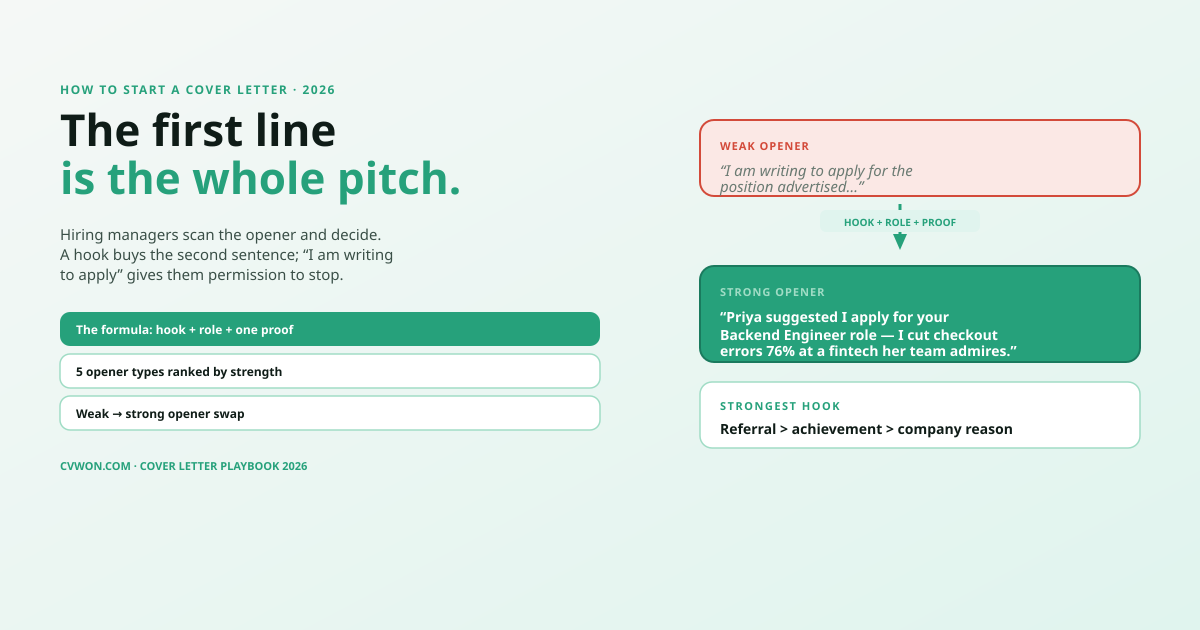
- Use the formula: hook + the role you want + one line of proof. "Priya suggested I apply for your Backend Engineer role — I cut checkout errors 76% at a fintech her team admires."
- The strongest opener is a referral, then a relevant achievement, then a company-specific reason. Generic enthusiasm ("I am excited to apply") is the weakest.
- Never use "To whom it may concern". Find the hiring manager's name; if you truly can't, use "Dear [Team] Hiring Team" or "Dear Hiring Manager".
- Delete the throat-clearing. "My name is", "I am writing to", "Please find attached" add nothing — start with the value.
Why the first line of a cover letter decides the rest
The first line of a cover letter is the hook that decides whether a hiring manager reads the second line — it is not a formality, it is the whole opening bid. Recruiters skim cover letters in seconds, and a generic first sentence signals a generic letter they can skip. A specific first sentence signals effort and buys the rest of the paragraph.

Compare two openings for the same job. "I am writing to apply for the Marketing Manager position advertised on your website" tells the reader nothing they didn't already know. "Your Q3 campaign on sustainable packaging is why I applied — I ran a similar launch that lifted trial signups 40%" names a specific reason and a proof point in one line. Same applicant; only the second earns a second sentence. The opener follows the same logic as a strong CV bullet in our action verbs for CV guide: lead with the value, not the throat-clearing.
Hiring managers do not read cover letters top to bottom — they scan the first line and decide. A generic opener ("I am writing to apply") gives them permission to stop. A specific one — a name, an achievement, a reason — is the only thing that reliably buys the second sentence.
Key takeaway: treat the first sentence as the entire pitch. If it could open anyone's letter for any job, rewrite it until it could only open yours for this job.
The opening-line formula: hook + role + proof
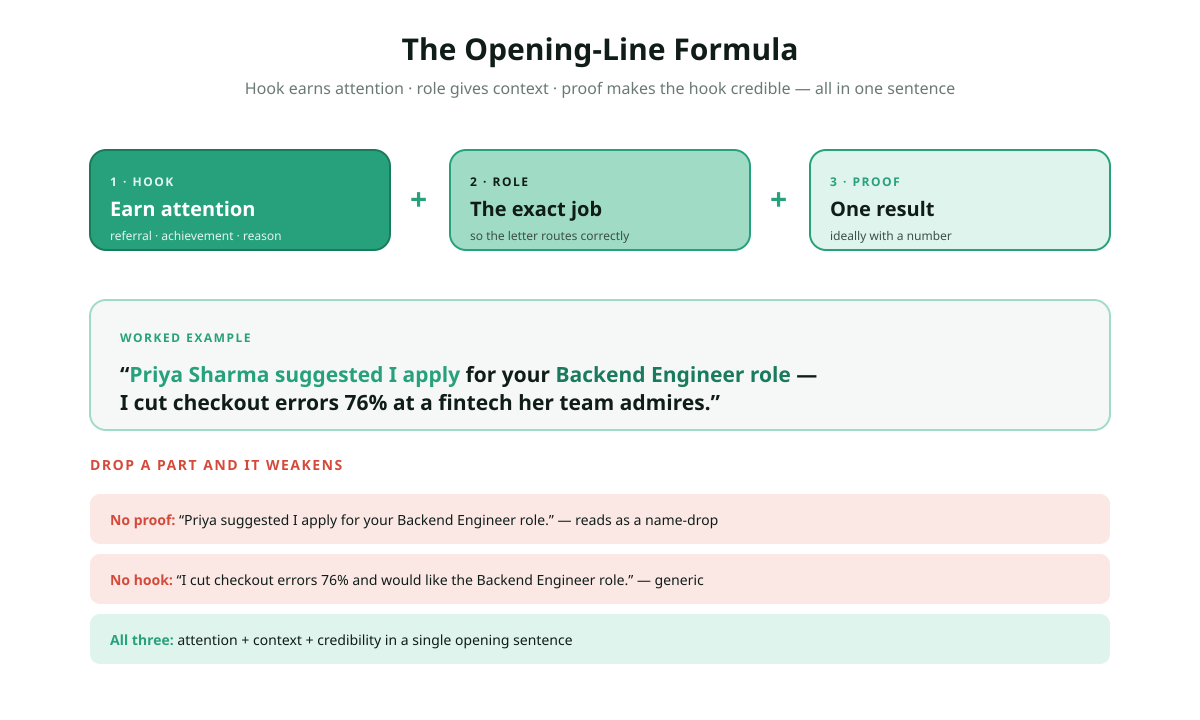
The opening-line formula is a hook, the role you want, and one line of proof — delivered in the first one or two sentences. The hook earns attention, the role gives context, and the proof makes the hook credible. Most weak openers have the role but no hook and no proof, which is why they read as filler.
The three parts:
- Hook — the specific reason the reader should keep going: a referral, an achievement, or a concrete company reason.
- Role — the exact job title you are applying for, so the letter routes correctly.
- Proof — one credible result that backs the hook, ideally with a number.
Applied: "Priya Sharma suggested I apply for your Backend Engineer role — I cut checkout errors 76% at a fintech her team admires." The hook (Priya's referral), the role (Backend Engineer), and the proof (76% cut) all land in one sentence. Drop the proof and it reads as a name-drop; drop the hook and it reads as generic. All three together open strong.
Key takeaway: before writing anything else, draft one sentence with all three parts. If you cannot supply a hook, you are not ready to write the opener — go find your strongest connection, achievement, or company-specific reason first.
The 5 opener types, ranked by strength
Cover letter openers fall into five types, and they are not equal — a referral opener beats an achievement opener, which beats a company-specific opener, which beats a skills-match opener, which beats generic enthusiasm. Choose the strongest type you can honestly use. Most applicants default to the weakest (generic enthusiasm) when a stronger one is available.
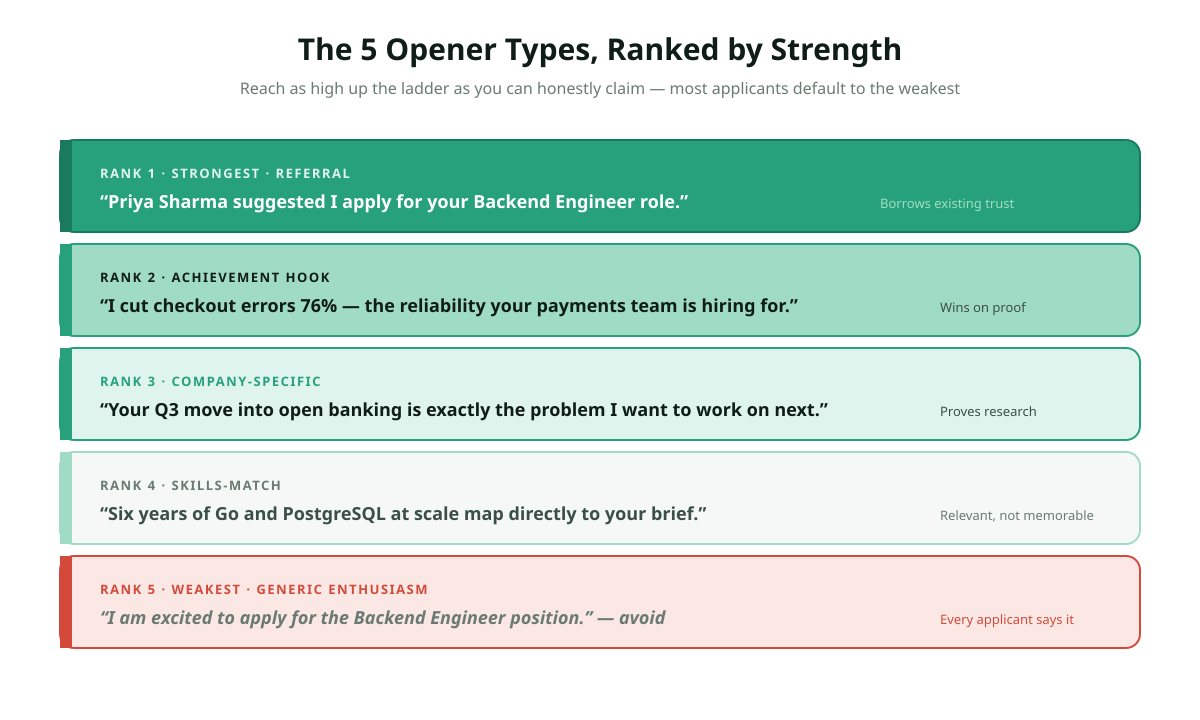
| Rank | Opener type | Example first line |
|---|---|---|
| 1 (strongest) | Referral | "Priya Sharma suggested I apply for your Backend Engineer role." |
| 2 | Achievement hook | "I cut checkout errors 76% at a fintech — the kind of reliability your payments team is hiring for." |
| 3 | Company-specific | "Your Q3 move into open banking is exactly the problem I want to work on next." |
| 4 | Skills-match | "Six years of Go and PostgreSQL at scale map directly to your Backend Engineer brief." |
| 5 (weakest) | Generic enthusiasm | "I am excited to apply for the Backend Engineer position." (avoid) |
A referral wins because it borrows trust from someone the company already knows. An achievement hook wins on proof. A company-specific opener wins on evidence you did your homework. Generic enthusiasm wins nothing — every applicant is "excited", so it carries no signal. Reach as high up this ladder as you honestly can.
Key takeaway: if you have a referral, use it in the first sentence — it is the single strongest opener available. If not, lead with your most relevant achievement.
Weak-to-strong opener swap table
Fixing a weak cover letter opening usually means deleting a predictable filler phrase and replacing it with a hook. The weak openers are the same across almost every application, which makes them easy to spot and swap. Run your draft against the table below.
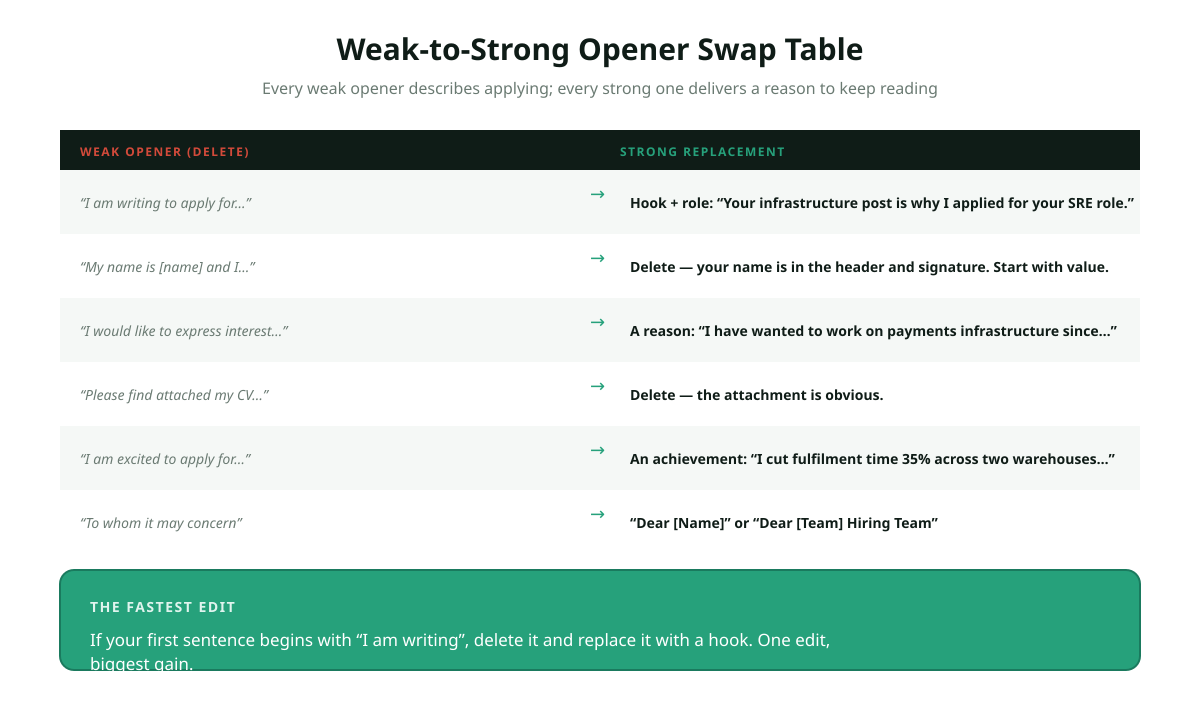
| Weak opener (delete) | Strong replacement |
|---|---|
| "I am writing to apply for…" | A hook + the role: "Your infrastructure post is why I applied for your SRE role." |
| "My name is [name] and I…" | (Your name is in the signature and header — start with value instead.) |
| "I would like to express my interest in…" | A reason: "I have wanted to work on payments infrastructure since…" |
| "Please find attached my CV for…" | (Delete — the attachment is obvious.) |
| "I am excited to apply for…" | An achievement: "I cut fulfilment time 35% across two warehouses —…" |
| "To whom it may concern" | "Dear [Name]" or "Dear [Team] Hiring Team" |
Every weak opener on the left describes the act of applying; every strong replacement delivers a reason to keep reading. The single fastest edit to any cover letter is deleting the first sentence if it begins with "I am writing" and replacing it with a hook. This mirrors the swap discipline in our action verbs guide — cut the filler, lead with the value.
Opening templates by scenario
The best cover letter opening depends on your situation — a referral, a cold application, a career change, or an internal move each calls for a different hook. The four templates below apply the formula (hook + role + proof) to the most common scenarios. Swap in your specifics.
Referral
"[Name] suggested I apply for your [role] — when I told them I [relevant achievement], they said it was exactly what your team needs." The referral is the hook, your achievement is the proof.
Cold application (no connection)
"Your [specific project/announcement] is why I applied for your [role]. I [relevant achievement with a number], and I want to do that work at [company]." Company-specific reason as the hook.
Career change
"After [X years] in [old field], I am moving into [new field] — and I bring one thing most candidates don't: [transferable proof]." Lead with the transferable strength, not an apology. Our CV with no experience guide covers the same framing for the whole application.
Internal move / promotion
"Over [time] on the [current team], I [specific result] — and I am ready to do it at a larger scope as your [target role]." Your track record inside the company is the hook.
There is no universal best opener — there is the best opener for your situation. Diagnose which hook you actually have (a name, an achievement, a company reason, an internal record), then lead with it. The formula stays; the hook changes.
The greeting: who to address when you have no name
The correct cover letter greeting names a specific person — "Dear [First Last]" — and only falls back to a team-specific line when the name genuinely cannot be found. "To whom it may concern" and "Dear Sir/Madam" both signal you did not try, which undercuts a strong opener before it starts.
The greeting hierarchy, strongest first:
- Named hiring manager: "Dear Priya Sharma," — find it on the job post, LinkedIn, or the company's team page.
- Named team lead / department head: if the direct hirer is unclear, address the function's leader.
- Team fallback: "Dear Engineering Hiring Team," — specific to the department, not generic.
- Last resort: "Dear Hiring Manager," — acceptable, but weaker than a name.
Spending five minutes to find the name is worth it: a named greeting signals research, which is the same signal your opener is trying to send. Government careers guidance such as the UK's National Careers Service and university careers offices consistently advise addressing a named person wherever possible.
How to start with no experience
To start a cover letter with no professional experience, lead with a hook drawn from studies, projects, volunteering or part-time work — a specific result, not an apology. The mistake is opening with what you lack ("Although I have limited experience…"); the fix is opening with what you have done, framed as proof.
A strong no-experience opener: "As course rep, I gathered feedback from 90 students and presented it to faculty — the kind of stakeholder work your Junior Analyst role needs." The academic result is the hook and the proof; the role gives context. First-job applicants have more evidence than they think, as the CV with no experience guide shows — the same results power both the CV and the cover letter opener.
Key takeaway: never open a first-job cover letter with an apology for your experience level. Open with the strongest thing you have actually done, and let it carry the same weight a work achievement would.
Opening mistakes that get cover letters skimmed
The common opening mistakes all share one trait: they delay or dilute the hook. A hiring manager who reaches the second line without a reason to continue has usually already decided to skim. Avoid the five below to keep the opener working.
- "I am writing to apply for…" — the single most common weak opener. Delete and lead with a hook.
- Starting with your name. It is already in the header and signature. Start with value.
- "To whom it may concern". Signals no research. Find a name or use a team-specific greeting.
- Generic enthusiasm. "I am excited/passionate" carries no signal — every applicant claims it. Show a specific reason instead.
- A long wind-up. Two sentences of context before the point. Put the hook first; context can follow. This is the cover-letter version of the buried-verb mistake in our common CV mistakes guide.
Next step
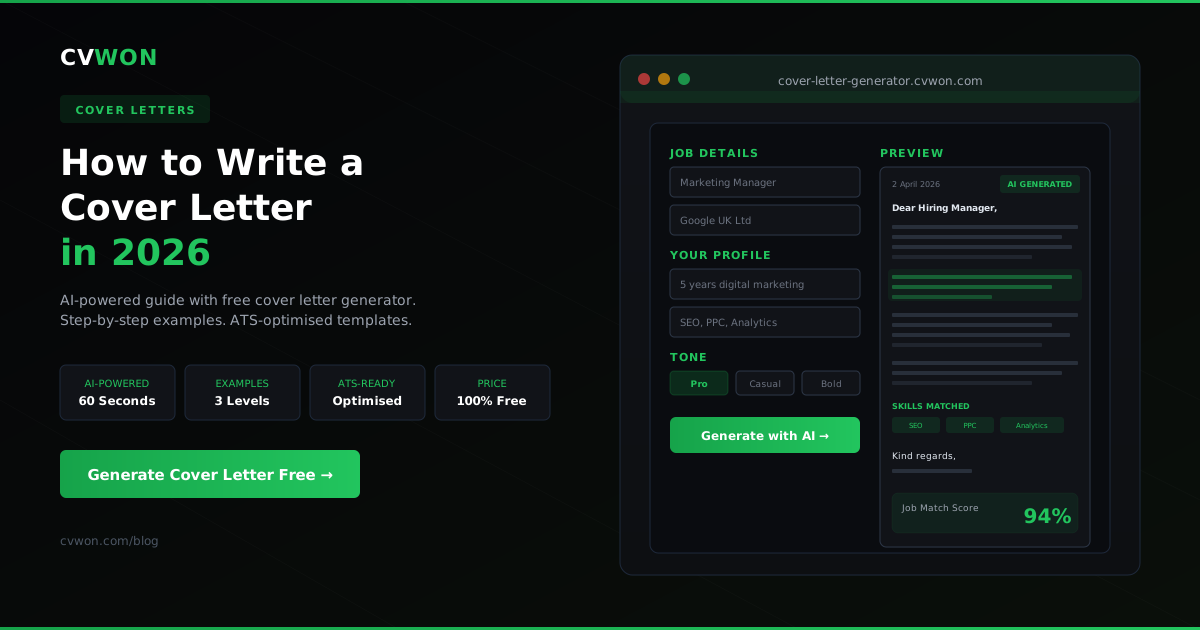
The fastest way to write a strong opening line is to start from your CV: paste your best achievement and target role into the CVWon cover letter builder, and it drafts an opener using the hook + role + proof formula, then flags weak phrases like "I am writing to apply". Pair it with our complete cover letter guide for the full letter structure.
Frequently Asked Questions
How do you start a cover letter in 2026?
Open with a specific hook in the first sentence — a shared connection, a relevant achievement, or a concrete reason you want this exact role — then name the job. Use the formula hook + role + proof. Avoid "I am writing to apply for", "My name is", and "To whom it may concern", which waste the one line a hiring manager reliably reads.
What is the best opening line for a cover letter?
The best opening line uses the strongest hook you can honestly claim, ranked: a referral first ("Priya suggested I apply"), then a relevant achievement, then a company-specific reason. A referral wins because it borrows trust the company already has. Whichever you use, pair it with the exact role and one line of proof.
Should I start a cover letter with "I am writing to apply for"?
No. "I am writing to apply for" is the most common weak opener — it states the obvious and gives the reader permission to skim. Replace it with a hook: a shared connection, an achievement with a number, or a specific reason you want this role at this company. Lead with value, not with the act of applying.
Is "To whom it may concern" acceptable in 2026?
No — it signals you did not try to find the hiring manager. Address a named person wherever possible ("Dear Priya Sharma"). If the name genuinely cannot be found, use a team-specific fallback like "Dear Engineering Hiring Team" or, as a last resort, "Dear Hiring Manager". A named greeting sends the same research signal your opener does.
How do I start a cover letter with no experience?
Lead with a specific result from studies, projects, volunteering or part-time work — not an apology for your experience level. "As course rep, I gathered feedback from 90 students and presented it to faculty" opens stronger than "Although I have limited experience". First-job applicants have more evidence than they assume; use the strongest example as the hook.
How long should the opening of a cover letter be?
One to two sentences. The hook and the role belong in the first sentence, and one line of proof in the first or second. Anything longer delays the point. A hiring manager decides whether to continue within those opening lines, so front-load the value and let context follow in the body.
Should I mention the company name in the first line?
Yes, when your hook is company-specific — naming a real project, announcement or value proves you did your research and did not mass-send the letter. "Your Q3 move into open banking is exactly the problem I want to work on" beats a generic opener. If your hook is a referral or an achievement, the company reason can come in the next sentence instead.
What should I never do at the start of a cover letter?
Never open with "I am writing to apply", your name, "To whom it may concern", or generic enthusiasm ("I am excited to apply"). Each either states the obvious or carries no signal. Never open a first-job letter with an apology for your experience. All of these delay or dilute the hook, which is the one thing the opening line exists to deliver.
How is starting a cover letter different from starting a CV?
A CV opens with a summary line naming your specialisation and a headline result; a cover letter opens with a hook aimed at one specific job and company. The CV is broad and reusable; the cover letter opener is tailored and singular. Both lead with value and a number rather than filler — the discipline is the same, the target is narrower for the letter.
Can I reuse the same cover letter opening for every job?
No — a reusable opener is by definition generic, and generic openers get skimmed. The formula (hook + role + proof) stays constant, but the hook must change per application: a different referral, a different company-specific reason, or a different achievement matched to the role. Tailoring the first line is the highest-impact edit you can make.
Last reviewed on 21 August 2026 by Muneeb Awan (Founder, CVWon).
About the Author
Muneeb Awan is the founder of CVWon, an AI-powered CV builder and career platform used by professionals across the EU and Gulf regions. He writes on hiring technology, ATS mechanics and the 2026 CV and cover-letter playbooks that get read.