How Long Should a Cover Letter Be? (2026)
Last updated: 21 August 2026 · 13 min read · Reviewed by Muneeb Awan (Founder, CVWon)
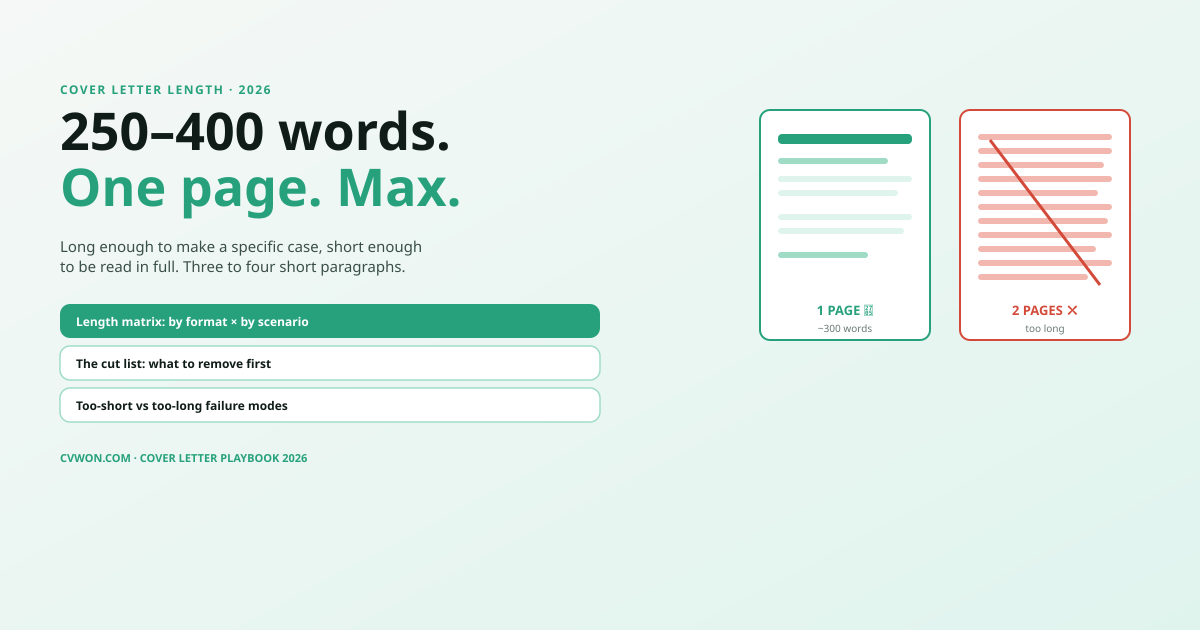
A cover letter should be 250 to 400 words — half a page to one full page, in three to four short paragraphs, and never more than a single page. That length is long enough to make a specific case and short enough to be read in full. The exact target shifts with the format (an email-body cover letter runs shorter than an attached one) and the scenario (a senior or academic letter can run to a full page, a first-job letter closer to half). This guide gives the length-target matrix by format and scenario, a ranked cut list for trimming an over-long draft, and the too-short and too-long failure modes to avoid.
TL;DR
- 250–400 words, half to one page, 3–4 paragraphs. That is the standard target for a cover letter in 2026.
- Never more than one page. A two-page cover letter is the most common length mistake and gets skimmed or skipped.
- Email-body cover letters run shorter — 150–250 words — because they are read in the inbox, not opened as an attachment.
- Length shifts by scenario: first-job and career-change letters can be shorter; senior, executive and academic letters can fill a full page.
- Too short is also a mistake. A three-line letter reads as low effort. Under ~150 words rarely makes a real case.
How long should a cover letter be? The direct answer
A cover letter should be 250 to 400 words, on half to one page, in three to four short paragraphs — and never longer than a single page. This is long enough to open with a hook, make one or two specific points of proof, and close with a confident call to action, without padding. Recruiters read cover letters in seconds, so anything past one page rarely gets read at all.

To picture it: a 300-word cover letter is roughly four short paragraphs — an opening hook, one or two proof paragraphs, and a confident close. That fits comfortably on half to two-thirds of a page in a standard 11pt font. A letter that spills onto a second page almost always contains material that repeats the CV or over-explains, both of which a recruiter skips. The structure follows the open-strong, close-strong logic in our how to start a cover letter guide and how to end a cover letter guide.
The right cover letter length is the shortest one that still makes a specific case. If you can cut a sentence without losing a proof point or the hook, cut it. Length is not a measure of effort — a tight 280-word letter beats a padded 600-word one every time.
Key takeaway: aim for 250–400 words on a single page. If your draft runs to a second page, the problem is not the page limit — it is content that repeats your CV or explains too much.
The length-target matrix: by format and scenario
The ideal cover letter length is not a single number — it shifts by format (email body, attached document, or online form field) and by scenario (standard, career-change, senior, academic, or first-job). A one-size answer misleads: an email-body letter that matched a full-page attached letter would be far too long for an inbox. Match the target to your situation.
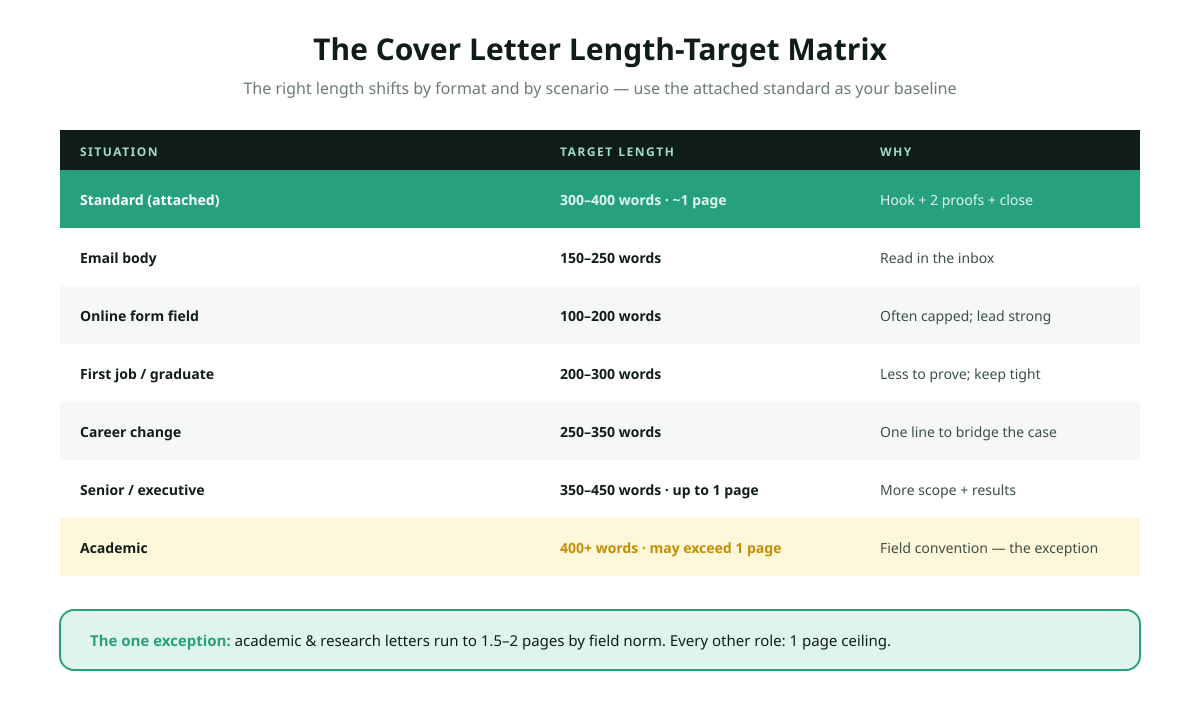
| Situation | Target length | Why |
|---|---|---|
| Standard (attached) | 300–400 words, ~1 page | Room for a hook, two proof points, and a close |
| Email body | 150–250 words | Read in the inbox; shorter holds attention |
| Online form field | 100–200 words | Often capped; lead with the strongest point |
| First job / graduate | 200–300 words | Less to prove; keep it tight and specific |
| Career change | 250–350 words | One extra line to bridge the transferable case |
| Senior / executive | 350–450 words, up to 1 full page | More scope and results to reference |
| Academic | 400+ words, may exceed 1 page by convention | Academic cover letters are longer by field norm |
The academic case is the one true exception to the one-page rule: academic and research cover letters routinely run to a page and a half or two, because the field expects a fuller account of teaching and publications. For every non-academic role, one page is the ceiling. Match the length to the format first, then adjust for your scenario.
Key takeaway: use the attached-document standard (300–400 words) as your baseline, then shorten for email and form fields, and lengthen only for senior or academic roles.
Word count vs page count: which to trust
Word count is the more reliable measure of cover letter length than page count, because font, size and margins change how many words fit on a page. "One page" can mean 250 words in a large font with wide margins or 600 in a cramped one — so aim for the word target first and let the page follow. If you hit 300–400 words and it runs slightly over a page, tighten the words, not the margins.
Two rules keep the two measures aligned:
- Set the word target first (250–400 for a standard letter), then check the page.
- Do not shrink the font or margins to force one page. A 9pt font with 1cm margins to cram 550 words onto "one page" reads as cramped and signals you would not cut. Cut the words instead, keeping 10.5–12pt and ~2cm margins — the same readability standard as the 2026 CV format guide.
"One page" is a formatting outcome, not a length target. Chase the word count — 250 to 400 — and the single page takes care of itself. Shrinking the font to fake a one-page letter fools no one and reads as padding you refused to remove.
Email-body vs attached cover letters
An email-body cover letter should be shorter than an attached one — 150 to 250 words — because it is read directly in the inbox, where attention is shortest. An attached cover letter (PDF or document) can run the full 250–400 words because opening it signals the reader has committed a moment to it. The two formats call for different lengths, even for the same job.
| Format | Length | Opening |
|---|---|---|
| Email body | 150–250 words, 2–3 short paragraphs | Straight to the hook; no formal letterhead |
| Attached (PDF) | 250–400 words, 3–4 paragraphs | Standard letter format with greeting + sign-off |
When you send both — an email with an attached CV and cover letter — keep the email body itself to a tight 150-word version that hooks the reader and points to the attachment, then let the attached letter carry the fuller case. Never paste a full 400-word letter into the email body and also attach it; that is length duplicated, and the reader sees it.
The cut list: what to remove to hit the target
To shorten an over-long cover letter, cut in a specific order: anything that repeats the CV first, then generic enthusiasm, then over-explanation, then filler openers and closers. Most over-long letters are not too detailed — they are padded with material that adds nothing. Cut top-down and the letter tightens fast.
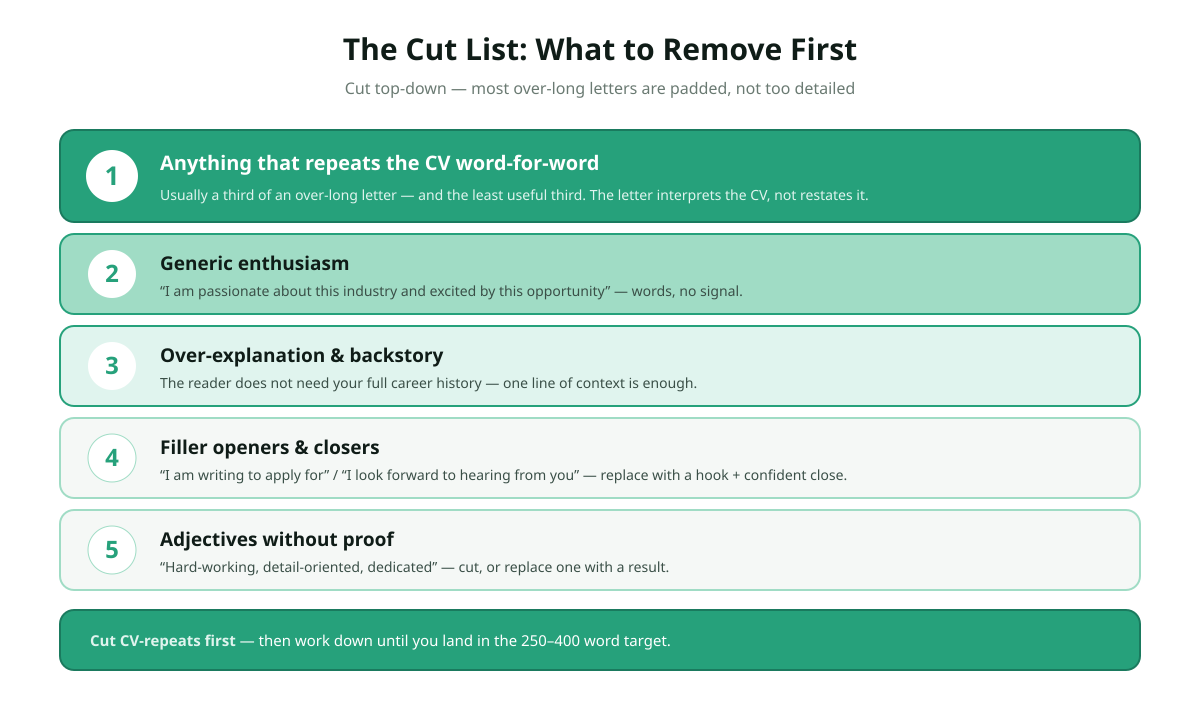
The cut list, in order:
- Anything that repeats the CV word-for-word. The letter should interpret your CV, not restate it. This is almost always the biggest chunk to cut.
- Generic enthusiasm. "I am passionate about this industry and excited by this opportunity" adds words and no signal.
- Over-explanation and backstory. The reader does not need your full career history — one line of context is enough.
- Filler openers and closers. "I am writing to apply for" and "I look forward to hearing from you" — replace with a hook and a confident close per our action verbs guide.
- Adjectives without proof. "Hard-working, detail-oriented, dedicated" — cut, or replace one with a result.
Key takeaway: cut the CV-repeats first — they are usually a third of an over-long letter and the least useful third. Then work down the list until you land in the 250–400 word target.
Too long: the failure mode and the fix
A too-long cover letter is one that exceeds a single page or 400 words for a standard role — and its failure mode is being skimmed or skipped entirely. Recruiters give a cover letter seconds; a wall of text past one page reads as "this person cannot self-edit", and the letter loses before its content is judged. The fix is the cut list above, not a smaller font.
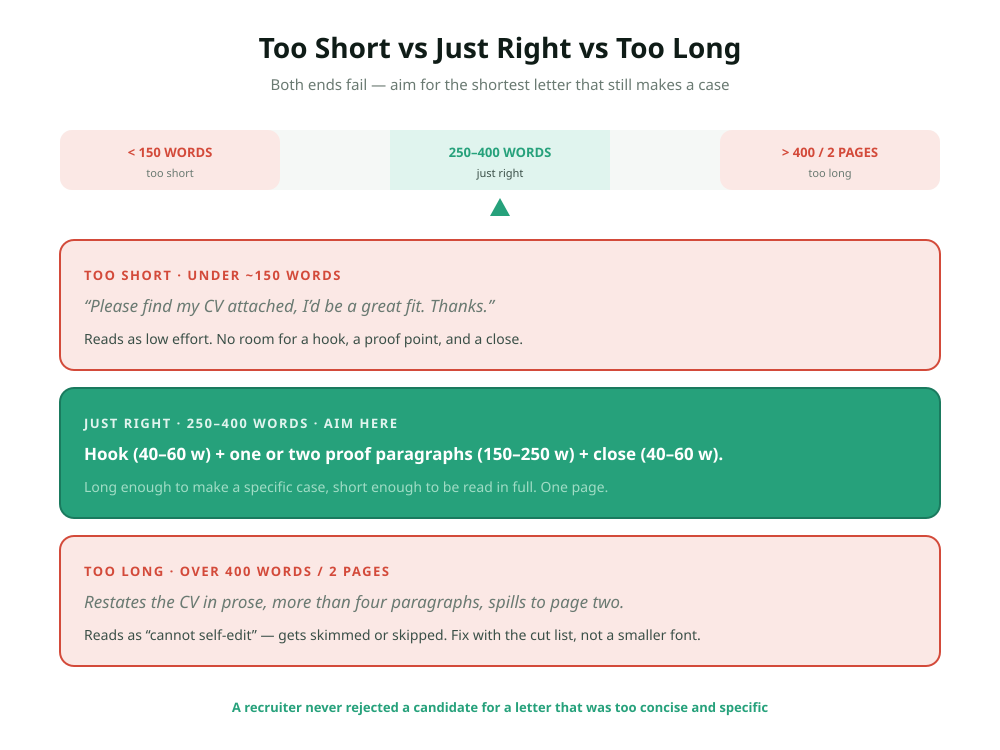
The signs your letter is too long:
- It runs onto a second page (non-academic).
- It exceeds ~400 words for a standard attached role.
- It restates your CV in prose.
- It has more than four paragraphs.
Length problems are a documented cause of skipped applications, and long-form filler is exactly the kind of low-signal content the 2026 screening layers de-prioritise, as covered in our common CV mistakes guide. When in doubt, cut — a recruiter has never rejected a candidate for a letter that was too concise and specific.
Too short: the other failure mode
A too-short cover letter is one under roughly 150 words or two or three lines — and its failure mode is reading as low effort or an afterthought. The advice to "keep it short" gets over-applied into a letter so thin it makes no actual case. A cover letter still needs a hook, at least one proof point, and a close; below ~150 words there is no room for all three.
A three-line "Please find my CV attached, I would be a great fit, thanks" letter is worse than no letter, because it signals you did the minimum. If you genuinely have little to add beyond the CV, a tight 200-word letter that leads with your single strongest proof point still beats a two-line note. The floor for a real cover letter is roughly 150 words; the sweet spot is 250–400.
Short is a virtue only up to the point where the letter still makes a case. Below about 150 words, "concise" tips into "couldn't be bothered". Aim for the shortest letter that still opens with a hook, proves one thing, and closes with confidence — not the shortest letter possible.
How the length maps to structure
The standard 250–400 word cover letter maps to a fixed structure: a one-to-two sentence opening hook, one or two proof paragraphs, and a two-to-three sentence closing call to action. Knowing the structure makes the length automatic — each part has a natural word budget, and hitting them lands you in range without counting.
- Opening (40–60 words): the hook + the role, per the start guide.
- Body (150–250 words): one or two paragraphs, each making a specific point backed by a result.
- Closing (40–60 words): a confident call to action, availability, and a thank-you, per the end guide.
Add those budgets and you land at roughly 250–370 words — squarely in target. If any single part balloons past its budget, that is where to cut first.
Next step
The fastest way to hit the right length is to draft from a structure that is already sized correctly: the CVWon cover letter builder generates a 250–400 word letter in the hook-body-close structure, flags CV-repeats and filler to cut, and adapts the length for email versus attached formats. Pair it with our complete cover letter guide for the full walkthrough.
Frequently Asked Questions
How long should a cover letter be in 2026?
A cover letter should be 250 to 400 words, on half to one page, in three to four short paragraphs, and never more than a single page. That length fits a hook, one or two proof points, and a confident close without padding. Email-body cover letters run shorter (150–250 words), and senior or academic letters can fill a full page.
How many words should a cover letter be?
250 to 400 words for a standard attached cover letter. Trust the word count over the page count, because font and margins change how much fits on a page. Aim for the word target first, keep a readable 10.5–12pt font, and let the single page follow — never shrink the font to force one page.
Can a cover letter be two pages?
No, for almost every role — a two-page cover letter is the most common length mistake and gets skimmed or skipped. The one exception is academic and research positions, where a page and a half to two pages is the field convention. For any standard job, keep it to a single page and cut anything that repeats your CV.
How long should an email cover letter be?
150 to 250 words in two or three short paragraphs. An email-body cover letter is read directly in the inbox, where attention is shortest, so it runs shorter than an attached one. Lead straight with the hook, make one strong point, and close — and if you also attach a full letter, keep the email body to a tight 150-word version that points to the attachment.
Is half a page too short for a cover letter?
No — half a page (around 250 words) is within the ideal range, as long as it still opens with a hook, proves one point, and closes with a call to action. Too short only becomes a problem below roughly 150 words or two to three lines, where the letter makes no real case. A tight half-page letter beats a padded full page.
What should I cut to make my cover letter shorter?
Cut in order: anything that repeats your CV word-for-word first, then generic enthusiasm, then over-explanation and backstory, then filler openers and closers, then adjectives without proof. The CV-repeats are usually the biggest and least useful chunk. Working down this list tightens most over-long letters into the 250–400 word target quickly.
How many paragraphs should a cover letter have?
Three to four: an opening hook, one or two body paragraphs each making a specific proof point, and a closing call to action. More than four paragraphs usually means the letter is over-explaining or repeating the CV. Each paragraph has a natural word budget — roughly 40–60 for the open and close, 150–250 for the body — which lands you in the right total length automatically.
Should a cover letter be shorter than a CV?
Yes — a cover letter is a single page at most (usually less), while a CV can run one to two pages depending on your tier. They do different jobs: the CV is a full record of your experience, the cover letter is a short, targeted argument for one specific role. Keeping the letter to 250–400 words ensures it stays a focused pitch, not a second CV.
Does cover letter length affect ATS or AI screening?
Indirectly. There is no strict length filter, but an over-long letter padded with CV-repeats and generic enthusiasm is exactly the low-signal content the 2026 screening layers de-prioritise, while a tight, specific letter reads as higher signal. Length itself is not scored; what fills the length is. Keep it concise and evidence-led rather than long and generic.
How long should a cover letter be for a first job with no experience?
200 to 300 words — slightly shorter than a standard letter, because there is less work history to reference. Lead with your strongest proof from studies, projects or volunteering, make one clear point, and close confidently. A first-job letter does not need to be long to be strong; it needs one specific, well-framed result, as our CV with no experience guide shows for the whole application.
Last reviewed on 21 August 2026 by Muneeb Awan (Founder, CVWon).
About the Author
Muneeb Awan is the founder of CVWon, an AI-powered CV builder and career platform used by professionals across the EU and Gulf regions. He writes on hiring technology, ATS mechanics and the 2026 CV and cover-letter playbooks that get read.