Forex Compliance Jobs: How to Become an AML/KYC Officer

TL;DR
- Forex compliance jobs are the AML, KYC, and regulatory roles that keep a broker licensed — verifying clients, monitoring transactions, and filing suspicious-activity reports.
- The career ladder runs KYC Analyst → AML Analyst → Compliance Officer → Compliance Manager → MLRO / Head of Compliance.
- US pay benchmarks (2026): AML/KYC analysts average around $65,600; AML compliance officers average $98,900, with top earners near $172,500.
- You do not need a finance degree, but a recognised certification — CAMS (ACAMS) or an ICA qualification — is the single biggest accelerator.
- Forex compliance differs from bank compliance: leverage limits, fast deposit/withdrawal flows, and regulators like CySEC and the FCA shape the day-to-day.
A forex compliance job is a role on a broker's compliance team responsible for following anti-money-laundering (AML) and know-your-customer (KYC) law. These professionals verify client identities, monitor trading and payment activity for financial crime, and make sure the broker keeps its licence with regulators such as CySEC or the FCA. Unlike sales or retention, compliance protects the firm and its clients rather than chasing revenue — and demand for it is rising fast in 2026.
What is a forex compliance job?
A forex compliance job is any role that keeps a brokerage on the right side of financial regulation. The compliance function exists because forex and CFD brokers handle client money and must prove, continuously, that they are not being used to launder it. Every regulated broker is legally required to run a KYC and AML programme, and compliance staff are the people who run it.
These roles are the trust layer of the industry. While the sales desk brings clients in and the retention desk keeps them active, compliance decides who is allowed to trade in the first place and flags anything that looks like financial crime. It is one of the few forex roles that is growing in headcount across every regulated hub.
AML vs KYC vs compliance officer vs MLRO
"Compliance" is an umbrella term for several distinct jobs. Knowing the difference helps you target the right entry point and the right salary.

| Role | Core focus | Seniority |
|---|---|---|
| KYC Analyst | Verifying client identity and documents at onboarding | Entry |
| AML Analyst | Transaction monitoring, screening, suspicious-activity reviews | Entry / mid |
| Compliance Officer | Owns policies, audits, regulator communication | Mid / senior |
| Compliance Manager | Leads the team, reporting, risk assessments | Senior |
| MLRO / Head of Compliance | Legally accountable officer; signs off SARs/STRs | Lead |
The MLRO — Money Laundering Reporting Officer — is the named individual a regulator holds responsible for the firm's AML programme. It is the senior destination of the compliance track and a legally significant position.
What a compliance team actually does
Forex compliance work is investigative and procedural. Across regulated brokers the core responsibilities are consistent:
- Client onboarding (KYC): verifying identity documents, proof of address, and source of funds before an account can trade.
- Transaction monitoring: watching deposits, withdrawals, and trading patterns for signs of money laundering or fraud.
- Sanctions and PEP screening: checking clients against sanctions lists and politically-exposed-person databases.
- Suspicious activity reporting: filing SARs/STRs with the relevant authority when something does not add up.
- Policy and audit: maintaining the AML manual, training staff, and preparing for regulator inspections.
- Regulatory reporting: submitting required returns to bodies like CySEC or the FCA on time.
Compliance is the one forex role where saying "no" is the job. A good officer stops bad money and bad clients before they ever reach the trading floor.
A day on the compliance desk
A compliance analyst's day is built around queues and alerts, not phone targets. The work is methodical and evidence-driven — you are building a defensible record for every decision you make, because a regulator may review it later.
- Morning: clear the onboarding queue — review new client documents, proof of address, and source-of-funds declarations, approving or escalating each one.
- Midday: work transaction-monitoring alerts: unusual deposit patterns, mismatched payment methods, or rapid withdrawals that the system has flagged.
- Afternoon: run sanctions and PEP screening on hits, document findings, and draft a suspicious-activity report if the evidence warrants one.
- Ongoing: update the AML manual, answer onboarding questions from the sales team, and prepare data for the next regulator return.
The best analysts are calm, consistent, and immune to pressure from revenue teams who want a borderline client approved. That independence is exactly what regulators expect — and what makes the role respected inside a serious broker.
Why forex compliance is different from bank compliance
Most AML/KYC career content is written for banks. Forex compliance shares the same legal foundation but has its own pressures, and understanding them is what separates a strong candidate from a generic one.
First, leverage and retail-protection rules dominate. Bodies such as the European Securities and Markets Authority (ESMA) cap retail leverage and ban certain practices, so forex compliance teams police marketing and onboarding far more tightly than a typical bank. Second, money moves fast: deposits and withdrawals happen in minutes across many payment providers, so transaction monitoring must be near real-time. Third, the industry's reputation risk is high — unlicensed operators exist alongside legitimate brokers, so regulators like CySEC and the FCA scrutinise the sector heavily. The global rulebook everyone follows is set by the Financial Action Task Force (FATF).
The practical takeaway for a job seeker: showing you understand forex-specific flows — first-time deposits, payment-service-provider risk, and leverage rules — instantly makes you more hireable than a candidate who only knows bank AML.
Skills, education and experience
Forex compliance is an analytical role, and the entry bar is more about aptitude and a certification than a specific degree.
What brokers look for
- Analytical skill and attention to detail: the core of transaction monitoring and document review.
- Regulatory knowledge: familiarity with AML directives, KYC rules, and the relevant regulator (CySEC, FCA, ASIC, DFSA).
- Education: a bachelor's in finance, law, or economics is recommended but not mandatory.
- Experience: 1–2 years in a KYC, AML, banking, audit, or financial-services role is the typical entry point.
- Tools: comfort with compliance and screening software, transaction-monitoring systems, and CRMs.
- Communication: you must write clear reports and explain decisions to regulators and management.
Career-changers from law, accounting, banking operations, or even fraud and customer due-diligence roles transfer well. A clean, ATS-friendly CV that surfaces those keywords is essential, because compliance teams screen heavily.
Certifications that actually matter
Certification is the fastest way into forex compliance because it signals you understand the rules before day one. Two names dominate.
| Certification | Body | Best for |
|---|---|---|
| CAMS | ACAMS | The global gold standard; recognised by regulators and major firms |
| ICA certificates / diploma | International Compliance Association | Widely valued in Europe and the UK; tiered from entry to advanced |
| CFE / CFCS | ACFE / ACFCS | Fraud and financial-crime specialisations |
If you are starting out, an entry-level ICA certificate or a focused online AML course is enough to land a KYC analyst role. To reach senior officer or MLRO level, the CAMS credential from ACAMS or the ICA Diploma carries the most weight. Many brokers will fund these once you are hired — but holding one before you apply moves you to the front of the queue.
How long does it take to get certified?
An entry-level ICA certificate can be completed in a few weeks of part-time study, which is enough to start applying for KYC analyst roles. CAMS is a larger commitment: most candidates prepare for two to three months before the exam, and ACAMS requires qualifying experience or education to sit it. The practical sequence for a career-changer is to land an entry analyst role with a short certificate first, get hands-on monitoring experience, then pursue CAMS — often employer-funded — to move into officer and MLRO positions. You do not need to finish the top certification before you start working; you need enough to get through the first door.
Forex compliance salary in 2026
Compliance pay is more stable than sales because it is salary-led, not commission-led. The trade-off is a lower ceiling than a top-performing sales agent, but far more predictability.

According to ZipRecruiter's 2026 US data, an AML/KYC analyst averages about $65,600 a year, an AML/KYC officer averages roughly $63,000 ($45,500–$74,500), and an AML compliance officer averages $98,900, with the top 10% earning around $172,500. In the offshore forex hubs where most brokers are based, the structure differs — typically a solid monthly base with bonuses, and no commission.
| Market | Entry (KYC/AML analyst) | Senior / officer | Notes |
|---|---|---|---|
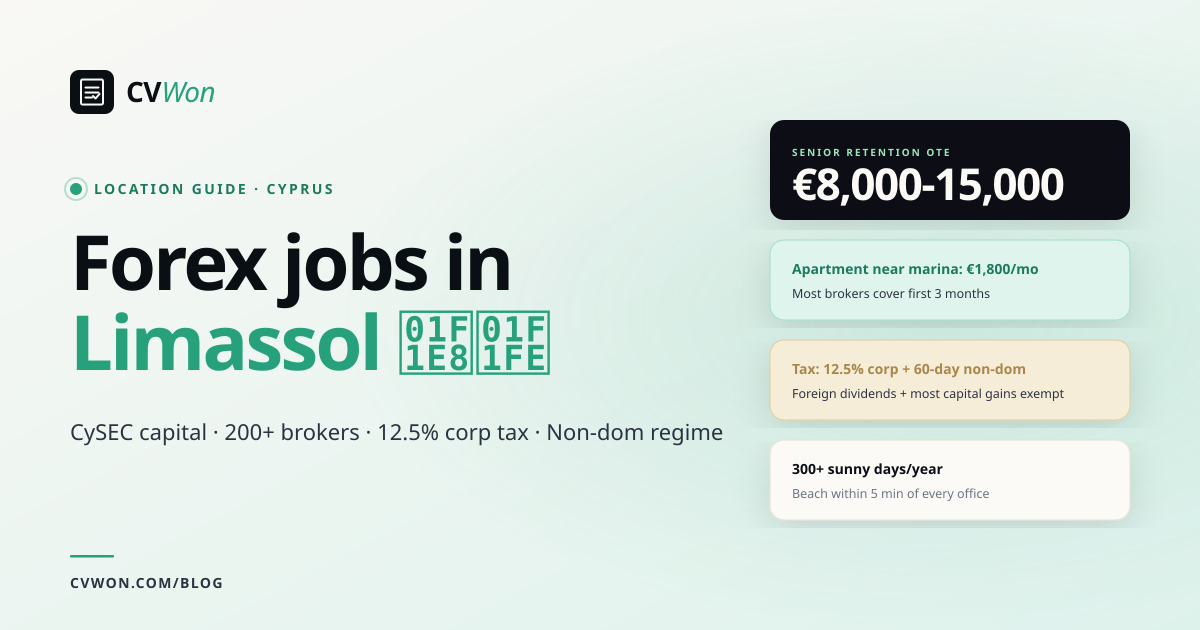
| Cyprus (Limassol) | ≈ €1,800–€2,800/mo | €3,500–€6,000+/mo | Largest concentration of CySEC brokers |
| Dubai (UAE) | Higher base | Premium for MLRO | 0% income tax lifts take-home |
| Remote / offshore | Varies widely | Officer roles less common remote | Verify the broker's licence first |
US figures from ZipRecruiter (2026); hub ranges are indicative, compiled from forex listings and vary by broker and licence.
For how compliance pay compares with the revenue-side roles, see our forex sales salary report and the city guides for Limassol and Dubai.
How to get hired: 5 steps
Here is the realistic path from interested to employed in a forex compliance role in 2026.

- Build the base. Get comfortable with financial-crime fundamentals — what money laundering looks like, the three stages, and why KYC exists. A finance, law, or economics background helps but is not required.
- Get a recognised certification. Start with an ICA certificate or an online AML course; target CAMS as you advance. This is the single highest-ROI move for a career-changer.
- Learn forex-specific AML. Study how CySEC and the FCA regulate brokers, how leverage limits work, and how first-time deposits and payment providers create risk.
- Build a compliance CV. Lead with any screening, monitoring, audit, or due-diligence experience, and include the right keywords so it passes automated screening.
- Apply to regulated brokers. Target licensed firms in Cyprus, Dubai, and remote-friendly companies — and verify the licence before you accept anything.
Because regulators require brokers to staff compliance properly, these teams hire steadily even when sales hiring slows.
Where the jobs are
Forex compliance hiring clusters in the same hubs as the rest of the industry, with a growing remote segment:
- Cyprus (Limassol): the densest market for CySEC-regulated brokers and the easiest place to find entry-level KYC/AML roles — see the Limassol jobs guide.
- Dubai (UAE): a fast-growing, tax-friendly hub with strong demand for senior compliance and MLRO talent; start with the Dubai guide.
- Remote: KYC and analyst roles are increasingly remote-friendly, though senior officer and MLRO positions usually require an on-site, regulated presence.
Whichever route you choose, apply through channels that verify the employer. Working for a licensed broker — not an unregulated desk — is the most important career decision you will make in this field.
Spotting an unregulated employer
Your employer's licence defines your career in compliance more than any other factor. Joining an unregulated or fake-licensed broker can attach your name to a firm that regulators later shut down — the opposite of what a compliance professional wants on a CV. Before you accept any offer, verify the broker directly on the regulator's public register.
In compliance, the badge you wear matters as much as the work you do. A role at a licensed broker builds your career; a role at an unlicensed one can quietly end it.
Warning signs of an employer to avoid include:
- A licence number you cannot find on the CySEC or FCA public register.
- A "compliance" role that is really a sales job with a compliance title.
- Pressure to approve clients quickly or skip source-of-funds checks.
- No named MLRO, or one person doing every compliance task with no oversight.
Platforms that screen brokers — such as CVWon, which only lets KYB-verified firms contact candidates — exist precisely to keep your record clean.
Frequently asked questions
What is a forex compliance job?
It is a role on a broker's compliance team that enforces AML and KYC law. Staff verify client identities, monitor transactions for financial crime, screen against sanctions lists, and keep the broker licensed with regulators such as CySEC or the FCA.
What is the difference between KYC and AML?
KYC (know your customer) is about verifying who a client is at onboarding. AML (anti-money laundering) is the wider programme of monitoring activity and reporting suspicious behaviour. KYC is one part of an overall AML framework.
How much do forex compliance jobs pay in 2026?
US benchmarks put AML/KYC analysts around $65,600 a year and AML compliance officers near $98,900, with top earners up to about $172,500. In hubs like Limassol, expect a solid monthly base plus bonuses rather than commission.
Do I need a degree to work in forex compliance?
No specific degree is required, though a background in finance, law, or economics helps. A recognised certification such as CAMS or an ICA qualification, plus 1–2 years of relevant experience, matters more to most brokers.
Which certification is best for AML/KYC jobs?
CAMS from ACAMS is the global gold standard and is recognised by regulators worldwide. In Europe and the UK, ICA certifications are also highly valued. Entry-level candidates can start with an ICA certificate or an online AML course.
What does an MLRO do?
The Money Laundering Reporting Officer is the named individual a regulator holds accountable for the firm's AML programme. The MLRO signs off suspicious-activity reports and is the senior endpoint of the compliance career ladder.
Is forex compliance a good career?
Yes. It offers stable, salary-led pay, clear progression to MLRO, and rising demand as regulation tightens. The skills also transfer across banking, crypto, and fintech, so it is a resilient long-term path.
Can I get a forex compliance job with no experience?
Entry is realistic through KYC analyst roles, especially with a certification and transferable skills from banking, law, audit, or customer due diligence. Many brokers train new hires and fund further certification once you are on board.
Where are forex compliance jobs concentrated?
Cyprus (Limassol) has the highest density of CySEC-regulated brokers and entry-level roles, followed by Dubai and Malta. Remote KYC/analyst roles are growing, while senior officer and MLRO roles usually require an on-site presence.
Next steps
Forex compliance is the most stable, future-proof career in the industry — and one of the few where you are paid to protect clients rather than sell to them. Build the fundamentals, earn a recognised certification, and apply only to licensed brokers. With a certification and one to two years of monitoring experience, a motivated analyst can realistically reach compliance-officer level within three to four years — and the MLRO track from there.
Want vetted forex and crypto firms to find you? Create your free CVWon candidate profile and let KYB-verified brokers reach you directly, or browse current forex and crypto roles. It is always free for candidates.
About the Author
Marcus Steiner is a forex industry recruiter tracking pay benchmarks and front-office hiring across 200+ regulated brokers.