How to Become a Forex Retention Agent in 2026

TL;DR
- A forex retention agent keeps existing, already-funded trading clients active — re-engaging them, reducing churn, and upselling — which is different from a sales agent who chases brand-new deposits.
- Typical pay is a steady base plus a retention bonus/commission. US "retention agent" benchmarks sit near $60K/year on average; specialist forex hubs like Limassol and Dubai pay a lower monthly base (≈€1,500–€2,500) plus performance commission.
- The biggest hiring filters are fluent desk language, market knowledge, and CRM/communication skills — a formal finance degree is rarely required.
- The single most important career decision is working for a regulated broker (CySEC, FCA, BaFin) rather than an unlicensed desk. We cover the red flags below.
- You can break in with 1–3 years of customer-facing experience by targeting verified brokers in Cyprus, Dubai, and remote roles.
A forex retention agent is a client-facing specialist at a forex or CFD broker who keeps existing customers trading. The job is to re-engage funded accounts, answer questions, resolve friction, and reduce churn — turning one-time depositors into long-term clients. Unlike a sales agent, who converts new leads, a retention agent manages a book of people who have already signed up. It is one of the most in-demand front-office roles in the industry in 2026.
What is a forex retention agent?
A forex retention agent is a retention-desk employee responsible for the long-term relationship with a broker's existing clients. Where the sales team's job ends at the first deposit, the retention team's job begins. Retention agents work a "book" of accounts — typically traders who funded once and may now be inactive, hesitant, or considering withdrawing — and their performance is measured by how many of those clients stay active and keep trading.
The role sits inside the broader forex front office, alongside sales agents, account managers, and dealing-desk staff. In most brokerages it is a phone- and chat-heavy job: calls, WhatsApp, and email are the daily tools. Brokers value retention highly because keeping an existing client is far cheaper than acquiring a new one — the same economics that make retention specialists well paid across financial services.
Retention vs sales: the real difference
Retention and sales are two separate desks that people outside the industry constantly confuse. A sales agent converts cold leads into first-time depositors (the "FTD"). A retention agent keeps those depositors engaged after the fact. The skills overlap — both need persuasion and resilience — but the rhythm and the metrics are different.
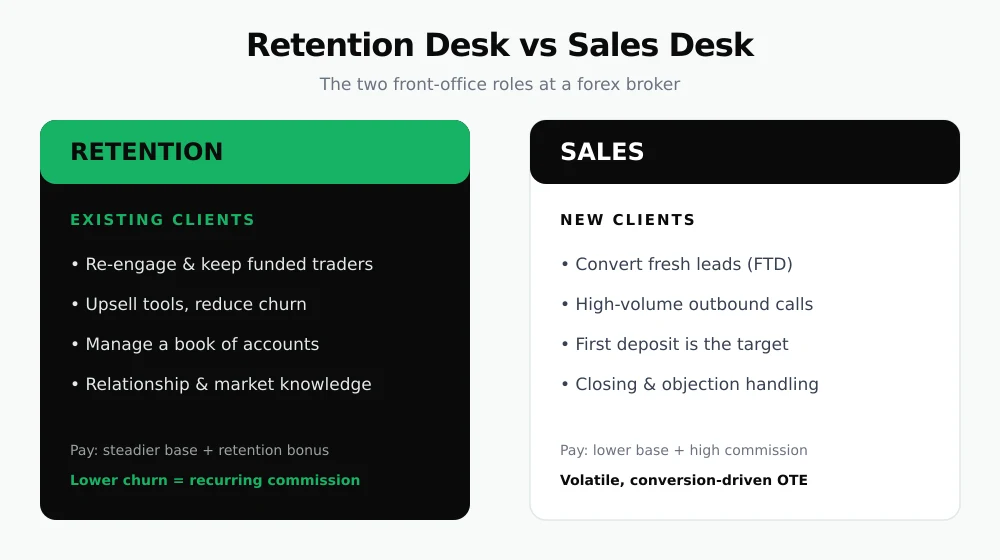
The table below breaks down the practical differences a candidate should understand before applying.
| Factor | Retention agent | Sales agent |
|---|---|---|
| Client type | Existing, already funded | New leads, not yet funded |
| Core metric | Churn rate, re-activation, retained volume | First-time deposits (FTD), conversion rate |
| Daily work | Relationship calls, upsells, problem-solving | High-volume outbound, closing |
| Pay shape | Steadier base + retention bonus | Lower base + high, volatile commission |
| Best fit for | Relationship builders, calm communicators | Aggressive closers, high-energy callers |
If you are great at keeping people happy over months rather than closing them in one call, retention is usually the better — and more sustainable — desk to build a career on.
What the job actually involves
Day to day, a forex retention agent owns the post-deposit client experience. Responsibilities are consistent across regulated brokers and typically include:
- Client re-engagement: contacting inactive or at-risk traders by phone, WhatsApp, and email to bring them back.
- Relationship management: understanding each client's goals and trading activity, and acting as their main point of contact.
- Churn reduction: spotting accounts likely to withdraw or go dormant, and resolving their concerns before they leave.
- Upselling and cross-selling: introducing relevant tools, account tiers, or promotions that genuinely fit the client.
- Market awareness: staying current on price moves and economic news so conversations are informed.
- Internal feedback: flagging product and service issues to sales, marketing, and compliance teams.
One nuance candidates miss: retention is a compliance-sensitive role. At a regulated broker you cannot promise profits, pressure vulnerable clients, or push trading on someone who has asked to stop. The best retention agents are persuasive and principled — which is exactly what licensed firms screen for.
A typical day on a forex retention desk
A retention shift is structured around the client book, not cold lists. Most agents start by reviewing which accounts went inactive, which deposits cleared, and which clients flagged a problem overnight. The day is then a rhythm of planned outreach and reactive support — far less frantic than a pure sales floor, but with higher-value conversations.
- Morning: review the book, check overnight market moves, and prioritise at-risk and recently funded accounts.
- Midday: outbound calls and WhatsApp follow-ups — re-engaging dormant traders and answering account questions.
- Afternoon: resolve withdrawal or platform issues with internal teams, log every interaction in the CRM, and tee up upsell conversations that genuinely fit the client.
- End of day: update notes, hand off open compliance items, and plan tomorrow's priority accounts.
The agents who thrive treat the book like a relationship portfolio: they remember context, follow up when they said they would, and never push a client who has clearly asked to pause. That consistency is what turns a one-time depositor into a multi-year client — and what makes retention income compound.
Skills and requirements to get hired
The good news for career-changers: forex retention is a skills-and-language role, not a credentials role. Across current 2026 listings, the requirements cluster tightly.
What brokers actually ask for
- Language: native or fluent command of the desk's target language (English, Arabic, German, Spanish, Hindi/Urdu, and others) is the number-one filter.
- Communication and negotiation: strong objection-handling, listening, and relationship-building skills.
- Market knowledge: a working understanding of forex/CFD basics, leverage, and platforms like MT4/MT5.
- Experience: typically 1–3 years in sales, retention, customer success, or a call-centre role; more than four years is a strong advantage.
- CRM and computer literacy: comfort with CRMs, dialers, and chat tools.
- Regulatory awareness: familiarity with CySEC, the FCA, or BaFin rules is considered a major plus, even though the firm provides formal training.
Notice what is not on the list: a finance degree, trading qualifications, or prior brokerage experience are rarely mandatory. If you have closed, retained, or supported customers in any industry — telecoms, insurance, real estate, iGaming — those skills transfer. See how transferable closing skills pay off in our breakdown of call-centre commissions versus real estate.
Which languages pay the most
Because brokers serve clients region by region, your language often matters more than your CV. The highest demand in 2026 is for agents who speak Arabic (Gulf and MENA clients), German and Dutch (high-value European traders), and Spanish, Italian, and Hindi/Urdu. Rarer European and Gulf languages can command a premium because the talent pool is thin. English is the baseline — useful everywhere, but rarely a differentiator on its own. If you are bilingual in English plus one in-demand language, you can usually negotiate a higher base or a faster route to a senior book.
Forex retention agent salary in 2026
Forex retention agent pay is built from two parts: a fixed monthly base and a variable retention bonus or commission tied to how much client volume you keep active. Because the variable part depends on your book and your broker, total earnings vary widely — but the anchors are knowable.
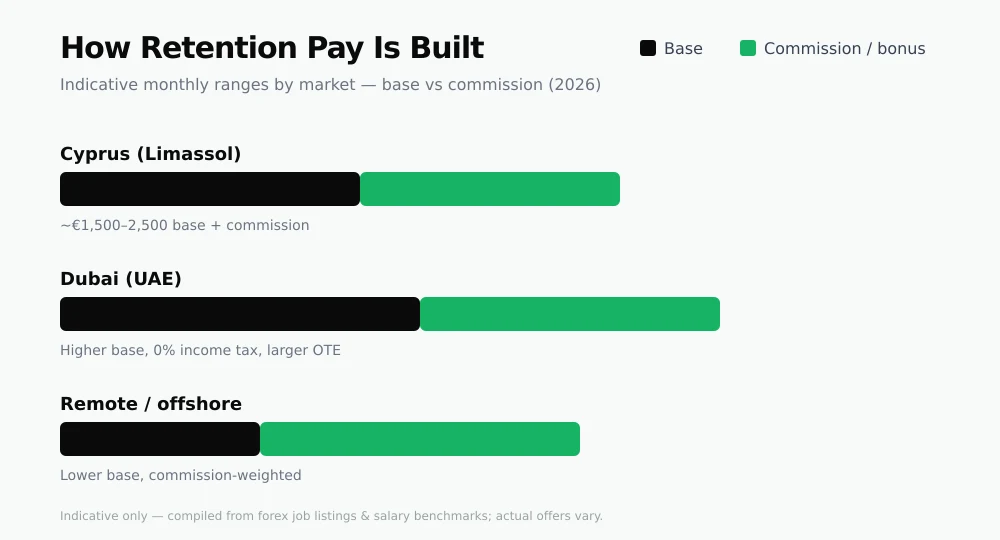
For a general benchmark, ZipRecruiter put the average US "retention agent" salary at roughly $60,400 per year in May 2026, with most roles between $44,500 and $74,500. Specialist and senior forex roles pay more: aggregators list "forex retention executive" positions in the US in the $105,000–$145,000 range. In the offshore hubs where most forex hiring happens, the structure looks different — a lower monthly base plus commission.
| Market | Typical monthly base | Variable | Notes |
|---|---|---|---|
| Cyprus (Limassol) | ≈ €1,500–€2,500 | Retention bonus + commission | Europe's forex hub; CySEC-regulated |
| Dubai (UAE) | Higher base | Larger OTE | 0% personal income tax lifts take-home |
| Remote / offshore | Lower base | Commission-weighted | Wider range; verify the broker carefully |
| Team lead / senior | Premium base | Override on team volume | 2–4+ years experience |
Indicative ranges compiled from current forex job listings and salary benchmarks; actual offers vary by broker, language, and book size.
For a city-by-city breakdown of forex front-office pay — including how commission ladders work — see our detailed guides to Limassol, Dubai, and the full base + commission salary report. Retention OTE usually tracks a notch below top sales OTE, but with steadier, more recurring income.
How to become a forex retention agent: 5 steps
You do not need to wait for permission or a qualification. Here is the fastest realistic path from "interested" to "hired" in 2026.
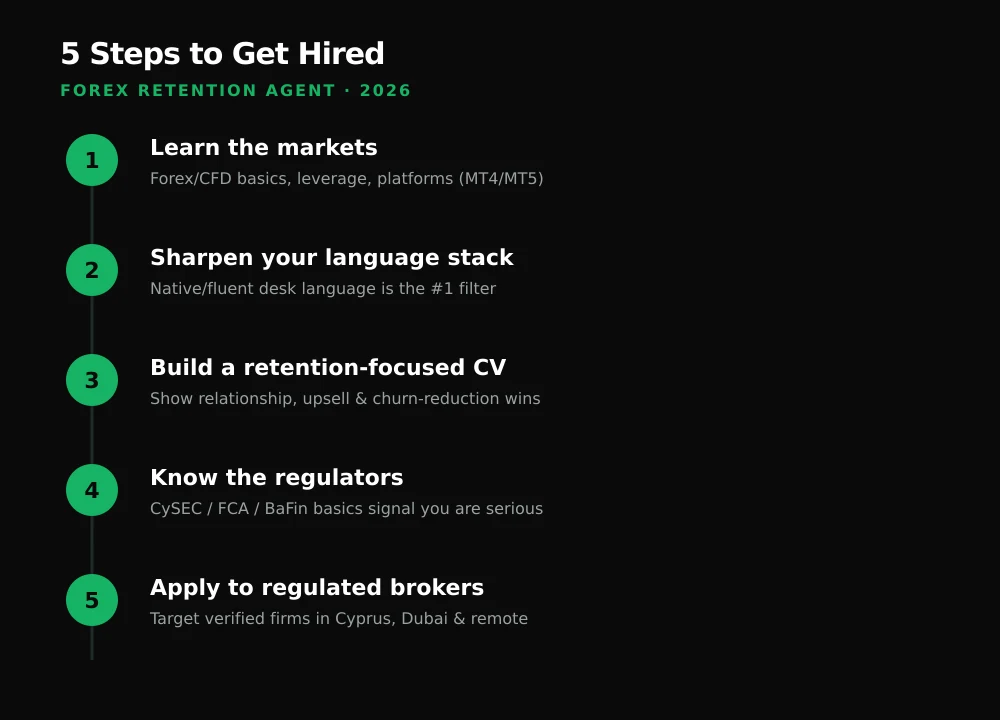
- Learn the markets. Spend a week understanding forex and CFD basics: pairs, leverage, spreads, and how MT4/MT5 work. You need enough to hold an informed conversation, not to trade professionally.
- Sharpen your language stack. Identify which language desk you can serve at a native or fluent level. This is the single biggest determinant of which roles you qualify for and what you are paid.
- Build a retention-focused CV. Lead with relationship, upsell, and churn-reduction results from any past job — quantified wherever possible. Use a clean, ATS-friendly format so it passes automated screening.
- Learn the regulators. Read the basics of CySEC, FCA, and ESMA rules. Mentioning that you understand compliance limits instantly separates you from candidates who treat retention as pure sales.
- Apply to regulated brokers. Target licensed firms in Cyprus, Dubai, and remote-friendly companies. Tailor each application to the language and market the role serves.
Most candidates who follow this path and speak an in-demand language land first interviews within weeks, because broker retention desks hire continuously.
Regulated vs unregulated: read this before you apply
This is the part most "how to" articles skip, and it matters more than salary. The forex industry contains both legitimate, licensed brokers and unlicensed "boiler-room" operations that pressure clients and sometimes block withdrawals. As a retention agent, the firm you choose defines your reputation and your legal exposure.
Your job title is the same at both kinds of firm. Your career, your conscience, and your CV are not. Always verify the licence before you accept an offer.
A regulated broker holds a licence from an authority such as CySEC (Cyprus), the FCA (UK), or BaFin (Germany), and operates under retail trading rules set by bodies like the European Securities and Markets Authority (ESMA). These rules cap leverage for retail clients and ban misleading profit claims. Watch for these red flags that signal a desk to avoid:
- No verifiable regulatory licence number, or a "licence" from an offshore shell with no real oversight.
- Scripts that promise guaranteed profits or pressure clients to deposit more to "recover losses".
- Reports of clients being unable to withdraw funds.
- Pay that is 100% commission with targets that only work if you push hard sells.
Choosing a verified employer is exactly why platforms that screen brokers — like CVWon, which only lets KYB-verified firms contact candidates — exist. It protects your name as much as the client's money.
Where to find legitimate forex retention jobs
Forex retention hiring concentrates in a handful of hubs plus a growing pool of remote roles. The strongest markets in 2026:
- Cyprus (Limassol): the European centre of gravity for brokers, with constant retention demand. Start with our Limassol forex jobs guide.
- Dubai (UAE): fast-growing, tax-friendly, and increasingly crypto-focused — see the Dubai guide.
- Remote and offshore desks: common for multilingual agents; the Philippines guide shows how offshore comp works.
Whichever market you target, apply through channels that verify the employer. Specialist forex job boards and verified hiring networks beat random listings, because they filter out the unregulated desks discussed above.
Career path and progression
Retention is a genuine career, not a dead end. A common progression looks like: retention agent → senior retention agent → retention team lead → head of retention or VIP account manager. Strong performers often move sideways into high-earning sales, dealing-desk, or compliance roles, because they already understand the client and the rules. The relationship and market skills you build transfer across the entire brokerage.
Within 2–3 years, a multilingual agent at a regulated firm can realistically move into a lead role with an override on team volume — the point where retention income becomes both high and stable.
Frequently asked questions
What does a forex retention agent do?
A forex retention agent keeps a broker's existing, funded clients active. They re-engage inactive traders, resolve concerns, manage relationships, and upsell relevant products — all to reduce churn. Their performance is measured by how many clients stay and keep trading.
What is the difference between a retention agent and a sales agent?
A sales agent converts new leads into first-time depositors. A retention agent manages clients who have already deposited, focusing on long-term engagement rather than the initial close. Sales pay is more commission-heavy and volatile; retention pay is steadier with a retention bonus.
How much does a forex retention agent earn in 2026?
It varies by market. US retention-agent roles average around $60,400 a year, with senior forex retention positions listed up to $105,000–$145,000. In hubs like Limassol, expect a base near €1,500–€2,500 a month plus commission. Total earnings depend heavily on your book and broker.
Do I need a degree to become a forex retention agent?
No. A finance degree is rarely required. Brokers prioritise fluent language skills, communication ability, and 1–3 years of customer-facing experience. Most firms provide product and compliance training after you are hired.
What skills do forex retention agents need?
The core skills are language fluency, persuasive but principled communication, relationship management, basic forex and platform knowledge, and CRM literacy. Awareness of CySEC, FCA, or BaFin rules is a strong advantage.
Is being a forex retention agent a legitimate job?
Yes — at a regulated broker it is a legitimate, well-paid client-management role. The risk is unlicensed "boiler-room" firms that pressure clients. Always verify the broker's regulatory licence before accepting an offer, and avoid 100%-commission desks built on hard selling.
Can I work as a forex retention agent remotely?
Yes. Many brokers hire remote or offshore retention agents, especially for multilingual desks. Remote roles often have a lower base and higher commission weighting, so check the pay structure and the firm's regulatory status carefully.
What is the career path for a retention agent?
A typical path is retention agent → senior agent → team lead → head of retention or VIP manager. Many also move into sales, dealing desk, or compliance. The client and market knowledge you gain transfers across the whole brokerage.
Which countries hire the most forex retention agents?
Cyprus (Limassol), the UAE (Dubai), Malta, and a growing set of remote-first firms hire the most, with strong demand for agents who speak Arabic, German, Spanish, Hindi/Urdu, and other languages.
Next steps
Forex retention is one of the most accessible, well-paid front-office roles in the industry — if you pick a regulated employer and lead with the right language and relationship skills. Get the fundamentals down, build a focused CV, and apply where the employer is verified.
Ready to be found by vetted forex and crypto firms? Create your free CVWon candidate profile and let KYB-verified brokers reach you directly, or browse current forex and crypto roles. It is always free for candidates.
About the Author
Marcus Steiner is a forex industry recruiter tracking pay benchmarks and front-office hiring across 200+ regulated brokers.