Forex Dealing Desk: What It Is and How to Become a Dealer

TL;DR
- A forex dealing desk is the part of a broker that executes client orders and manages the broker's market risk — often acting as the counterparty to client trades (the "market maker" model).
- Dealing desk (DD) brokers take the other side of your trade; no dealing desk (NDD) brokers (STP/ECN) route orders to external liquidity providers.
- A dealing desk operator (dealer) is a salaried broker employee who manages execution, spreads, and exposure — not a prop trader risking personal capital.
- US benchmarks: forex traders/dealers average $80,000–$101,500, with senior desk roles reaching $150k–$165k plus bonus.
- You break in through markets knowledge, MT4/MT5 platform skill, and risk-management ability — usually starting in broker back-office or support.
A forex dealing desk is the desk inside a brokerage that executes clients' trades and manages the firm's resulting market exposure. In the classic "dealing desk" model the broker is a market maker — it takes the other side of client orders rather than passing them to the open market. The people who run it, called dealers or dealing desk operators, are salaried staff who handle pricing, execution, and risk. It is one of the core front-office functions every forex broker needs.
What is a forex dealing desk?
A forex dealing desk is the operational heart of a market-maker broker. It receives client orders, sets the prices clients see, executes those orders, and decides how to handle the risk that results. Because a dealing desk broker often becomes the counterparty to a trade, it earns mainly from the spread and from clients' net losses, rather than from a per-trade commission.
The global foreign-exchange market is the largest in the world — the Bank for International Settlements measures daily FX turnover in the trillions of dollars — and brokers are the gateway retail clients use to access it. The dealing desk is where that access is priced and executed. It sits alongside the broker's revenue and support teams covered across our forex jobs guide.
Dealing desk vs no dealing desk (STP/ECN)
The difference between a dealing desk and a no-dealing-desk broker is simply where your order goes. A dealing desk (DD) broker keeps the order in-house and may take the other side. A no-dealing-desk (NDD) broker passes it straight to external liquidity providers.

| Feature | Dealing Desk (DD) | No Dealing Desk (STP / ECN) |
|---|---|---|
| Order routing | Kept in-house; broker is counterparty | Routed to liquidity providers / interbank |
| Spreads | Wider, usually fixed; no commission | Tighter, variable; commission per trade |
| Broker earns from | Spread and client losses | Commission and markup |
| Conflict of interest | Possible (broker profits when client loses) | Lower (broker is an intermediary) |
| Best for | Beginners, small accounts, fixed spreads | Active traders wanting raw spreads |
ECN brokers go a step further than STP by letting client orders interact in a shared network with a visible order book. Both ECN and STP are "no dealing desk" because neither takes the opposite side of the trade.
What a dealing desk operator does
A dealing desk operator is the broker employee who runs execution and risk on the desk. The role is technical and real-time. Core responsibilities include:
- Pricing and quotes: maintaining accurate, competitive prices and spreads across instruments.
- Order execution: filling client orders and monitoring slippage and requotes.
- Exposure management: tracking the broker's net position and deciding what to hedge externally.
- Risk controls: watching for abnormal activity, latency arbitrage, or toxic flow.
- Platform operation: running the MT4/MT5 bridge and risk dashboards.
- Reporting: end-of-session P&L and risk reports for management.
A dealer's job is not to bet — it is to make sure the broker is never accidentally betting either. The best dealers are risk managers first and traders second.
A day on the dealing desk
A dealer's day follows the market clock, not a call sheet. The desk is busiest around session opens, major economic releases, and the hours when its client base trades most. The work is continuous monitoring punctuated by fast decisions.
- Pre-open: check overnight exposure, review the economic calendar, and confirm pricing and spreads are correct across instruments.
- During the session: watch the net book in real time, execute and monitor fills, and hedge externally when exposure crosses risk limits.
- Around news: widen spreads or adjust execution during high-impact releases to protect the broker from gaps and slippage.
- Session close: reconcile positions, produce the P&L and risk report, and hand over open exposure to the next shift.
It is a disciplined, screen-heavy role. The best dealers are unflappable under pressure and treat every decision as a risk decision — which is why the desk usually runs in shifts to keep it covered whenever markets are live.
A-book vs B-book, explained honestly
Dealing desks manage risk using two models: the A-book and the B-book. A-book means the broker passes a client's trade to a liquidity provider, earning the spread or commission with no directional risk. B-book means the broker keeps the trade in-house and becomes the counterparty, profiting if the client loses.
Neither is illegal, and most brokers run a hybrid — A-booking consistent winners and B-booking the rest. The reputational risk lies in how a desk runs the B-book. A regulated broker under CySEC or the FCA must still give best execution and cannot manipulate prices against clients; rules from the European Securities and Markets Authority (ESMA) cap leverage and ban abusive practices.
As a dealer, the firm you choose defines your ethics. A regulated B-book desk is a legitimate risk operation; an unlicensed one can become a machine for taking client money.
Understanding this honestly is what separates a professional dealer from someone who simply runs a stacked house. It is the same regulated-versus-unregulated divide we cover for retention agents and the compliance team.
Common myths about dealing desks
The dealing desk is one of the most misunderstood roles in forex, partly because the market-maker model sounds like a conflict by default. Clearing up the myths helps you judge an employer — and answer interview questions well.
- Myth: "All dealing desks cheat clients." A regulated desk must give best execution and is audited. Manipulation is the mark of an unlicensed broker, not the model itself.
- Myth: "A dealer is a trader." A dealer manages the broker's risk and execution; they do not speculate for personal profit.
- Myth: "B-book means the broker always wins." Holding client risk also means holding losses when clients win, which is exactly what the desk must manage.
- Myth: "Dealing desks are dying." Even NDD brokers run risk desks; someone still manages exposure, pricing, and hedging.
The model is not the problem — the licence is. A dealing desk at a regulated broker is a respected markets job; the same title at an unlicensed shop is a red flag.
Where the desk fits inside a broker
The dealing desk is one of four front-office pillars at a forex broker, and knowing how they connect helps you choose where to build a career. Sales brings clients in, retention keeps them active, compliance keeps the firm licensed, and the dealing desk prices and executes everything they generate.
Unlike the client-facing roles, the dealing desk rarely speaks to customers. It is a back-of-house, screen-and-numbers job. That makes it a strong fit for analytical people who prefer markets and risk over phones and targets — the opposite end of the spectrum from a retention agent. If you are weighing the revenue side instead, our sales jobs guide maps those roles.
This separation also explains career mobility. Because the dealing desk touches pricing, risk, and platform operations, dealers often understand the broker's economics better than anyone on the floor. That makes the desk a strong springboard into risk management, treasury, or head-of-trading roles, and it is why brokers protect good dealers carefully. It is a quieter path than sales, but a deep and durable one — the kind of skill set that stays relevant even as brokers shift between dealing-desk and no-dealing-desk models.
Skills and requirements
Dealing is a markets-and-risk role, so the bar leans technical. Brokers typically look for:
- Market knowledge: a solid grasp of FX pairs, spreads, leverage, and order types.
- Risk management: the ability to read net exposure and decide what to hedge.
- Platform skill: hands-on MT4/MT5 administration, bridges, and risk dashboards.
- Analytical speed: comfort making decisions in real time under pressure.
- Education: a finance, economics, or maths background helps but is not mandatory.
- Composure: dealers stay calm when markets move fast.
Many dealers start in a broker's back office, support, or operations team and move onto the desk once they understand the flow. A clean, numbers-focused CV that highlights any trading, risk, or platform experience is the fastest way to get noticed.
Forex dealer salary in 2026
A forex dealer's pay is salary-led with a performance bonus tied to desk results, not personal trading profits. It sits between the steady compliance salaries and the commission-heavy sales packages.

Using 2026 US benchmarks as a proxy, PayScale puts the average foreign-exchange trader around $80,100, while ZipRecruiter's "forex trader" average is about $101,500, ranging from roughly $57,500 to $181,000. Senior dealing-desk and head-of-dealing roles are advertised at $150,000–$165,000 plus bonus. In the offshore hubs where most brokers operate, the structure is a solid monthly base plus a desk-performance bonus.
| Level | Typical profile | Pay shape |
|---|---|---|
| Junior dealer | 0–2 yrs, from back office/support | Base + small bonus |
| Dealer / dealing desk operator | 2–5 yrs, owns a shift | Solid base + desk bonus |
| Senior dealer / head of dealing | 5+ yrs, runs the desk | Premium base + larger bonus |
US figures are proxy benchmarks (PayScale, ZipRecruiter, 2026); broker desk pay varies by hub and licence. Compare with the forex sales salary report.
Why dealers are not paid like prop traders
It is worth being clear about pay, because the word "trader" inflates expectations. A prop trader's income is a cut of the profit they generate, so it is uncapped but volatile and high-risk. A dealing desk operator is paid a salary plus a bonus tied to how well the desk is run — tight execution, controlled risk, minimal errors. The dealer is rewarded for stability, not for swinging the broker's capital. That makes dealing a lower-variance, more predictable career than speculative trading, with a clear promotion path from junior dealer to head of dealing rather than a personal P&L gamble. For most people, that trade-off is a feature, not a limitation.
How to become a forex dealer: 5 steps
Here is the realistic path onto a dealing desk in 2026.

- Master the markets. Learn FX pairs, spreads, leverage, and order types until you can read a price feed instinctively.
- Learn the platforms. Get hands-on with MT4/MT5 administration, the bridge, and risk dashboards — the dealer's daily tools.
- Build risk-management skills. Understand exposure, hedging, and the A-book/B-book models so you can manage the broker's position, not just watch it.
- Start in back office or support. Many dealers move up from broker operations, where they already see order flow and client behaviour.
- Apply to regulated brokers. Target licensed firms in Cyprus, Dubai, and London — and verify the licence before you accept.
Because the desk runs whenever markets are open, brokers value reliable dealers highly and promote from within often.
Where the jobs are
Dealing desk roles cluster in the same regulated hubs as the rest of the industry:
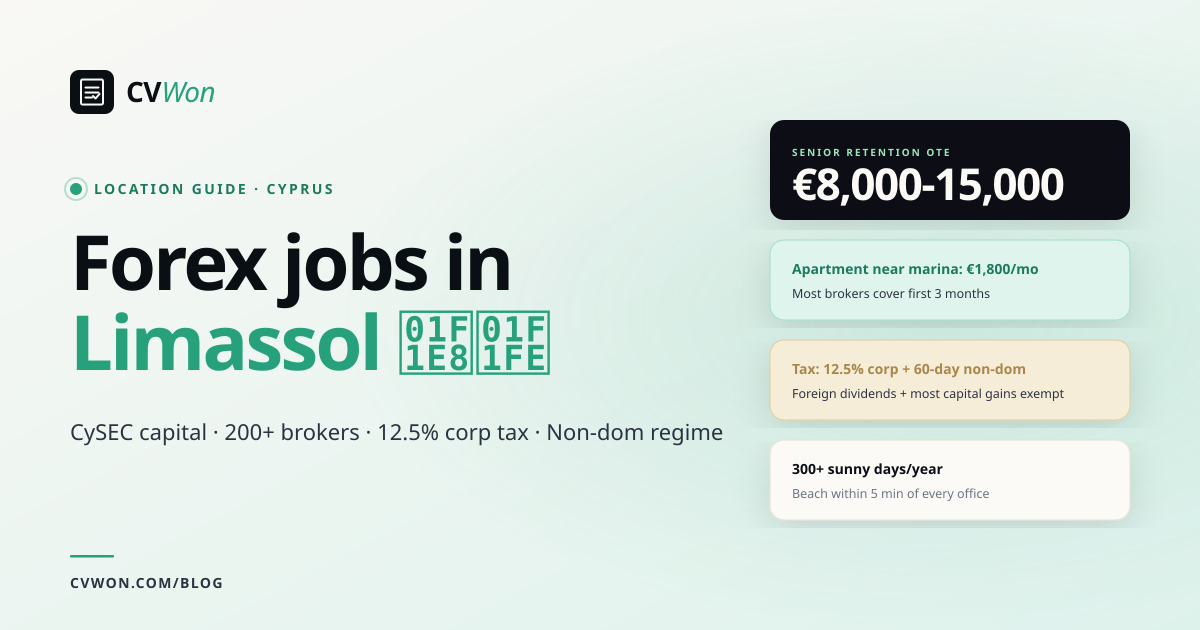
- Cyprus (Limassol): the densest concentration of CySEC brokers and dealing desks — see the Limassol jobs guide.
- Dubai (UAE) and London: larger brokers and senior dealing roles, with London hosting institutional desks.
- Remote: rare for dealing, because desks need low-latency infrastructure and tight oversight.
As with every forex role, the most important filter is whether the broker is licensed. A dealing job at a regulated firm builds a real markets career; one at an unlicensed shop does not.
Frequently asked questions
What is a forex dealing desk?
A forex dealing desk is the part of a broker that prices and executes client orders and manages the firm's market risk. In the market-maker model the broker often takes the other side of the trade, earning from the spread and from client losses rather than a commission.
What is the difference between a dealing desk and no dealing desk broker?
A dealing desk broker keeps orders in-house and can be the counterparty. A no-dealing-desk broker (STP or ECN) routes orders to external liquidity providers. DD brokers offer wider, commission-free spreads; NDD brokers offer tighter spreads with a commission.
Is a dealing desk broker bad?
Not inherently. A regulated dealing desk broker must still provide best execution and cannot manipulate prices. The risk lies with unlicensed brokers. Always check the firm's regulatory licence with bodies like CySEC or the FCA.
What does a dealing desk operator do?
A dealing desk operator, or dealer, manages pricing, order execution, and the broker's risk exposure in real time. They run the MT4/MT5 bridge, decide what to hedge, and report desk P&L. They are salaried risk managers, not personal traders.
What is A-book vs B-book?
A-book means the broker passes a client's trade to a liquidity provider and earns the spread or commission. B-book means the broker keeps the trade in-house and profits if the client loses. Most brokers run a regulated hybrid of both.
How much does a forex dealer earn?
US benchmarks put forex traders/dealers between roughly $80,000 and $101,500 on average, with senior desk roles reaching $150,000–$165,000 plus bonus. In offshore hubs, pay is a solid base plus a desk-performance bonus.
Do I need a degree to become a forex dealer?
No degree is strictly required, though a finance, economics, or maths background helps. Market knowledge, MT4/MT5 platform skill, and risk-management ability matter most, and many dealers start in broker back office or support.
Is a forex dealer the same as a forex trader?
No. A forex dealer is a salaried broker employee who executes orders and manages the firm's risk. A trader speculates to make a profit, either for a fund or their own account. The dealer's goal is controlled execution, not speculative gains.
Where are forex dealing desk jobs located?
Most dealing desk roles are in regulated hubs — Cyprus (Limassol), Dubai, and London. Remote dealing is rare because desks need low-latency infrastructure and close supervision.
Next steps
The dealing desk is the most markets-focused career in a forex broker — a risk-management role for analytical people who would rather watch exposure than work a phone. Learn the platforms, build real risk skills, and apply only to licensed brokers.
Want regulated forex and crypto firms to find you? Create your free CVWon candidate profile and let KYB-verified brokers reach you directly, or browse current forex and crypto roles. It is always free for candidates.
About the Author
Marcus Steiner is a forex industry recruiter tracking pay benchmarks and front-office hiring across 200+ regulated brokers.