How to Ask for a Raise in 2026: Scripts, Timing & Data

Last updated: 31 July 2026 · 13 min read
How to ask for a raise in 2026 is a different conversation than it was two years ago. The EU Pay Transparency Directive came into force in June, most employers are locked in a retention squeeze for skilled talent, and the classic email-template scripts online do not tell you the two most important things: when the salary budget actually gets locked in your company’s fiscal calendar, and what to do when the answer is "not now". This guide is the full 2026 playbook — timing matrix, meeting-request script, conversation frame, EU-directive leverage, and the three paths after "yes", "maybe" and "no".
TL;DR
- Ask 6-12 weeks before your company’s performance-review or budget cycle. Waiting until the review meeting itself is usually too late — the number was locked weeks earlier.
- The strongest single anchor is a concrete win. The two weeks after a major project ships is the best moment to ask.
- EU employees have a new legal lever from 8 June 2026: the right to request gender-broken-down pay data for the same or equivalent work under Directive (EU) 2023/970.
- Do the data homework before you open your mouth: market benchmark, three quantified wins, and a specific number range — not a vague "more".
- Prepare three responses: what to say to yes, to maybe, and to no. The "no" script matters most because that is the moment that decides your next 12 months.
What asking for a raise really means in 2026
Asking for a raise in 2026 is a structured conversation with your current employer about moving your base salary — and often total compensation — to reflect either the market rate for your role or the growth in your responsibilities since your last salary review. It differs from the offer-stage negotiation you would run with a new employer in three ways: your leverage is your track record rather than a competing offer, your timing has to fit an existing budget cycle you did not set, and the relationship survives the meeting either way.
Most raise requests fail not because the ask was too high, but because it was too late, too vague, or aimed at a manager who did not have the authority to say yes in the room.
Three structural changes shape how to ask for a raise in 2026: the EU Pay Transparency Directive gives European employees a legal right to written pay data, retention pressure has increased employer willingness to move on base for tenured performers, and remote-first companies now benchmark across geographies in ways that flatten some of the old regional gaps. This guide covers all three.
The timing matrix: when to ask and when not to
Every "when to ask for a raise" guide tells you to pick a good moment. Almost none tells you which moments actively hurt your chances. Both matter equally:

| Ask now if… | Wait if… |
|---|---|
| You are 6-12 weeks before your company’s performance-review or budget cycle. | You are inside the review meeting itself — the number was locked 6-8 weeks earlier. |
| You just shipped a project with a quantified outcome the whole team can see. | Your team just missed a quarter, a big customer left, or your own quota is behind. |
| You have taken on scope beyond your job description for at least 6 months. | You are inside your first 6 months at the company. |
| A market benchmark shows a clear gap vs your current base. | Layoffs, budget freezes, or a bad earnings quarter are public news. |
| Your manager has authority — and budget headroom — for a mid-cycle raise. | Your manager is under performance pressure and looking for cost signals to send upward. |
The fiscal-calendar point is the one most candidates miss. In most companies, next year’s salary budget is drafted 8-12 weeks before the fiscal year turns and locked with finance 4-6 weeks before. Asking during the review conversation itself is asking to renegotiate a number that has already been written into a spreadsheet three layers up.
Do the data homework first
A raise conversation without data is a preference. A raise conversation with data is a business case. For a wider view of wage trends, the OECD average annual wages dataset tracks year-over-year moves across most member countries. Three inputs, in order:
- Market benchmark for your specific role, level and geography. Cross-check three sources: a role-specific site (Levels.fyi for tech, Glassdoor and Payscale for most roles), the salary data now published in EU job adverts under the pay transparency rules, and public-sector or CAO/collective agreement bands if they apply. Bring a range, not a single number.
- Three quantified wins from the last 12 months. Not "led a project" — "shipped the billing migration, cut p99 latency 62%, closed the November enterprise renewal at $2.1M ARR". If you cannot list three concrete outcomes with numbers, use the next 6-8 weeks to change that before you ask.
- A defensible target number. Give a range with a top figure you can justify against the market benchmark and a floor you would still accept. "I’m looking at €72K-€78K, up from €65K" beats "I’d like more".
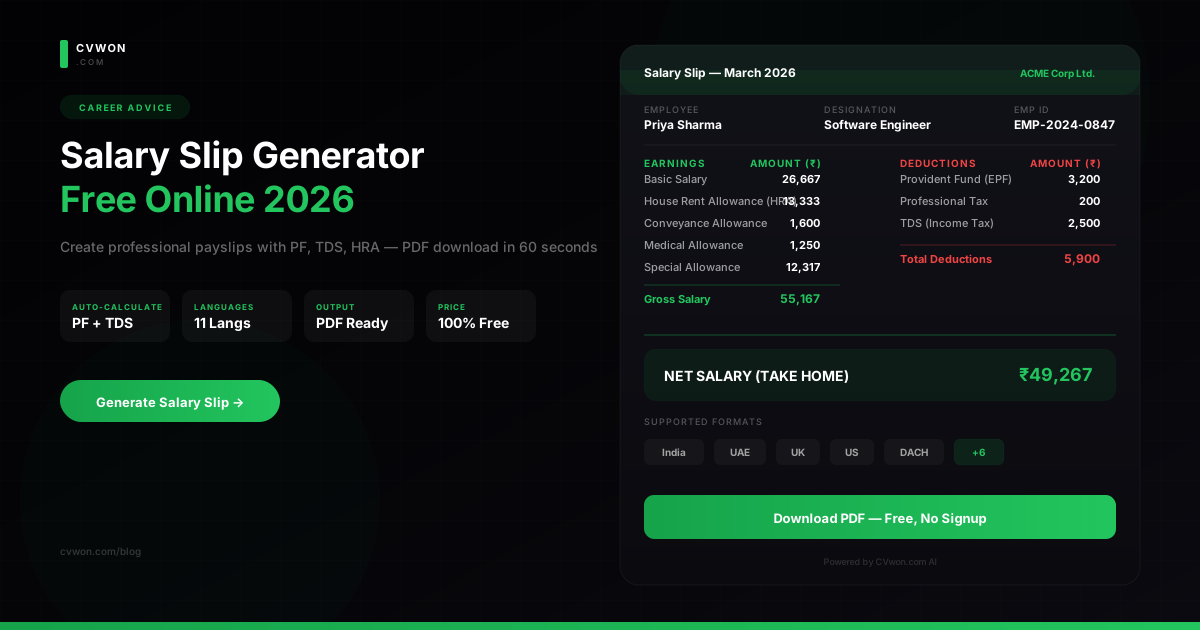
Check your current payslip against what you actually earn (base, bonus, allowances, deductions) so you are not surprised by a counter that adjusts one line item at the expense of another. Our free salary slip breakdown guide covers the components.
The meeting-request email: script + template
Do not ask for a raise in the email itself. Ask for a meeting to discuss compensation. The subject line matters more than most guides admit — a clear, unambiguous subject filters the request straight to the top of your manager’s inbox, which is exactly where you want it:
Subject: Meeting request — compensation discussion
Hi [Manager],
I’d like to set up a short meeting next week to discuss my compensation. Since our last review I’ve [one concrete win with a number], taken on [one specific area of expanded scope], and market benchmarks for my role have moved. I’d like 20-30 minutes to walk through this with you and align on next steps.
Would Wednesday or Thursday afternoon work?
Thanks,
[Your name]
Three sentences, one specific win, one specific new scope, one clear time-bound ask. The email does not name a number — the number belongs in the meeting where you can read the reaction and negotiate live.
The raise conversation script: five parts, fifteen minutes
A well-run raise conversation is 15 minutes and moves in a fixed order. Rushing part 1 is the most common failure mode:

- Context (2 minutes). "I appreciate you making time. I’d like to talk about my compensation. I’ve been in this role [X months], my last change was [date], and I want to make sure we’re aligned on where I sit relative to the market and to my current scope."
- Wins (4 minutes). Three quantified achievements. Lead with the biggest. Numbers, not adjectives. Stop before you feel you should keep going — the manager will remember three; they will not remember eight.
- Market data (3 minutes). Neutral tone. "For this role, level and city, the market is €72K-€82K in the sources I checked. My base is €65K." Do not editorialise. The gap speaks for itself.
- The ask (3 minutes). Specific range, defensible top figure. "I’m asking for a move to €72K-€78K base, effective the next pay cycle. I’m open to how we get there — one adjustment now, a step at review, or tied to a specific milestone."
- Next steps (3 minutes). Ask two questions: what does your manager need to move this forward, and by when will you get an answer? Follow up in writing the same afternoon: "Thanks for the conversation. To confirm what we agreed…"
Using the EU Pay Transparency Directive as leverage
If you are employed by an EU-based employer, from 8 June 2026 you have a new legal right that changes the raise conversation. Under Directive (EU) 2023/970 you can request, in writing, your individual pay level and the average pay level — broken down by gender — for workers doing the same or work of equal value in your organisation. The employer has to respond in a reasonable time set by national law.
You do not have to file the written request before you ask for a raise. But knowing the exact gap between your pay and the gender-broken-down average for your role changes the conversation from your opinion vs your manager’s opinion to a documented, employer-owned data point vs an outdated pay slip.
Two ways to use it well:
- Ask calmly. "I want to make sure my pay reflects the role. Under the pay-transparency rules that came into force in June, I’d like to see the average pay figures for this level. Can HR share those, or should I send the request in writing?"
- Never open with a threat. The directive is a data source, not a weapon. Framing it as leverage against your manager escalates a conversation that is easier to win at the manager level.
Full mechanics of what the directive gives you and what your employer now owes you are in our EU Pay Transparency Directive 2026 guide.
Yes, maybe, no — three paths after the ask
Half the value of learning how to ask for a raise in 2026 is knowing what to do in the ninety seconds after your manager responds. The value of a raise conversation is not just the number — it is the information you walk out with. Three responses, three scripts:

- Yes. Get it in writing the same day. Confirm the exact new base, the effective date, and whether it flows through into bonus, pension and stock. Do not celebrate publicly until the change appears on a pay slip.
- Maybe / "not now". Ask for a specific milestone or timeline. "If I hit X by Y date, is this a yes?" Get the criteria and the date in writing. A verbal "we’ll look at it at review" is the raise version of a ghosted offer.
- No. Do not accept "no" as a full answer. Ask three questions calmly: what would need to be true for this to be a yes; what is the current pay-band ceiling for your role; and how does the manager see your progression from here. The answers tell you whether you have a growth path or you have your answer about staying.
A "no" is a data point, not the end of the relationship. Two things to do in the following two weeks: refresh your CV against the market you just researched (use our free CV builder), and update your LinkedIn profile so recruiters can find you at the level you were told you cannot yet reach internally.
Regional differences: US, EU, Gulf
| Region | Cycle | Legal / data lever | What is culturally acceptable |
|---|---|---|---|
| US | Annual review, often calendar year | NYC salary transparency, Colorado Equal Pay Act | Direct ask; naming a number is expected |
| EU | Annual review; CAO/collective bargaining bands may cap | Directive (EU) 2023/970 in force from 8 June 2026 — written pay-data request | Data-first, less confrontational; range framing preferred |
| UAE / KSA (Gulf) | Bonus at fiscal or Ramadan; base moves less often | No pay-transparency directive; MOHRE guidance | Relationship-first; approach after a visible win; allowances are negotiable |
If your role is Gulf-based, the more effective 2026 lever is often total package (base + housing + schooling + flight allowance) rather than base alone, and the conversation flows differently. Our CV for UAE jobs guide covers the compensation architecture unique to that market.
Five mistakes that torpedo a raise request
Getting the mechanics of how to ask for a raise in 2026 right is only half the game — the other half is not undoing the case in the room. Five failure modes in order of frequency:

- Asking during the review meeting. The budget was locked 6-8 weeks earlier. Move the conversation to the pre-cycle window and you shift the conversation from renegotiation to input.
- Opening with a threat to leave. Even when true, this frames the conversation as leverage rather than value and makes the "yes" feel like retention duress. Retention raises are usually smaller and often burn political capital.
- No market data. "I feel underpaid" is a preference. "The market benchmark for this role is €72K-€82K and my base is €65K" is a business case. The second one moves numbers; the first one does not.
- Wrong manager. If your direct manager does not control the budget line for your role, they cannot say yes in the room. Ask them who else needs to be aligned and, if appropriate, request the meeting one level up.
- Not getting the yes in writing. A verbal "yes, we’ll take care of it" that is not confirmed in email and reflected on a payslip within one cycle is not a raise. Send the follow-up "to confirm what we discussed" email the same afternoon.
Next steps
Knowing how to ask for a raise in 2026 is one lever. The other three are your CV (in case the answer is no), your market visibility (so competing offers are real, not implied), and your understanding of the compensation stack the employer sees. Start with the free CV builder to have a refreshed CV on standby, run through the EU Pay Transparency Directive guide if you are in Europe, and read the salary negotiation after job offer playbook for the offer-stage script if this raise conversation ends with you exploring the outside market. If it does, our 30/60/90-day job-search playbook covers the sequence.
Frequently Asked Questions
How much of a raise is realistic to ask for in 2026?
A common starting range in most 2026 markets is 5-15% for a solid year of performance without a role change, 15-25% if you have taken on materially more scope, and 25%+ if you have been operating a level above your title. US private-sector wages moved about 4.1% year-on-year in the latest BLS Employment Cost Index, so anything above that is a case you have to defend with specific market data and quantified achievements — but is very much defendable when the data supports it.
When is the best time to ask for a raise?
Six to twelve weeks before your company’s performance review or budget cycle, ideally in the two weeks after a project you led shipped with a visible outcome. Avoid the week after a bad earnings call, during a public layoff wave, or in your first six months at the company. Asking inside the review meeting itself is usually too late — the salary budget is drafted 8-12 weeks earlier and locked with finance 4-6 weeks before your review.
Should I ask for a raise by email or in person?
Use email to request the meeting, not to ask for the raise itself. A three-sentence email with a specific meeting slot filters the request to the top of your manager’s inbox and creates a paper trail. The actual number belongs in a 15-minute live conversation where you can read your manager’s reaction, adjust framing, and agree next steps.
What if my company has a strict pay band and my manager cannot go above it?
Ask the manager two questions: what is the ceiling of your current band, and what would trigger a move to the next band. If the answer is a role or level change, your raise conversation converts into a promotion conversation — different criteria, sometimes different budget line, often more room. If the band is genuinely fixed and equals your current pay, the honest read is that your progression at this company is capped.
How do I ask for a raise without another offer in hand?
Anchor on internal value and external market data instead. "In the last 12 months I delivered X, Y and Z, and market data for this role, level and city is €72K-€82K. My current base is €65K. I’d like to align on a move to €72K-€78K." No implied threat, no need for a competing offer. A concrete track record plus verified market data is a stronger case than "I have another offer" for most managers who read retention pressure clearly either way.
Can I use the EU Pay Transparency Directive to get a raise?
You can use it as a data source. From 8 June 2026 employees of EU-based employers can request, in writing, their individual pay level and the gender-broken-down average pay for workers doing the same or equivalent work. Framing the raise conversation around that data is legitimate and often defusing — you are asking the employer to align on facts the employer itself provides. Full mechanics are in our EU Pay Transparency Directive guide.
What should I do if the answer is "not now" or "we’ll look at review time"?
Convert the maybe into a specific commitment. Ask what needs to be true for this to be a yes, and by when. Get the criteria and the timeline in writing the same afternoon. "As discussed, if I hit [outcome] by [date], we will revisit the €72K move at that point." Without a written milestone, "we’ll look at it" evaporates in the first busy week.
Is it a bad idea to threaten to quit if I do not get the raise?
Almost always, yes. Even when the threat is true, it converts a business-value conversation into a leverage negotiation and makes any resulting raise feel like retention duress — those raises are usually smaller and often burn political capital that costs you at the next cycle. The one exception is if you already have a written offer and are genuinely willing to accept it if the raise is denied — then it is a factual counter, not a threat, and should be delivered that way.
How often can I reasonably ask for a raise?
Once per performance cycle is the practical maximum in most companies — twice a year in fast-moving scale-ups, once every 12-18 months in stable enterprises and public-sector environments. Asking every three months without a materially new data point (market move, scope change, promotion-adjacent responsibilities) reads as pressure and stops moving the number.
What is the fastest way to prepare for a raise conversation next week?
Two hours of preparation done in the right order beats a week of drift. Hour one: pull three quantified wins from the last 12 months and cross-check the market benchmark for your role in three sources (Levels.fyi, Glassdoor, and — if in EU — published pay ranges in current job ads). Hour two: rehearse the five-part script out loud, write the meeting-request email, and pre-draft the same-day follow-up email you will send after the conversation.
About the Author
Muneeb Awan is the founder of CVWon, an AI-powered CV builder and career platform used by professionals across the EU and Gulf regions. He writes on hiring, compensation and the internal-negotiation playbooks that move real numbers in the 2026 market.