How Far Back Should a CV Go? (2026)
Last updated: 30 August 2026 · 13 min read · Reviewed by Muneeb Awan (Founder, CVWon)
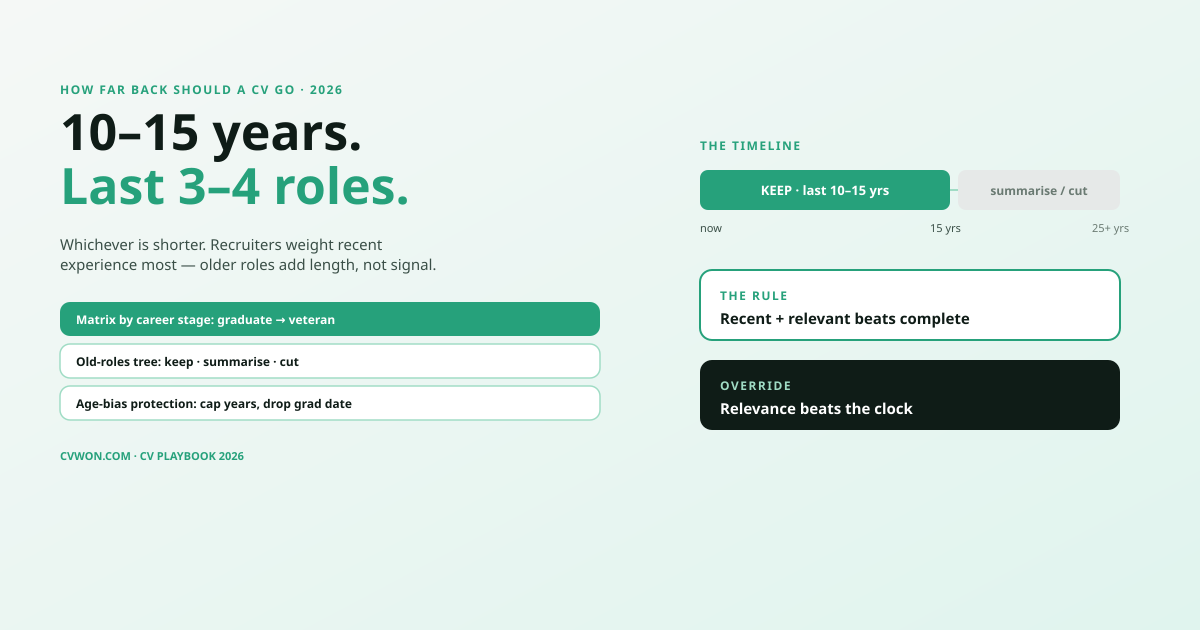
A CV should go back 10 to 15 years, or your last three to four relevant roles — whichever is shorter. Older positions get summarised in a single line or cut entirely, because a recruiter cares most about what you have done recently and what maps to the target job. Listing 20-plus years of history pads the CV, buries your best recent work, and can invite age screening. This guide gives the how-far-back rule by career stage, a decision tree for what to do with each old role, and the age-bias protection tactics that matter most for experienced candidates.
TL;DR
- Go back 10–15 years, or your last 3–4 relevant roles — whichever is shorter. Recent and relevant beats complete.
- Summarise or cut older roles. Anything past ~15 years usually belongs in a one-line "Earlier career" summary or gets dropped.
- Depth shifts by career stage: a graduate lists everything; a 20-year veteran caps at the last 10–15 years and summarises the rest.
- Trimming protects against age screening. Capping years and dropping your graduation date removes signals that invite age-based filtering.
- Relevance overrides the clock. A directly relevant role from 18 years ago can stay (briefly); an irrelevant one from 6 years ago can go.
How far back should a CV go? The direct answer
A CV should go back 10 to 15 years, or cover your last three to four relevant roles — whichever is shorter. Recruiters weight recent experience most heavily, so older roles add length without adding much signal. Everything past that window either gets a one-line summary or comes off the CV entirely.

Consider a candidate with 22 years of experience across seven jobs. Listing all seven, back to a 2004 graduate role, pushes the CV to three pages and buries the recent, senior work a hiring manager actually wants. Keeping the last four roles (about 13 years) and compressing the earlier three into a single "Earlier career" line keeps the CV to two pages and leads with the strongest material. This is the same recency logic behind the length rules in our 2026 CV format guide.
A CV is not a complete work history — it is a targeted argument for one job. Older roles that neither the target role needs nor your best evidence lives in are pure length. Cut back to the last 10–15 years and the CV gets stronger, not thinner.
Key takeaway: use 10–15 years or your last 3–4 roles as the default window, then let relevance adjust it in either direction. Recency is the rule; relevance is the override.
The how-far-back matrix by career stage
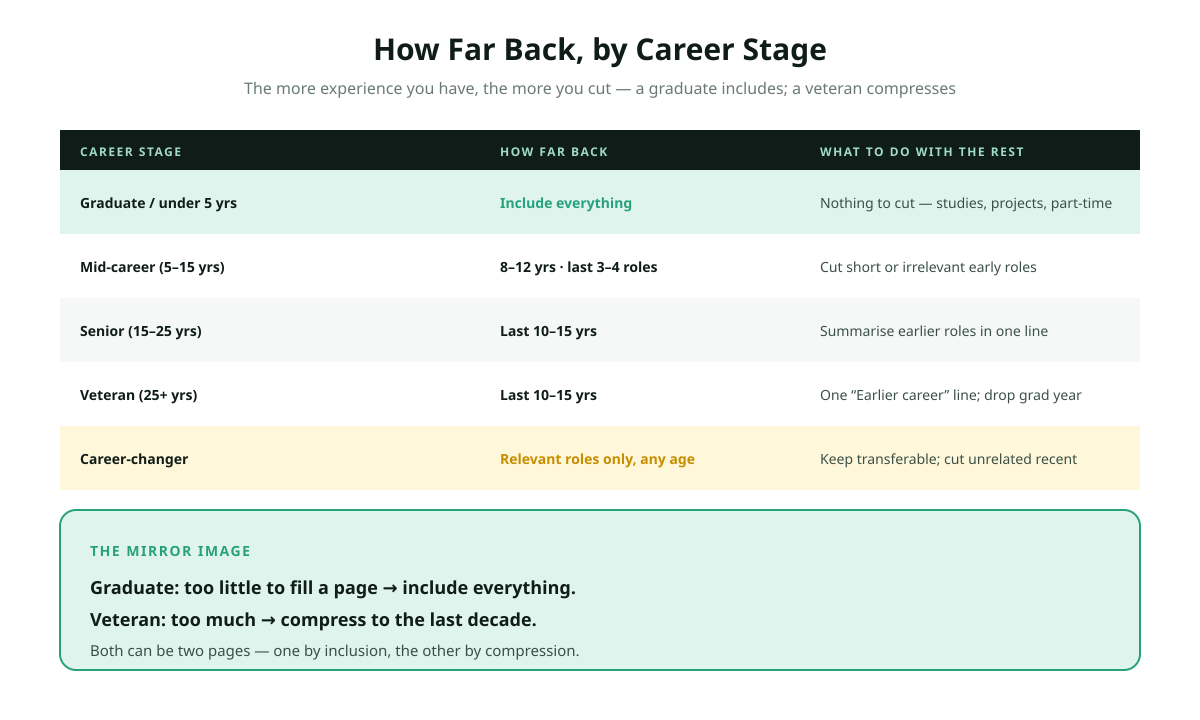
How far back a CV should go depends on your career stage — a graduate lists everything, a mid-career professional covers 8 to 12 years, and a 20-plus-year veteran caps at the last 10 to 15 and summarises the rest. A single number misleads: "10–15 years" is meaningless to someone with three years of experience and restrictive for a senior specialist whose defining project was 16 years ago.
| Career stage | How far back | What to do with the rest |
|---|---|---|
| Graduate / under 5 years | Include everything | Nothing to cut — use studies, projects, part-time work |
| Mid-career (5–15 yrs) | 8–12 years, last 3–4 roles | Cut short or irrelevant early roles |
| Senior (15–25 yrs) | Last 10–15 years | Summarise earlier roles in one line |
| Veteran (25+ yrs) | Last 10–15 years | Single "Earlier career" line; drop graduation year |
| Career-changer | Relevant roles only, any age | Keep transferable roles; cut unrelated recent ones |
The graduate case is the mirror image of the veteran case: one has too little to fill a page and should include everything (studies, projects, volunteering, as our CV with no experience guide shows), while the other has too much and must compress. Match the depth to where you are, not to a universal number.
Key takeaway: the more experience you have, the more you cut. A 25-year veteran's CV and a graduate's CV can both be two pages — one by compression, the other by inclusion.
The old-roles decision tree: keep, summarise, or cut
Every older role gets one of three treatments: keep it in full, compress it to a one-line summary, or cut it entirely — decided by its relevance and recency. The mistake is treating the decision as all-or-nothing; most CVs need a mix, keeping recent-and-relevant roles full and demoting the rest.
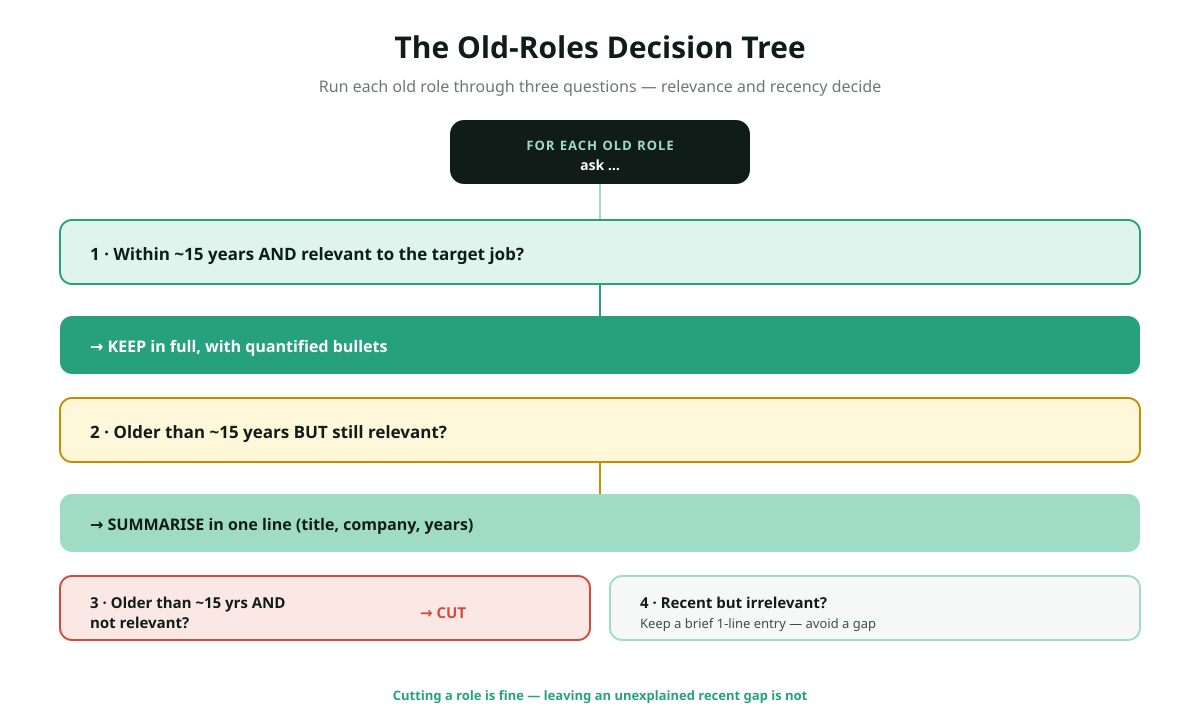
Run each old role through three questions:
- Within ~15 years AND relevant? → Keep it in full, with quantified bullets.
- Older than ~15 years BUT relevant? → Summarise in one line (title, company, years).
- Older than ~15 years AND not relevant? → Cut it entirely.
There is a fourth case: a recent role that is irrelevant to the target job. Keep it as a brief one-line entry rather than cutting it, so you do not create an unexplained gap — the gap-handling logic from our employment gap CV guide applies. Cutting a role is fine; leaving an unexplained hole in your timeline is not.
Do not delete old roles to hide age — delete them because they no longer earn their space. A relevant role from 17 years ago can stay in one line; an irrelevant one from 8 years ago can go. Relevance decides, and a clean summary beats a buried full entry.
Relevance beats recency: the exception to the rule
Relevance overrides the 10-to-15-year window: a directly relevant older role can stay, and a recent irrelevant one can be demoted. The years rule is a default, not a law. If your single most impressive, most on-target achievement happened 18 years ago, a one-line entry preserving it beats dropping it to obey the clock.
Two cases where relevance wins:
- An older role matches the target job closely. A candidate returning to a field they left 16 years ago should keep that earlier role — briefly — because it is the most relevant thing on the CV.
- A recent role is off-target. Two years in an unrelated field can shrink to a one-line entry so the relevant older work gets the space, while still covering the timeline.
Key takeaway: apply the years window first, then ask "is anything outside it more relevant than what is inside it?" If yes, keep the relevant older role in a compressed form and trim the less relevant recent one.
Age-bias protection: what to trim and why
Trimming a CV to the last 10 to 15 years also removes signals that can invite age-based screening — a legitimate secondary reason to cap history depth for experienced candidates. Age discrimination in hiring is unlawful in most markets, but subtle screening still happens, and a CV that broadcasts 30 years of history hands a screener the exact signal to act on.
The tactics that reduce that exposure, without dishonesty:
- Cap experience at ~15 years. Summarise or cut earlier roles — this is standard practice, not concealment.
- Drop your graduation year. List the degree and institution without the date; the qualification matters, the year does not.
- Cut very early roles entirely. A first job from 25 years ago adds nothing but a date.
Official guidance from bodies such as the US EEOC and the UK's Acas confirms age discrimination is unlawful, but candidates cannot rely on enforcement alone at the screening stage. Trimming the CV is a practical, legitimate step — the same "cut what does not earn its space" discipline covered in our common CV mistakes guide.
Should you put your graduation year on a CV?
You do not need to put your graduation year on a CV — list the degree, subject and institution, and omit the date once you have several years of experience. The graduation year adds no value to an experienced candidate and is one of the clearest age signals on a CV. For recent graduates, keep the year, because it confirms you are newly qualified.
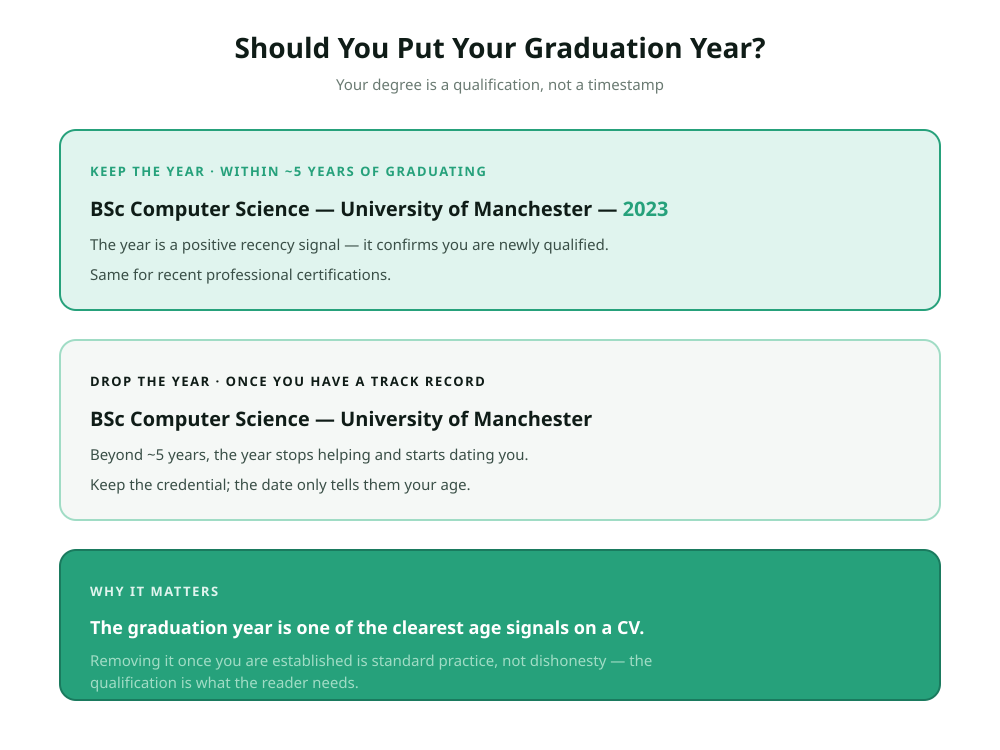
The rule by stage: within about five years of graduating, keep the year (it is a positive recency signal). Beyond that, the year stops helping and starts dating you — drop it and keep the qualification. The same applies to early professional certifications where the year is not required for validity.
Your degree is a qualification, not a timestamp. Once you have a track record, "BSc Computer Science, University of Manchester" says everything the reader needs; adding "2001" only tells them your age. Keep the credential, drop the date.
How history depth interacts with CV length
History depth and CV length are linked: cutting older roles is the fastest way to bring an over-long CV back to one or two pages. A CV that runs to three pages is almost always carrying history it does not need — trimming to the last 10–15 years usually fixes the length problem at the same time.
The interaction works both ways. If your CV is a page too long, the first place to cut is the oldest, least relevant roles, not the recent achievements. And if trimming history leaves the CV feeling thin, the fix is deeper, more quantified bullets on the recent roles — more evidence, not more years. This ties directly to the tier-based length rules in our 2026 CV format guide: senior candidates earn two pages through recent scope, not through decades of history.
Key takeaway: when a CV is too long, cut old roles before you cut anything recent. History depth is the cheapest length to remove and the least costly to lose.
How to write an "Earlier career" summary line
An "Earlier career" summary is a single line that compresses your pre-window roles into one entry, preserving the timeline without spending space on detail. It lets you acknowledge earlier experience — and avoid an unexplained gap — while keeping the focus on your recent, relevant work.
The format is a one-liner under your main experience:
- Label it "Earlier career" or "Previous experience".
- List roles compactly: "Earlier career: Analyst roles at [Company A] and [Company B] (2004–2011)."
- Add a value line only if one older role is genuinely notable: "… including leading the team that launched [product]."
Keep it to one or two lines total. The point is to close the timeline and show progression, not to re-litigate a decade of work. Anyone who wants the detail will ask in the interview, where you can tell the fuller story with the framing from our achievements on CV guide.
Next step
The fastest way to get the history depth right is to build from a format that already handles it: the CVWon CV builder flags roles older than your target window, offers to compress them into an "Earlier career" line, and drops graduation dates on request — keeping the CV to the last 10–15 years and one to two pages automatically. Pair it with our 2026 CV format guide for the full structure.
Frequently Asked Questions
How far back should a CV go in 2026?
A CV should go back 10 to 15 years, or cover your last three to four relevant roles, whichever is shorter. Older positions get summarised in a single "Earlier career" line or cut entirely. Recruiters weight recent experience most heavily, so history past that window adds length without adding much signal.
How many years of experience should you list on a CV?
List the last 10 to 15 years for most professionals, focusing on your three to four most relevant roles. Graduates include everything they have; 25-year veterans cap at the last decade or so and summarise the rest. The right number is set by relevance and career stage, not a fixed count — recent and on-target beats complete.
Should I include jobs from 20 years ago on my CV?
Usually not in full. A role from 20 years ago belongs in a one-line "Earlier career" summary, or is cut entirely if it is not relevant to the target job. The exception is a role from that far back that closely matches the job you are applying for — keep that one briefly, because relevance overrides the years window.
Should I put my graduation year on my CV?
Only within about five years of graduating, where it signals you are newly qualified. Beyond that, drop the year and keep the degree, subject and institution — the qualification matters, the date does not, and the graduation year is one of the clearest age signals on a CV. Removing it is standard practice, not dishonesty.
Does a long work history cause age discrimination on a CV?
It can invite age-based screening, even though age discrimination is unlawful in most markets. A CV broadcasting 30 years of history and a 1995 graduation date hands a screener an age signal to act on. Capping experience at 10 to 15 years and dropping the graduation year reduces that exposure while keeping the CV honest and focused on relevant work.
What should I do with old jobs that are not relevant?
Cut them entirely if they are older than about 15 years, or compress them into a one-line "Earlier career" summary if you want to preserve the timeline. For a recent but irrelevant role, keep a brief one-line entry rather than deleting it, so you do not create an unexplained gap. Relevance and recency together decide keep, summarise, or cut.
How do I show a long career without making my CV too long?
Keep the last 10 to 15 years in full and compress everything earlier into a single "Earlier career" line. Cutting old roles is the fastest way to bring an over-long CV back to two pages. If trimming leaves it feeling thin, add deeper, quantified bullets to your recent roles — more evidence, not more years.
Is it okay to leave a job off my CV?
Yes, if it is old and irrelevant — a CV is a targeted argument, not a complete legal record, so you can omit early or off-target roles. The one caution is gaps: do not cut a recent role if doing so leaves an unexplained hole in your timeline. Cutting old history is fine; creating a mysterious recent gap is not.
Should a career-changer follow the 10-15 year rule?
No — a career-changer should keep relevant roles regardless of age and demote irrelevant recent ones. If your most transferable experience is 16 years old, keep it (briefly); if your last two years were in an unrelated field, a one-line entry is enough. Relevance to the new field, not recency, drives what stays on a career-change CV.
How far back should a CV go for a senior or executive role?
The last 10 to 15 years, leading with the most recent, highest-scope roles, and a one-line summary of earlier career. Senior candidates earn a second page through recent scope and results, not through decades of history. A 30-year executive CV that lists every role reads as unedited; one that leads with the last decade of impact reads as senior.
Last reviewed on 30 August 2026 by Muneeb Awan (Founder, CVWon).
About the Author
Muneeb Awan is the founder of CVWon, an AI-powered CV builder and career platform used by professionals across the EU and Gulf regions. He writes on hiring technology, ATS mechanics and the 2026 CV playbooks that pass both filters.