Should You Put a Photo on Your CV? (2026)
Last updated: 28 September 2026 · Written by Muneeb Awan, founder of CVWon
TL;DR
- It depends on the country. In the US, UK, Ireland, Canada and Australia, leave the photo off. In Germany, Austria, Switzerland and most of the Gulf, a professional photo is expected.
- The rule is legal, not aesthetic. Anglophone markets discourage photos to reduce discrimination risk; German-speaking and Gulf markets treat a clean headshot as a standard part of the application.
- Always follow an explicit instruction. If the job ad or portal asks for a photo (or bans one), that instruction beats any general rule.
- A photo can break older ATS parsers. If you must include one, keep it in the document header of a single-column template — never inside a text box or table.
- When unsure, omit it. A missing photo rarely costs you an interview; a badly placed or unprofessional one can.
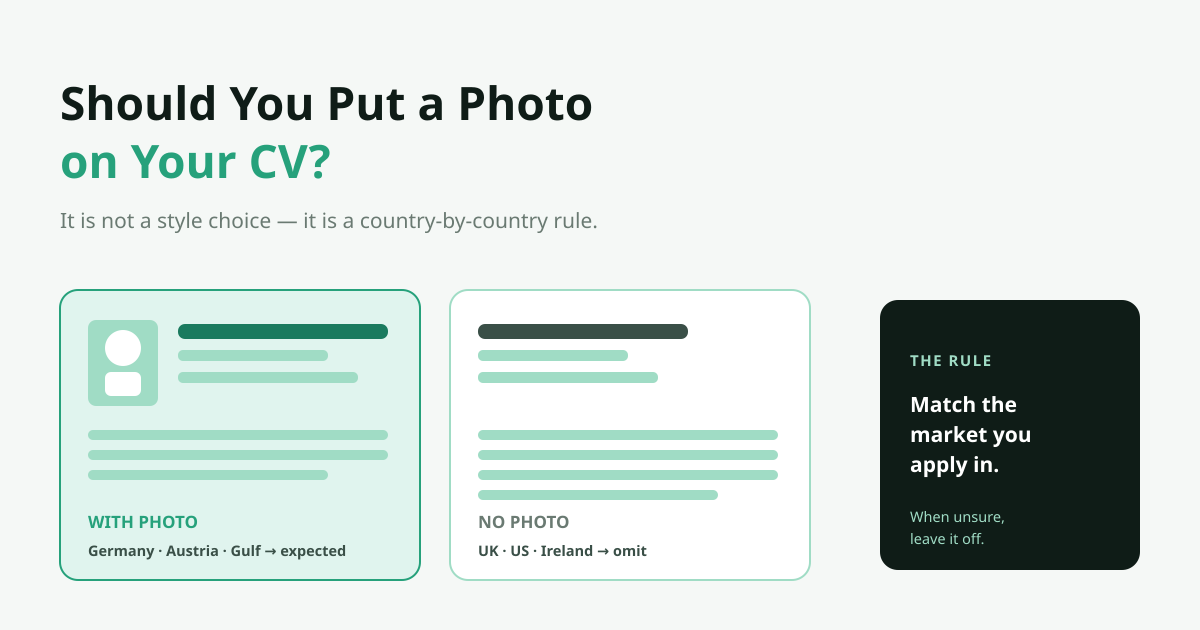
Should you put a photo on your CV? For most English-speaking countries, no — a photo invites bias and many recruiters discard photo CVs to stay compliant with anti-discrimination law. For Germany, Austria, Switzerland and the Gulf states, yes — a professional headshot is a normal expectation, and leaving it off can read as incomplete. The deciding factor is the country you are applying in and any instruction in the job ad, not personal preference.
Build your CV free on CVWon using a template that fits the market you are targeting — photo-ready layouts for German and Gulf applications, and clean text-only layouts for the UK and US.
The direct answer, by market
A CV photo is a professional headshot placed on your CV, usually in the top corner beside your name and contact details. Whether it helps or hurts depends almost entirely on where you are applying. In the United States, United Kingdom, Ireland, Canada, Australia and New Zealand, the convention is to leave it off. In Germany, Austria, Switzerland, and across the Gulf — the UAE, Saudi Arabia, Qatar and neighbouring states — a photo is a routine, often expected, part of the application.
This split is not a matter of taste. It comes from two different legal and cultural approaches to hiring. Anglophone markets have built recruitment around reducing discrimination on protected characteristics, so anything that reveals age, race or gender before the interview is treated as a liability. German-speaking and Gulf markets treat a formal application as a complete personal dossier, in which a headshot signals professionalism and effort.
A CV photo is neither universally good nor universally bad. It is a local convention. Match the convention of the country you are applying in, and the question answers itself.
Key takeaway: decide by destination market first, then by any explicit instruction in the job ad. Personal preference comes last.
The CV photo country matrix
Most advice online is written for a US audience and tells everyone to remove the photo. That is wrong for a large share of the world. The table below maps the real convention across the markets CVWon users apply to most, along with the reason behind each norm. Use it as your starting point, then check the specific job ad.
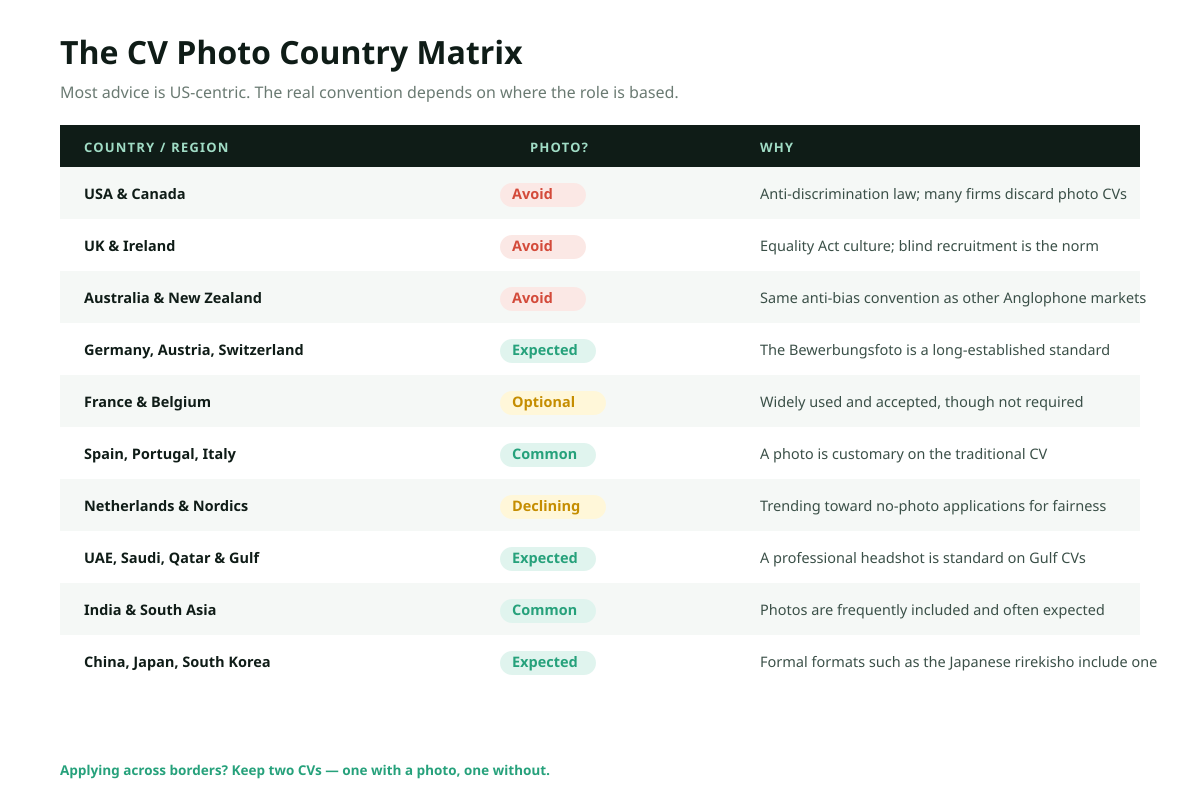
| Country / Region | Photo on CV? | Why |
|---|---|---|
| USA & Canada | Avoid | Anti-discrimination law and recruiter policy; many firms discard photo CVs to limit bias claims |
| UK & Ireland | Avoid | Equality Act 2010 culture; blind-recruitment is the norm at most employers |
| Australia & New Zealand | Avoid | Same anti-bias convention as other Anglophone markets |
| Germany, Austria, Switzerland | Expected | The Bewerbungsfoto is a long-established standard; a missing photo reads as incomplete |
| France & Belgium | Common (optional) | Widely used and accepted, though not strictly required |
| Spain, Portugal, Italy | Common | A photo is customary on the traditional CV |
| Netherlands & Nordics | Optional / declining | Trending toward no-photo applications for fairness reasons |
| UAE, Saudi Arabia, Qatar & Gulf | Expected | Regional convention; a professional headshot is standard on Gulf applications |
| India, Pakistan & South Asia | Common | Photos are frequently included and often expected |
| China, Japan, South Korea | Expected | Formal application formats (such as the Japanese rirekisho) include a photo by design |
Key takeaway: if you are applying across borders — a common case for CVWon users moving between the EU and the Gulf — keep two versions of your CV: one with a photo, one without.
Why the US, UK and Ireland say no
In Anglophone markets, a photo is discouraged because it exposes the employer to discrimination risk. A headshot reveals age, ethnicity, gender and other protected characteristics before a fair assessment of skills can happen, which is exactly what modern recruitment law tries to keep out of the early screening stage.
In the United States, the Equal Employment Opportunity Commission treats pre-employment information that reveals protected characteristics as a compliance hazard, which is why many recruiters simply reject CVs that carry a photo. You can read the EEOC's position on prohibited employment practices. In the United Kingdom and Ireland, the culture built around the Equality Act 2010 pushes employers toward anonymised, or "blind", recruitment, where names and photos are stripped before shortlisting.
There is also a practical reason. When we reviewed feedback from recruiters using CVWon in the UK and US, the pattern was consistent: a photo adds no useful hiring signal and creates a paper trail an employer would rather avoid. The safest move in these markets is to spend that space on a stronger personal statement instead.
In a blind-recruitment market, your photo is not a first impression — it is a reason for the CV to be filtered out before a human reads it.
Key takeaway: in the US, UK, Ireland, Canada and Australia, a photo is a downside with no matching upside. Remove it.
Why Germany, France and the Gulf expect one
In German-speaking Europe and the Gulf, a photo is expected because the application is treated as a complete, formal document. In Germany, Austria and Switzerland, the Bewerbungsfoto has been a standard element for decades: applications are often assembled as a structured folder, and a professional photo signals that the candidate has invested proper effort.
Germany's General Equal Treatment Act (the Allgemeines Gleichbehandlungsgesetz, or AGG) technically means no employer can require a photo, and anonymised applications are slowly growing. In practice, though, the convention holds, and most hiring managers still expect one. The EU's official guidance on job applications across member states confirms that CV expectations vary by country rather than following a single European standard.
Across the Gulf — the UAE, Saudi Arabia, Qatar and neighbouring states — a clean, professional headshot is a normal part of the CV, and its absence can read as an unfinished application. If you are targeting the region, our guide to writing a CV for UAE jobs covers the local format in detail, and the German conventions are set out in our Lebenslauf guide.
Key takeaway: in these markets, omitting the photo is the mistake. Include a professional headshot that meets the spec below.
The photo decision tree
When the country rule and the job ad seem to conflict, resolve it in this order. Each step overrides the ones below it, so stop at the first one that gives you a clear answer.
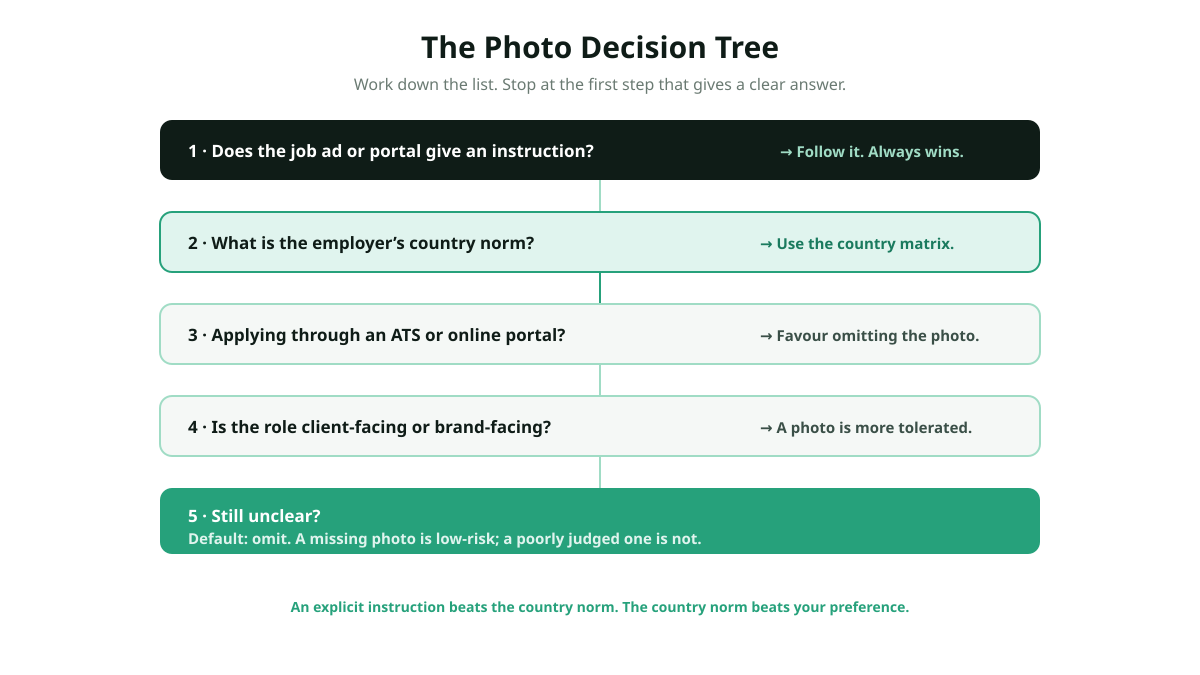
- Explicit instruction in the job ad or portal. If it asks for a photo, include one. If it says "no photo" or uses an anonymised application system, leave it off. This always wins.
- The employer's country and hiring culture. Use the country matrix above. Apply the convention of where the role is based, not where you live.
- The application channel. If you are applying through an ATS or online portal, favour omitting the photo unless a photo field is provided, because embedded images can disrupt parsing.
- The role type. Client-facing or brand roles (hospitality, sales, on-camera) tolerate a photo more readily than back-office or technical roles, even within the same market.
- Default: omit. If none of the above gives you a clear yes, leave the photo off. A missing photo is low-risk; a poorly judged one is not.
Key takeaway: an explicit instruction beats the country norm, and the country norm beats your preference. Work down the list and stop at the first clear answer.
Does a CV photo break ATS parsing?
An applicant tracking system (ATS) is software that reads and stores CVs before a recruiter sees them, and a photo can interfere with how it extracts your text. The image itself is not read; the problem is the layout that photos usually force — text boxes, tables and multi-column headers — which older parsers handle badly.
When we tested common templates through parsing tools, the pattern was clear: a photo placed in the natural document header of a clean single-column CV parsed without issue, while photos anchored inside a text box or a two-column sidebar frequently caused the name, contact details, or nearby text to be dropped or scrambled. The photo did not break parsing; the container around it did.
So if a market expects a photo, you can include one and still stay ATS-safe — you just need a template built for it. If you are not sure how your current CV parses, run it through a checker first; our free ATS resume checker flags layout issues before you apply, and our wider CV format guide explains which structures survive parsing.
A photo does not confuse an ATS. The text box you hide it in does. Keep the layout simple and the image in the header, and parsing stays clean.
Key takeaway: photos are ATS-safe in a single-column layout with the image in the document header; they fail when buried in tables or sidebars.
If you include a photo: the spec that works
A CV photo only helps if it looks professional and is placed correctly. If your target market expects one, follow this spec. It is the same standard we build into CVWon's photo-ready templates.
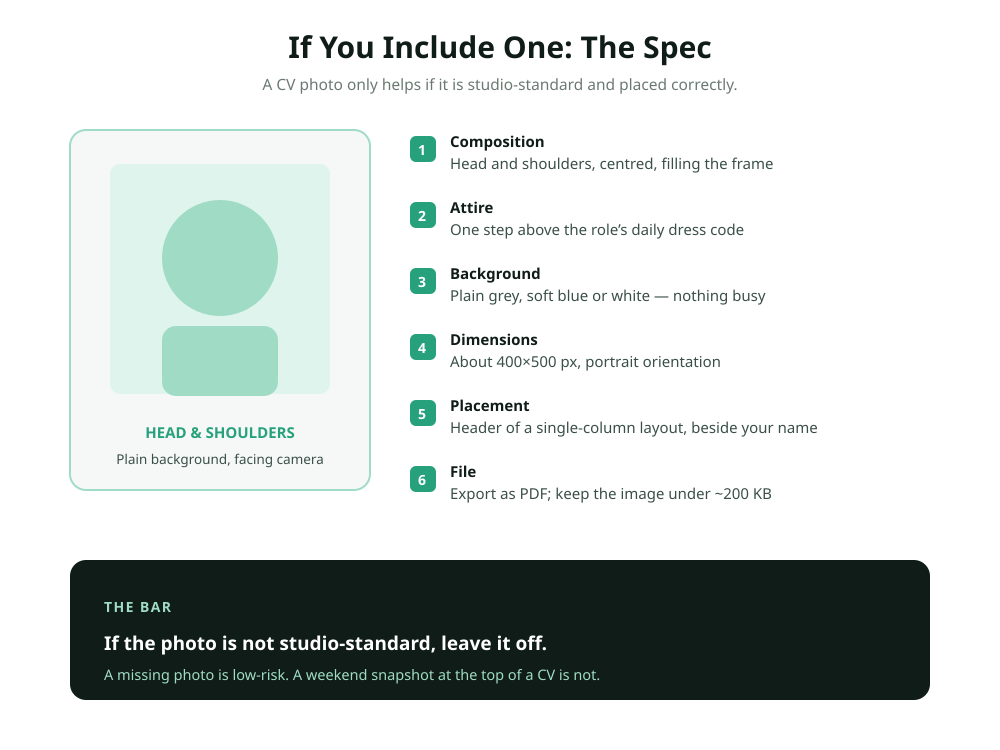
- Composition: head and shoulders, centred, facing the camera, filling most of the frame. Avoid full-body or cropped-from-a-group shots.
- Attire: dress one step above the role's daily norm. Business or smart-casual, plain and current.
- Background: plain and neutral — light grey, soft blue or white. No holidays, no doorways, no busy interiors.
- Lighting and expression: soft, even light, a natural and approachable expression. No heavy filters or dramatic shadows.
- Dimensions: roughly 3.5×4.5 cm at print scale, or about 400×500 px on screen, in portrait orientation.
- Placement: top corner beside your name, inside the document header of a single-column layout so the ATS still reads your details.
- File: export the finished CV as a PDF so the photo stays fixed and the file size stays reasonable — aim to keep the image under about 200 KB.
Start with a CVWon template that already positions the photo correctly and keeps the layout ATS-readable, so you do not have to solve the placement problem by hand.
Key takeaway: a professional headshot on a plain background, in the header of a clean layout, is the only version of a CV photo worth including.
Common CV photo mistakes
Most photo problems are not about whether to include one, but how. These are the errors we see most often, and each is easy to avoid. They also appear in our broader roundup of common CV mistakes.
- Using a cropped social or holiday photo. A relaxed selfie signals the opposite of the effort a formal application is meant to show.
- Including a photo in an anti-photo market. Adding one for a UK or US role can get the CV filtered out before it is read.
- Burying the photo in a text box. This is the single most common cause of a photo CV failing ATS parsing.
- Oversized image files. A multi-megabyte photo bloats the CV and can trip upload limits on job portals.
- An outdated or heavily edited image. The photo should look like you today, not a decade ago or through a filter.
The fastest way to weaken a strong CV is to staple a weekend snapshot to the top of it. If the photo is not studio-standard, leave it off.
Key takeaway: a wrong-market, wrong-quality or wrong-placement photo does more damage than no photo at all.
What to do instead of a photo
If you are applying in a no-photo market, or you simply do not have a professional headshot, you are not missing anything a recruiter needs. The space a photo would take is better spent on evidence. Lead with a sharp personal statement and quantified achievements that make your case on merit.
Recruiters who want to see a face will look at your LinkedIn profile, which is the correct place for a professional photo — it is expected there in every market, Anglophone included. Keep that headshot current and consistent with the spec above, and let your CV stay focused on results.
Key takeaway: in a no-photo market, put your professional headshot on LinkedIn and give the CV space to a stronger summary and measurable wins.
Frequently asked questions
Should you put a photo on your CV in the UK?
No. UK employers work within the culture of the Equality Act 2010 and widely use blind recruitment, so a photo adds discrimination risk with no benefit. Many recruiters filter out photo CVs automatically. Use the space for a stronger personal statement instead.
Do German employers expect a photo on a CV?
Yes, in most cases. The Bewerbungsfoto is a long-standing convention in Germany, Austria and Switzerland, and a missing photo can read as an incomplete application. The AGG means no employer can formally require one, but the expectation still holds in practice.
Should I include a photo on my CV for jobs in Dubai or the Gulf?
Yes. Across the UAE, Saudi Arabia, Qatar and neighbouring states, a professional headshot is a standard part of the CV, and its absence can look unfinished. Follow the photo spec: head and shoulders, plain background, business attire, placed in the document header.
Does a photo stop my CV passing an ATS?
Not by itself. An ATS does not read the image, but the text boxes and multi-column layouts photos usually sit in can break parsing. Keep the photo in the header of a single-column layout and the text extracts cleanly.
What size should a CV photo be?
Aim for about 3.5×4.5 cm at print scale, or roughly 400×500 px on screen, in portrait orientation. Keep the file under about 200 KB so the CV does not become oversized, and export the whole document as a PDF so the photo stays in place.
Where should the photo go on a CV?
In the top corner beside your name and contact details, inside the document header. Keep it out of text boxes and sidebars so an ATS can still read the surrounding text. A single-column layout with a header image is the safest placement.
Can a photo get my CV rejected?
Yes, in two ways. In anti-photo markets like the US and UK, a photo can trigger an automatic filter. Anywhere, an unprofessional or badly placed photo can weaken an otherwise strong CV or break ATS parsing. When in doubt, leave it off.
Is it better to have no photo than a bad one?
Almost always, yes. A missing photo is low-risk and, in many markets, the correct choice. A cropped, outdated or casual photo actively harms your application. Only include a photo if it meets a professional, studio-standard bar.
Conclusion and next steps
The photo question has a clear answer once you stop treating it as a style choice. Check the destination market, follow any instruction in the job ad, and when the answer is still unclear, leave the photo off. If your target market expects one, use a professional headshot on a plain background, placed in the header of a clean, single-column layout so it stays ATS-readable.
The simplest way to get both right is to start from a template built for your market. Build your CV free on CVWon — switch between photo-ready layouts for German and Gulf applications and clean text-only layouts for the UK and US, and export a properly sized PDF in minutes.
About the author
Muneeb Awan is the founder of CVWon, an AI-powered CV builder and career platform used by professionals across the EU and Gulf regions. He writes on hiring technology, ATS mechanics and the CV conventions that differ from one market to the next. Last reviewed on 28 September 2026.
About the Author
Muneeb Awan is the founder of CVWon, an AI-powered CV builder and career platform used by professionals across the EU and Gulf regions. He writes on hiring technology, ATS mechanics and the 2026 CV playbooks that pass both filters.


